Abstract ceramic art is clay work that explores form, texture, colour, and surface for their own sake rather than depicting a recognisable subject like a person, animal, or everyday object. It can be built by hand, thrown and then altered, or shaped through experimental surfaces, and the kiln often plays a part in the final result. The piece asks you to respond to what it is, not to what it represents.
Walk into a gallery during a ceramics exhibition and you’ll often find pieces that don’t look like anything in particular. A torn, folded form. A tall stack of uneven cylinders. A slab with a surface that looks like weathered rock. Visitors sometimes pause in front of these and quietly wonder what they’re meant to be looking at. That’s abstract ceramic art, and once you know how to approach it, it can become one of the most rewarding things to see in clay.
At Le Studio Art Space in Mordialloc, we spend our days surrounded by clay in every stage, from wet lumps on the wedging bench to finished work on the gallery walls. This guide is the kind of conversation we’d have with you standing in front of an abstract piece: what it means, how it’s made, why clay suits it so well, and how you might try it yourself.
What Abstract Ceramic Art Actually Means
In the simplest terms, abstract ceramic art is clay work that isn’t trying to show you something recognisable. Instead of a figure, a bird, or a teapot, the artist is working with the raw elements of the material itself: shape, weight, balance, texture, colour, and the marks left by hands and tools.
Abstraction sits on a spectrum. Some pieces are completely non representational, with no reference to anything in the world at all. Others start from something real, like a shell, a landscape, or a vessel, and then simplify or distort it until it becomes more about form than subject. Both count as abstract in a broad sense.
It’s also worth knowing that a lot of abstract ceramic work still has a relationship with the vessel. Clay has been used for pots for many thousands of years, so plenty of abstract artists play with the idea of a container that no longer holds anything, or a bowl that has been split, collapsed, or turned inside out.
What ties it all together is intention. The artist wants you to notice the curve of a surface, the crack in a glaze, or the tension between a heavy base and a fragile edge. If you want a broader sense of how this fits into the field, our guide to what counts as ceramic art covers the wider picture.
How Abstract Ceramic Pieces Are Made
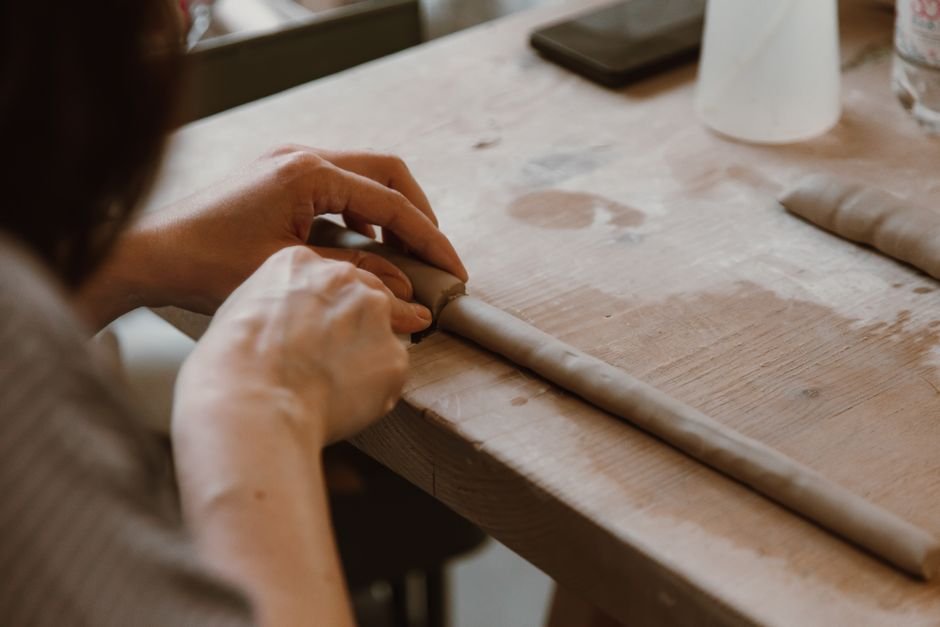
There’s no single technique behind abstract work, which is part of its appeal. Hand building is one of the most common starting points. Coils, slabs, and pinched forms let an artist build shapes that would be impossible on a wheel, adding and subtracting clay freely as the piece grows.
Wheel altered forms are another big part of the tradition. A potter throws a round form on the wheel, then cuts, dents, folds, stretches, or reassembles it. The American artist Peter Voulkos became famous for this in the 1950s while teaching at what is now Otis College in Los Angeles, tearing, gouging, and stacking thrown forms into large sculptural works that helped push ceramics toward abstraction.
Surface is just as important as shape. Abstract pieces often use layered slips, heavily textured clay, crawling or cracked glazes, carved marks, or bare clay left unglazed so you can see the material itself. Some artists deliberately invite effects that a functional potter would try to avoid, because those surprises are the whole point.
Many abstract makers also work in series, making a group of related forms and changing one variable at a time. That process of exploration, rather than a finished plan, is often where the most interesting work comes from. Our guide to the core hand building methods is a good grounding if you’d like to understand the building side.
What Clay Brings To Abstract Work
Clay is a wonderfully responsive material for abstraction. It records every press of a thumb, every drag of a tool, and every fold. That tactility means an abstract ceramic piece often carries a visible trace of the maker’s hand, which gives it a quality that’s quite different from cast metal or carved stone.
Firing adds permanence. Once clay goes through the kiln, it becomes ceramic, a hard, stable material that can last for an extraordinarily long time. Abstract ceramic art therefore captures a moment of soft, flexible making and fixes it in a durable form, which many artists find poetic.
Glaze and fire also become collaborators. Heat changes colours, melts surfaces, and sometimes produces drips, crackles, or variations the maker couldn’t fully control. A piece can come out of the kiln looking noticeably different from how it went in, and abstract artists often embrace that unpredictability.
Clay also has a built in history. Because it’s so tied to pots and everyday life, an abstract ceramic piece can carry a quiet echo of function, a hint of vessel or tile or brick, even when it has no practical use at all. That layered meaning is something many painters and sculptors in other materials simply can’t access.
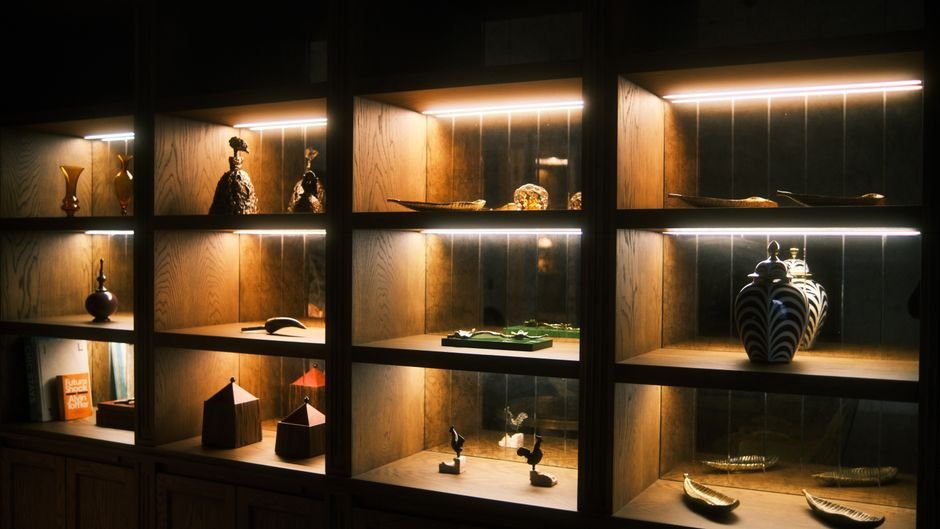
How To Look At An Abstract Ceramic Piece
The most common worry we hear is, “I don’t get it.” The good news is that there’s usually nothing to get, at least not in the sense of a hidden answer. A good starting point is simply to slow down and notice what you’re seeing before deciding what you think about it.
Walk around the piece if you can. Ceramics are three dimensional, and an abstract form can change completely from one side to another. Look at the silhouette, then at the surface, then at the base and how the piece meets the plinth or table it sits on.
Pay attention to the materials. Is the clay rough or smooth? Is the glaze glossy, matte, or broken? Can you see finger marks, tool lines, or cracks? These details tell you about the decisions the artist made and the process the piece went through.
Then notice your own response. Does the piece feel heavy or light, calm or restless, stable or about to tip? Abstract ceramic art often works on that physical, almost bodily level. And if there’s an artist statement or a gallery sitter nearby, it’s always fine to ask questions. In our experience, artists usually love talking about their work.
What Competing Guides Leave Out About Abstract Ceramic Art
Most explanations of abstract ceramic art either list famous names or describe it in the same terms as abstract painting. But clay is different. A painting is usually seen from the front, while a ceramic piece has weight, volume, and an inside and outside, so abstraction in clay is as much about space and touch as it is about colour.
It also differs from abstract sculpture in other materials. Bronze or steel can be cast or welded into almost any shape, whereas clay has to survive drying and firing. That means abstract ceramic artists work within real physical limits, like wall thickness, shrinkage, and the size of the kiln, and those limits shape the work in interesting ways.
Another gap is the beginner’s perspective. Many guides assume abstraction is only for advanced artists, but plenty of beginners find it a freeing place to start. When you’re not trying to make a perfect mug, there’s less pressure to get things right, and you can focus on how clay behaves.
Finally, few guides mention that abstract work is easiest to understand in person. Photos flatten texture and scale. Visiting a local exhibition, especially in a working studio gallery where you might meet the maker, can change how you see abstraction far more than reading about it.
Trying Abstract Ceramic Work Yourself
If abstract ceramic art has caught your interest, the easiest way in is a low pressure experiment. Take a lump of clay and see how many different textures you can make on its surface using your fingers, a fork, a piece of bark, or a scrap of fabric.
You could also make three simple forms, like a cube, a sphere, and a pinched cup, and then alter each one by cutting, folding, or pressing it. Don’t aim for a result. Aim to notice what the clay does when you push it in different directions.
A hand building session is a great setting for this, because you’ll have guidance on joining, wall thickness, and drying so your experiments survive the kiln. Our workshops and classes are a friendly place to start, and members of our ceramic studio often use their own time to explore more experimental work.
Once your pieces are dry, our firing service can take them through the kiln. Many people find that seeing their first abstract experiment come out fired is the moment the whole idea clicks.
The best way to understand abstract ceramic art is to stand in front of it. Visit an exhibition in the gallery at Le Studio Art Space in Mordialloc, walk around the work, and chat with the makers about how their pieces came to be.
Frequently Asked Questions
Is abstract ceramic art just pottery that went wrong?
Not at all, although some abstract artists do welcome happy accidents. The difference is intention. An abstract piece is made deliberately to explore form, texture, and surface rather than to function as a pot.
Do I need to understand art to enjoy abstract ceramics?
No. Many people enjoy abstract work simply by noticing how it looks and feels. Knowing a little about how it’s made can deepen that enjoyment, but there’s no test to pass.
Can a beginner make abstract ceramic art?
Yes. Many beginners find abstract experiments relaxing because there’s no single right result. Basic knowledge of joining and drying helps your pieces survive the kiln.
Is abstract ceramic art functional?
Usually not, although some pieces sit on the line between vessel and sculpture. Most abstract ceramic work is made to be looked at and handled with care rather than used daily.
Where can I see abstract ceramic art in Melbourne?
Galleries, art centres, and studio galleries around Melbourne regularly show ceramic work. Le Studio Art Space in Mordialloc hosts exhibitions and pop up shows in its gallery, which is a relaxed way to see contemporary clay up close.
This article is provided for general educational purposes by Le Studio Art Space. Artistic approaches and firing results vary between makers, materials, and kilns.