What makes a glaze food safe, at a technical level, is the stability of its fired glass surface and how well it resists leaching once matured. Firing temperature, glaze thickness, and the ingredients used all affect that stability, which is why food safe describes a genuine outcome rather than a single fixed ingredient list to memorise.
Trusting a bottle label is one thing, but genuinely understanding why a glaze is considered food safe in the first place is a different, more satisfying kind of knowledge. At Le Studio Art Space, this deeper question tends to come up in more technical studio conversations, usually from a member who’s already comfortable with the basics and wants to know what’s actually happening chemically behind the label, rather than accepting it purely on trust.
This is meant as general, educational background rather than a safety guarantee for any specific product, since real world safety always depends on correct firing and application as much as the underlying formulation.
Understanding these underlying mechanics also makes it much easier to spot a vague or unsupported claim, since a potter who knows what actually creates food safety can ask sharper, more useful questions of any supplier or product label.
The Core Idea Behind Food Safety In Glaze
At its core, a food safe glaze is one that forms a stable, glass-like surface once properly fired, resistant to releasing its chemical components into food or drink during normal use over time.
This stability comes from the glaze fully vitrifying, meaning its mineral ingredients have melted and fused together into a continuous glassy layer, rather than remaining a loosely bonded, more porous surface that could allow moisture and acids to interact with it more easily over repeated use.
Leaching, the actual transfer of chemical components from the glaze into food or drink, is the specific risk food safety testing is designed to evaluate, and a well matured glaze resists this transfer far more effectively than an unstable or improperly fired one.
It helps to think of a fired glaze less like paint sitting on a surface and more like a thin sheet of glass fused permanently to the clay body underneath, since that mental picture makes it much easier to understand why maturity and stability matter so much to the overall outcome.
Why Firing Temperature Matters So Much
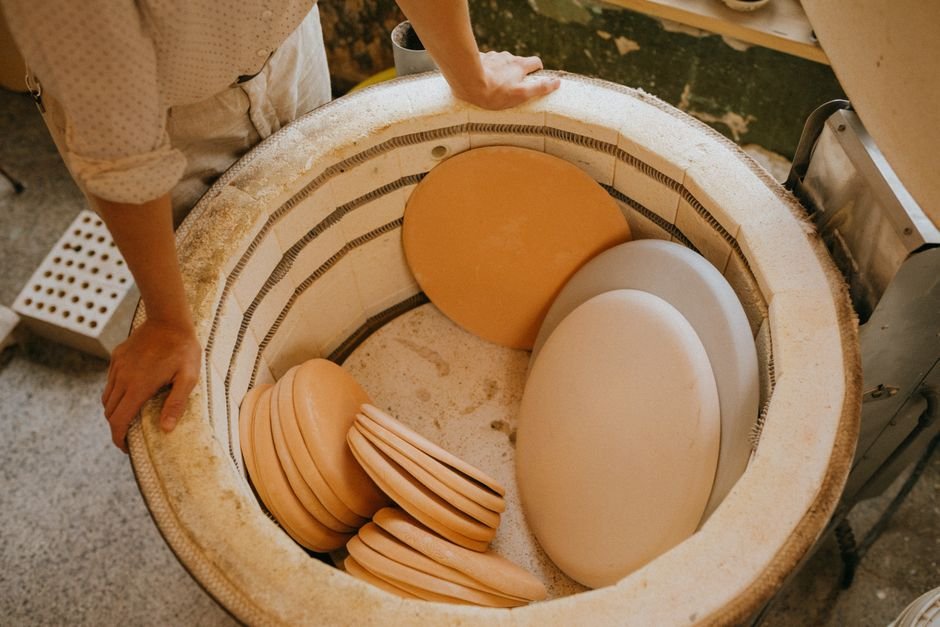
An underfired glaze remains more porous and chemically reactive than the same glaze fired correctly to its intended cone, since the vitrification process that creates a stable glass surface simply hasn’t fully completed.
This is exactly why a food safe rating printed on a glaze bottle is always tied to a specific cone range, since the same glaze recipe fired outside that range may not achieve the stability the rating actually assumes.
Reaching the correct temperature isn’t only about the kiln’s programmed setting either, since actual heat work inside the kiln can vary from what’s displayed, which is part of why a properly managed firing service genuinely matters for consistent, reliable results.
Firing schedule holds at peak temperature also contribute to this maturity, since a kiln that reaches the right cone but doesn’t hold long enough before cooling can leave a glaze technically fired without being fully matured into its most stable, food safe state.
Cone packs, small clay indicators that physically bend once the correct heat work has been reached, remain one of the most reliable ways to confirm a kiln truly reached its target, rather than relying solely on an electronic controller’s displayed reading.
Ingredients That Raise Or Lower Risk
Historically, lead was a common glaze ingredient prized for its low melting point and glossy finish, but it’s also well understood today to pose a genuine risk if a lead-bearing glaze isn’t properly formulated, applied, and fired.
Cadmium, another historically used ingredient, particularly in vivid reds, oranges, and yellows, carries similar well documented concerns, which is part of why bright, saturated colours in these ranges warrant a bit more scrutiny, especially in older or unverified glazes without clear documentation behind them.
Most modern commercial glazes from reputable suppliers are formulated specifically to avoid these risks, using alternative colourants and stabilisers that achieve similar visual effects without the same historical safety concerns attached to them.
Zinc, boron, and various other stabilising oxides also play a role in a well formulated glaze, contributing to how firmly the finished glass structure holds together and resists breaking down when it comes into repeated contact with acidic foods or liquids over time.
How Glaze Thickness And Application Affect Safety
Even a well formulated, food safe glaze depends on being applied at a reasonably even thickness, since a coat applied too thin can leave weak, more porous spots that don’t achieve full stability during firing.
A coat applied too thick, on the other hand, can crawl, crack, or pool unevenly, creating its own inconsistencies that undermine the reliability the food safe rating was based on in controlled testing conditions.
This is part of why consistent, practiced application technique genuinely matters for functional ware, not just glaze selection, since even the most reputable glaze can behave inconsistently if applied carelessly or unevenly across a piece.
Number of coats and drying time between applications also factor in here, since rushing multiple layers on before each has properly dried can trap moisture and lead to uneven thickness or surface defects once the piece reaches the kiln.
What Competing Guides Leave Out
The difference between food safe and dishwasher safe rarely gets explained clearly, despite being a genuinely important distinction. Food safe refers to chemical leaching resistance, while dishwasher safe refers to a glaze’s durability against detergent, heat cycling, and repeated washing, which are separate qualities entirely and shouldn’t be assumed to travel together automatically.
A glaze can be genuinely food safe while still being unsuitable for the dishwasher, gradually dulling or wearing under repeated harsh washing cycles, which is exactly why some handmade pottery is recommended for hand washing despite being perfectly safe for food contact.
None of these distinctions are meant to make food safety feel more complicated than it needs to be. They simply explain why a single word on a label can’t capture every practical quality a piece of functional ware might need for everyday use.
Microwave safety is a related, often confused third category worth mentioning too, since a piece can be food safe and dishwasher safe while still being unsuitable for microwave use if it contains metallic decoration or an unstable clay body prone to uneven heating.
How This Differs From What A Product Label Actually Tells You
A product label typically states a conclusion, food safe, without necessarily explaining the testing standard, cone range, or formulation reasoning behind that claim, which circles back to why the same word can carry different levels of confidence across different brands.
Understanding the actual chemistry, vitrification, thickness, and ingredient awareness covered here gives a potter the tools to evaluate a label more critically, rather than simply trusting or distrusting it without any real basis for that judgment either way.
This kind of technical understanding doesn’t replace buying from a reputable supplier and firing correctly, but it does turn food safety from a mysterious label into something a potter can genuinely reason about with real confidence.
It also makes conversations with suppliers, studio staff, and other potters considerably more productive, since asking about cone range, formulation, and testing history gets a far more useful answer than simply asking whether a glaze is food safe in isolation, without any further context attached.
Curious about the food safe glaze options and firing practices used at Le Studio Art Space’s ceramic studio in Mordialloc? Ask us during your next visit.
Frequently Asked Questions
Is food safe glaze the same thing as lead free glaze?
Not exactly, though they’re related. Lead free is one factor contributing to food safety, but a lead free glaze can still be unsafe if underfired or applied incorrectly. Food safe describes the overall fired outcome, not one single ingredient.
Why do some food safe glazes cost more than others?
Formulation, testing, and ingredient quality all factor into cost. A more expensive glaze isn’t automatically safer, but reputable brands with documented testing often charge more to reflect that additional quality assurance work.
Can a glaze be food safe on one clay body but not another?
The glaze chemistry itself doesn’t change, but an underfired or overly porous clay body underneath can still allow moisture to work its way beneath the glaze layer over time, so the pairing genuinely matters too.
Is it true that older glaze recipes are automatically unsafe?
Not automatically, but older or undocumented recipes carry more uncertainty, since they may predate current understanding around ingredients like lead and cadmium. Extra caution is reasonable without assuming the worst outright.
Does a glossy finish always mean a glaze is more food safe?
Not necessarily, though a glossy, fully vitrified surface generally indicates good stability. Matte glazes can be equally food safe when properly formulated and fired, so glossiness alone isn’t a reliable safety indicator on its own.
This article is provided for general educational purposes by Le Studio Art Space and does not declare any named glaze product definitively safe or unsafe.