The ceramic terms beginners hear most fall into four groups: the stages of clay (wet, leather hard, bone dry, greenware, bisqueware), making terms (wedging, centring, throwing, trimming, scoring, slip), decorating terms (glaze, underglaze, sgraffito, resist), and firing terms (bisque firing, glaze firing, cones, kiln furniture). Learning these ceramic definitions makes classes much easier to follow.
Your first pottery class can feel a bit like visiting a foreign country. Someone tells you to wedge your clay, wait until it’s leather hard, then score and slip the join before it goes in the bisque. Everyone nods, and you quietly wonder what half those words mean. Don’t worry. Every potter started exactly there.
At Le Studio Art Space in Mordialloc, we hear these questions in every intro class, and we love answering them. This guide is a friendly translation of the language of the studio, grouped into the stages you’ll actually meet, so these ceramic definitions make sense in context rather than as a list to memorise.
Terms For The Stages Of Clay
Clay changes a lot as it dries and fires, and potters have names for each stage. Wet or plastic clay is soft, workable clay straight from the bag. It’s what you throw and build with.
Leather hard clay has dried enough to hold its shape but is still slightly damp, a bit like firm cheese. This is the ideal stage for trimming, carving, attaching handles, and joining pieces.
Bone dry clay has lost all its workable moisture. It’s pale, light, room temperature to the touch, and very fragile. Greenware is the general term for any unfired clay piece, from leather hard through to bone dry. Our guide to what greenware is explains how to handle it.
Bisqueware is clay that has been fired once. It’s hard, porous, and ready for glazing. Many paint your own studios use bisqueware for decorating. For the full journey, our guide to the stages of clay from wet to fired walks through every step.
One more stage word you’ll hear is reclaim. Reclaim is clay that has been collected as scraps, trimmings, or failed pieces, soaked back down with water, and dried to a workable consistency again. As long as clay hasn’t been fired, it can usually be reclaimed and reused, which is one of the lovely things about the material. Once it’s fired, though, the change is permanent.
Terms For Making
Wedging is how potters prepare clay before using it. It involves kneading the clay on a table to remove air bubbles and even out its consistency. Our guide to what a wedge tool does covers the process in more detail.
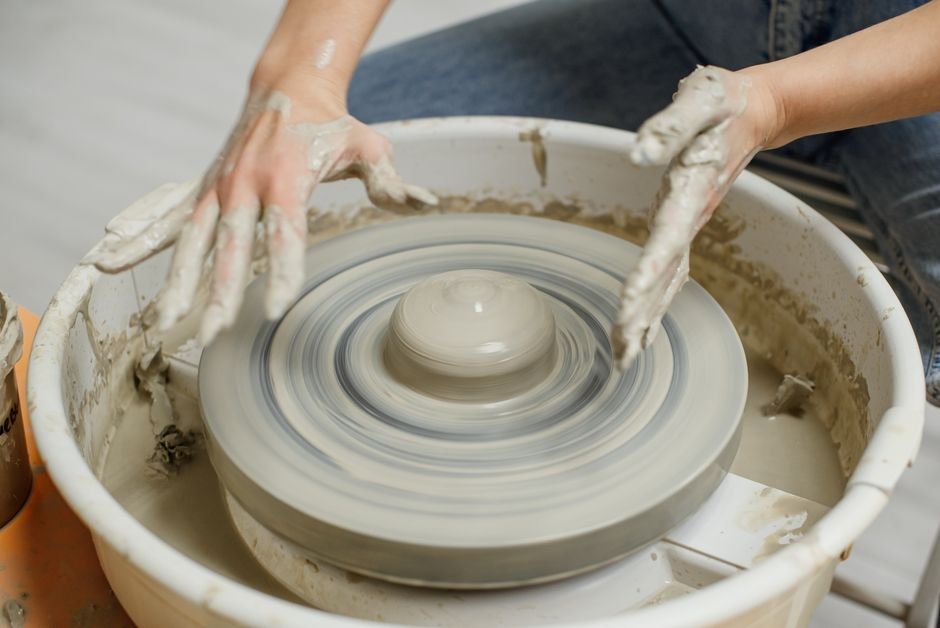
Centring is the first step on the pottery wheel. You press the spinning clay until it runs perfectly true in the middle of the wheel head. Throwing means shaping that centred clay into a form by opening it and pulling up the walls.
Trimming happens once a thrown piece is leather hard. You turn it upside down on the wheel and carve away extra clay to refine the shape and create a foot ring. Our article on centring, throwing, and trimming explains how they fit together.
Scoring and slip go hand in hand. Scoring means scratching crosshatched lines into two clay surfaces before joining them. Slip is clay mixed with water to a creamy consistency, used like glue on those scored surfaces. Together they make strong joins in hand building and when attaching handles.
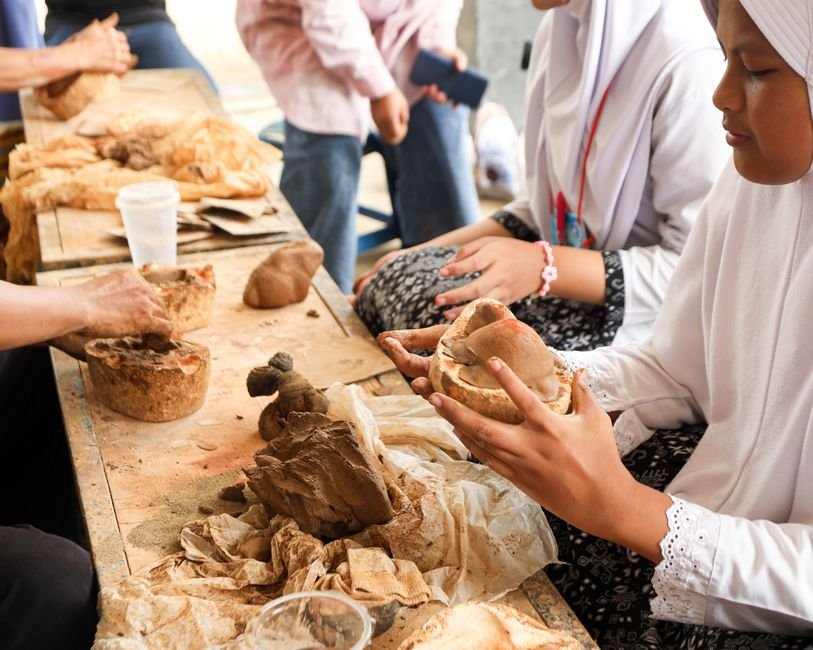
You’ll also hear pinch, coil, and slab, the three main hand building methods. Pinching shapes clay with your fingers, coiling stacks rolled snakes of clay, and slab building uses flat rolled sheets.
Terms For Decorating
Glaze is a coating of minerals that melts in the kiln to form a glassy surface. It can be glossy, satin, or matte, and it often makes a piece waterproof and easier to clean. Our guide to how ceramic glaze actually works explains the science simply.
Underglaze is a coloured decorating material, usually applied to greenware or bisque, that stays put when fired. It’s great for painting designs and is often covered with a clear glaze. You’ll also hear people describe slip as a decorating material when it’s coloured and brushed or poured onto a surface.
Sgraffito comes from an Italian word meaning to scratch. You apply a layer of coloured slip or underglaze, then scratch through it to reveal the clay underneath, creating line drawings and patterns.
Resist describes any material that stops glaze or slip sticking to part of a surface. Wax resist is the most common, used on the bottoms of pots so glaze doesn’t stick to the kiln shelf, or to create patterns. Our guide to how wax resist works covers both uses.
Terms For Firing
Bisque firing is the first firing. It turns greenware into bisqueware, making it hard enough to handle and glaze while staying porous. Glaze firing is the second firing, usually at a higher temperature, which melts the glaze onto the piece.
Cones are small pyrometric cones made from ceramic materials, designed to bend at a certain combination of heat and time. Potters use cone numbers, like cone 06 or cone 6, to describe firing temperatures. Our guide to what cone numbers mean makes them easier to understand.
Kiln furniture means the shelves, posts, and stilts used to stack work inside the kiln. Shelves hold the pieces, while posts hold up each layer of shelves.
You might also hear about kiln wash, a protective coating on kiln shelves, and the terms oxidation and reduction, which describe the atmosphere inside the kiln during firing. You don’t need to master these right away, but they’ll come up as you go.
Two more firing words come up often. Vitrification describes clay becoming dense and glass like as it reaches maturity in the kiln, which makes stoneware and porcelain strong and less absorbent. Shrinkage is the amount a piece gets smaller as it dries and fires, often somewhere around ten to fifteen percent depending on the clay body. Knowing about shrinkage helps you plan sizes, especially for lids and sets.
What Competing Guides Leave Out About Ceramic Definitions
Most glossaries list ceramic definitions alphabetically, which makes them hard to learn. What they rarely mention is which terms beginners confuse most often. Greenware and bisqueware are a classic mix up. Remember that green means unfired and bisque means fired once.
Slip and glaze also get confused. Slip is liquid clay, used for joining or decorating, while glaze is a glassy coating that melts in the kiln. Underglaze and glaze trip people up too, since one is mainly for colour and the other for the glassy surface.
Clay body is another term that puzzles beginners. It simply means the particular clay recipe you’re using, like a stoneware body or a porcelain body.
Competing guides also skip the emotional side. Many beginners feel embarrassed to ask what a word means. In our experience, every teacher is happy to explain, and asking is often the quickest way to learn. You can even point at something and say, what’s this called? That’s how most potters picked up the language.
Using The Language Confidently In The Studio
The best way to learn ceramic terms is to use them while you work. When your teacher says leather hard, touch the clay and notice how it feels. When you score and slip a join, say the words in your head. The vocabulary sticks much faster when it’s connected to something your hands are doing.
Keep a small notebook. Jot down new words, what they mean, and maybe a quick sketch. Many potters keep these notes for years as they add glaze recipes and firing results.
Don’t worry about getting it perfect. Even experienced potters use slightly different words for the same thing, depending on where and how they learned. Studio language is friendly and practical, not a test.
Labelling is another great teacher. Many studios label shelves for greenware, bisque, and glazed work, and noticing where your piece goes at each stage quietly reinforces the vocabulary. Before long you’ll hear yourself telling a newer student that their bowl is ready to trim because it’s leather hard.
Our workshops and classes introduce these terms as you go, members of our ceramic studio pick them up by working alongside others, and our firing service team is always happy to explain what happens to your work in the kiln.
The language of clay makes much more sense with clay in your hands. Join a hands on class at Le Studio Art Space in Mordialloc and pick up wedging, leather hard, bisque, and more the easy way.
Frequently Asked Questions
Do I need to learn pottery terms before my first class?
No. Teachers explain terms as they come up, and most people learn them by doing. Reading a short guide like this can help you feel a little more relaxed, though.
What is the difference between greenware and bisqueware?
Greenware is unfired clay, while bisqueware has been fired once. Bisqueware is much stronger and ready for glazing.
Is slip the same as glaze?
No. Slip is liquid clay used for joining or decorating, while glaze is a glassy coating that melts during firing. They behave very differently.
What does leather hard actually feel like?
It feels firm but slightly cool and damp, a bit like hard cheese or leather. You can handle it without denting it, but you can still carve and trim it.
Will the teachers at Le Studio Art Space explain words I don’t know?
Yes. Teachers at Le Studio Art Space are used to explaining studio language, and beginners are encouraged to ask whenever a term is unfamiliar.
This article is provided for general educational purposes by Le Studio Art Space. Terminology can vary slightly between studios, teachers, and regions.