Mayco publishes tested glaze combinations on its website, written as top glaze over base glaze. This chart lists the 35 combinations Mayco showed when we checked: 28 stoneware pairs built around SW-231 Lilac Speck, tested at cone 6 and cone 10, some over Mayco engobes, and 7 low-fire pairs over CG-722 Seawind at cone 06. Mayco applied two coats of the base glaze, then two of the top.
Mayco Glaze Combinations Chart: Published Stoneware and Low-Fire Pairs
These Mayco glaze combinations are gathered from Mayco’s own combinations page into a chart you can search, filter and print. Find a code such as SW-231 or SW-164, filter to stoneware or low-fire bases, and pick any pair to see the cone and how it was applied.
35 combinations in this chart.
Pick one in the chart below to see its details here.
This tool at a glance
- What it does
- Lists the glaze combinations Mayco currently publishes on its website, so you can search, filter and print them in one place.
- Inputs
- Search words (a code such as SW-231, or a colour), a colour group and a base glaze.
- Method
- No calculation. Each combination is transcribed from Mayco’s glaze combinations page, with Mayco’s two coats of base then two of top. Split swatches show approximate colours suggested by the top and base glaze names.
- Outputs
- Matching combinations with a split swatch, the cone, the coats and any engobe underneath.
Mayco glaze combinations chart
The combinations Mayco currently publishes on its glaze combinations page, at cone 6 and 10 for the stoneware pairs and cone 06 for the low-fire pairs. Split swatches show the approximate colours of the top and base glazes, not the fired result.
| Swatch | Combination | Details | Show |
|---|---|---|---|
| Whites and creams | SW-408 White Flux over SW-231 Lilac Speck | Cone 6 and 10. Two coats of base, then two of top | |
| Oranges | SW-407 Clear Flux over SW-231 Lilac Speck | Cone 6 and 10. Two coats of base, then two of top | |
| Blacks | SW-402 Dark Flux over SW-231 Lilac Speck | Cone 6 and 10. Two coats of base, then two of top | |
| Oranges | SW-401 Light Flux over SW-231 Lilac Speck | Cone 6 and 10. Two coats of base, then two of top | |
| Purples | SW-231 Lilac Speck over SW-408 White Flux | Cone 6 and 10. Two coats of base, then two of top | |
| Purples | SW-231 Lilac Speck over SW-407 Clear Flux | Cone 6 and 10. Two coats of base, then two of top | |
| Purples | SW-231 Lilac Speck over SW-402 Dark Flux | Cone 6 and 10. Two coats of base, then two of top | |
| Purples | SW-231 Lilac Speck over SW-401 Light Flux | Cone 6 and 10. Two coats of base, then two of top | |
| Purples | SW-231 Lilac Speck over SC-31 The Blues | Cone 6 and 10. Two coats of base, then two of top | |
| Purples | SW-231 Lilac Speck over CG-1006 Purple Reign | Cone 6 and 10. Two coats of base, then two of top | |
| Purples | SW-231 Lilac Speck over EL-132 Rust Red | Cone 6 and 10. Two coats of base, then two of top | |
| Greens | SW-221 Mint Speck over SW-231 Lilac Speck on EG-006 Sparkle Black Engobe | Cone 6 and 10. Two coats of base, then two of top. Over Sparkle Black Engobe | |
| Greens | SW-221 Mint Speck over SW-231 Lilac Speck | Cone 6 and 10. Two coats of base, then two of top | |
| Browns | SW-204 Amber Topaz over SW-231 Lilac Speck on EG-007 Terracotta Engobe | Cone 6 and 10. Two coats of base, then two of top. Over Terracotta Engobe | |
| Browns | SW-204 Amber Topaz over SW-231 Lilac Speck | Cone 6 and 10. Two coats of base, then two of top | |
| Yellows | SW-169 Frosted Lemon over SW-231 Lilac Speck on EG-004 Dark Brown Engobe | Cone 6 and 10. Two coats of base, then two of top. Over Dark Brown Engobe | |
| Yellows | SW-169 Frosted Lemon over SW-231 Lilac Speck | Cone 6 and 10. Two coats of base, then two of top | |
| Blues | SW-164 Satin Patina over SW-231 Lilac Speck on EG-005 Black Engobe | Cone 6 and 10. Two coats of base, then two of top. Over Black Engobe | |
| Blues | SW-164 Satin Patina over SW-231 Lilac Speck | Cone 6 and 10. Two coats of base, then two of top | |
| Whites and creams | SW-141 White Matte over SW-231 Lilac Speck on EG-003 Brick Red Engobe | Cone 6 and 10. Two coats of base, then two of top. Over Brick Red Engobe | |
| Whites and creams | SW-141 White Matte over SW-231 Lilac Speck | Cone 6 and 10. Two coats of base, then two of top | |
| Blues | SW-116 Robin’s Egg over SW-231 Lilac Speck on EG-002 Speckled Buff Engobe | Cone 6 and 10. Two coats of base, then two of top. Over Speckled Buff Engobe | |
| Blues | SW-116 Robin’s Egg over SW-231 Lilac Speck | Cone 6 and 10. Two coats of base, then two of top | |
| Purples | SW-113 Speckled Plum over SW-231 Lilac Speck on EG-001 White Engobe | Cone 6 and 10. Two coats of base, then two of top. Over White Engobe | |
| Purples | SW-113 Speckled Plum over SW-231 Lilac Speck | Cone 6 and 10. Two coats of base, then two of top | |
| Blues | SC-31 The Blues over SW-231 Lilac Speck | Cone 6 and 10. Two coats of base, then two of top | |
| Purples | CG-1006 Purple Reign over SW-231 Lilac Speck | Cone 6 and 10. Two coats of base, then two of top | |
| Reds | EL-132 Rust Red over SW-231 Lilac Speck | Cone 6 and 10. Two coats of base, then two of top | |
| Pinks | S-2724 Lotus Blossom over CG-722 Seawind | Cone 06. Two coats of base, then two of top | |
| Oranges | CG-1012 Haystack over CG-722 Seawind | Cone 06. Two coats of base, then two of top | |
| Purples | CG-1011 Frosted Berries over CG-722 Seawind | Cone 06. Two coats of base, then two of top | |
| Blues | CG-1010 Periwinkle Sky over CG-722 Seawind | Cone 06. Two coats of base, then two of top | |
| Blues | CG-1008 Blue Guppy over CG-722 Seawind | Cone 06. Two coats of base, then two of top | |
| Blues | CG-1007 Blueberry Bubblegum over CG-722 Seawind | Cone 06. Two coats of base, then two of top | |
| Purples | CG-1006 Purple Reign over CG-722 Seawind | Cone 06. Two coats of base, then two of top |
How the Mayco glaze combinations chart works
The chart transcribes the combinations Mayco shows on its glaze combinations page. Each one is written the way Mayco writes it: the top glaze, then “over”, then the base glaze, and for some stoneware pairs, “on” a Mayco engobe underneath both. The base goes on first.
Search matches every word you type against codes, names, details and colour groups, so “SW-231” finds every pair using Lilac Speck, and “engobe” finds the versions over Mayco’s engobes. The base glaze filter narrows the chart to pairs over one base, which is handy for seeing what Mayco paired with a single glaze.
The split swatch beside each pair shows two approximate colours, the top glaze’s on the left and the base glaze’s on the right, both suggested by the glaze names rather than the fired result. Layered glazes mix and break in ways a swatch can’t show, so check Mayco’s photo and fire your own tile.
Which Mayco glaze combinations are on the chart?
The chart has 35 Mayco glaze combinations: 28 stoneware pairs and 7 low-fire pairs. All 28 stoneware pairs involve SW-231 Lilac Speck, either as the base under glazes such as SW-164 Satin Patina and SW-221 Mint Speck, or as the top over Mayco’s flux glazes and other lines.

Seven of the stoneware pairs are shown again over a Mayco engobe, from EG-001 White to EG-007 Terracotta. Engobes change the colour underneath and show through where the glaze breaks thin, so the same pair can look warm over terracotta and dramatic over black.
The low-fire pairs use CG-722 Seawind as the base under glazes such as CG-1010 Periwinkle Sky and CG-1012 Haystack, and S-2724 Lotus Blossom, all at cone 06. Mayco’s page currently features these combinations; older combination sheets aren’t included because we couldn’t confirm they’re current.
How do you apply Mayco glaze combinations?
Mayco’s guidance is to apply two coats of the base glaze, letting each dry, then two coats of the top glaze. Brush the coats evenly and let the piece dry between coats so they don’t lift each other off.
Mayco also advises testing any combination before you apply it all over a piece, and that’s sound advice. Two coats of a fluid top glaze over a fluid base can run, especially at the hotter end of the range. Leave the lower part of the piece bare until you’ve seen how a pair behaves, and fire your first test on a cookie.
For the engobe versions, apply the engobe first to leather-hard or bone-dry ware as Mayco directs for its engobes, bisque fire, then apply the two base coats and two top coats as usual.
Stoneware at cone 6 and 10, low fire at cone 06
The stoneware pairs on Mayco’s page are shown at both cone 6 and cone 10, which suits studios that fire either range. Mayco states a firing range of cone 5 to 10 for its stoneware glazes, and the hotter firing generally gives more movement and blending between the layers.
The low-fire pairs over CG-722 Seawind are shown at cone 06. They’re not interchangeable with the stoneware pairs: a cone 06 combination in a cone 6 firing will overfire and run, while a stoneware glaze at cone 06 won’t mature. The pyrometric cone chart shows how far apart those firings really are.
If you fire mid-range in an electric kiln, as many studio potters do, start with the stoneware pairs at cone 6.
Testing Mayco combinations in your kiln
A good test tile for a glaze combination stands upright, has a little texture, and is made from the clay you’ll use. Apply Mayco’s two and two coats, label the back with both codes and the order, and fire it in a normal load.
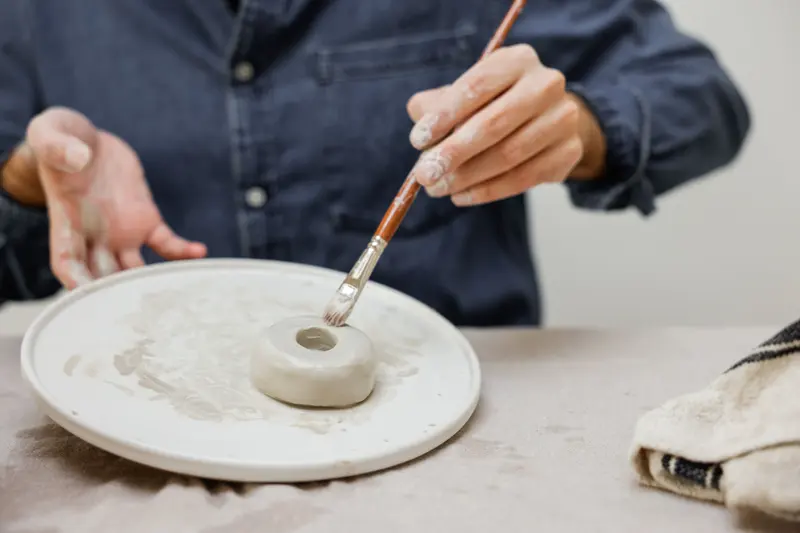
Compare the tile with Mayco’s photo. If your result is paler or drier, you may need slightly thicker coats or a hotter finish. If it ran, try fewer top coats. Keeping notes on each change turns a chart into a reliable system for your own work.
Our kiln firing service in Mordialloc fires mid-fire glazes at cone 6 in electric kilns, so stoneware test tiles can go in with your other work. For background on the range, see our guide to Mayco stoneware glazes.
Common mistakes with Mayco combinations
The most common mistake is putting the glazes on in the wrong order. “Over” means the second glaze named goes on first. The second is firing a low-fire pair at stoneware temperatures, or the reverse.
The third is forgetting the engobe. The engobe versions on Mayco’s page look different because of what’s underneath, so a pair photographed over black engobe won’t look the same on white stoneware. Finally, coats matter: one thick dip isn’t the same as two brushed coats, so test your own method.
Planning a set with Mayco glaze combinations
A chart like this is most useful when you’re planning a set of work rather than a single piece. Because so many of Mayco’s current pairs share SW-231 Lilac Speck, you can glaze a whole set with one base and vary the top glaze from piece to piece, which gives a range of colours that still look like they belong together.
Start by shortlisting three or four pairs from the chart, then make a tile for each on the clay you’ll use. When the tiles come out, lay them beside each other and decide which sit well as a family. It’s often the pair you didn’t expect that works best, which is why testing several at once saves time.
Think about how the pieces will be used, too. Mugs and bowls get handled and washed, so a smooth, durable surface matters more than a dramatic break, while a vase or platter can carry a more fluid, reactive combination. Note on each tile how the surface feels as well as how it looks.
Lastly, buy enough of each glaze for the whole set before you start. Small differences between batches can shift a layered result, so glazing a set from the same jars keeps everything consistent. Keep your tiles with the jars, and you’ll have a ready reference the next time you glaze the same pair.
Frequently asked questions
Why are there only 35 Mayco combinations?
Because we only include what Mayco currently shows on its glaze combinations page, which listed 35 when we checked. Mayco has published many more over the years, but we couldn’t confirm older sheets are current, so they’re not on this chart.
Are the swatches the fired colour?
No. Each split swatch shows approximate colours suggested by the two glaze names, top on the left and base on the right. The fired result blends and breaks, so look at Mayco’s photo and fire a test tile.
Can I fire the stoneware pairs at cone 6?
Yes. Mayco shows its stoneware pairs at both cone 6 and cone 10, and its stoneware glazes have a stated range of cone 5 to 10. Expect a little more movement at cone 10.
Do I need the engobe?
Only if you want the engobe version’s look. Each engobe pair is also shown without an engobe, and the chart lists both, so pick the one that matches your clay and the result you want.
Can Le Studio Art Space fire Mayco stoneware glazes?
The Le Studio Art Space firing service in Mordialloc fires mid-fire glazes at cone 6 in electric kilns, which suits Mayco’s stoneware pairs at the cone 6 end of their range. Check the firing service page for drop-off details.
Sources and method
Combinations are transcribed from Mayco’s glaze combinations page at maycocolors.com, checked on 27 October 2026, which shows each stoneware pair at cone 6 and cone 10 and the low-fire pairs at cone 06. The two-and-two coat method, the advice to test before glazing a whole piece and the cone 5 to 10 stoneware range are from Mayco’s published guidance.
Split swatch colours are our approximations from the glaze names, not Mayco’s colours. Mayco is a trademark of Mayco Colors, used here to identify its products.
Figures last checked .
Use this tool on your site
You’re welcome to embed the mayco glaze combinations chart on your own site, studio page or class notes. Copy the code below. Please keep the credit link, it’s how other potters find the full version.
Cite this tool
Le Studio Art Space (2026). Mayco Glaze Combinations Chart. The Potter’s Bench. https://lestudioartspace.com/potters-bench/glaze-brand-chart-library/mayco/ (accessed 27 October 2026).
This mayco glaze combinations chart from Le Studio Art Space is general educational content. The chart lists only combinations Mayco publishes, and the split swatches are approximate colours suggested by the glaze names, not the fired result: always fire test tiles first. Always follow the clay and glaze manufacturer’s data, and for glaze and food safety decisions follow the manufacturer’s guidance and local regulations.