A small electric kiln of 3 to 4 kW costs roughly $4 to $5 in electricity for an 8 hour firing at Victoria’s default flat rate of about 27 cents per kWh. The sum is kW times hours times about 0.6, because the elements cycle on and off, times your rate. A large 11 kW three-phase kiln costs about $14 for the same firing.
Kiln Electricity Cost Calculator: What Does One Firing Cost?
This kiln electricity cost calculator answers a question every home potter asks before buying a kiln, and again when the bill arrives. Pick a kiln or enter its rating, set the firing length and your tariff, and it shows what one firing costs, what that works out to per kilogram of pots, and how the same firing compares on peak, off-peak and solar soak rates.
Electricity for one firing
$4.73
17.3 kWh: 3.6 kW x 8 hours x 0.6 at 27.35 c/kWh.
- Per weight of ware
- $0.47 per kg
- Per month
- $18.904 firings
- Per year
- $226.85
- At full power
- $7.88the most it could be
Same firing on United Energy time-of-use rates
Daily supply charges are not included. The 0.6 share of full power is an assumption; a kiln with an energy meter or a controller that logs kWh will give you the real figure.
This tool at a glance
- What it does
- Estimates what one electric kiln firing costs in electricity, per firing, per kilogram of ware, per month and per year.
- Inputs
- Kiln power rating in kW, firing length in hours, the average share of full power the kiln draws (duty factor), your electricity rate in cents per kWh, the weight of ware and firings per month.
- Method
- Energy (kWh) = kW x hours x duty factor. Cost = kWh x rate / 100. Cost per kg = cost / weight of ware. Monthly cost = cost x firings per month; yearly = monthly x 12. The 0.6 duty factor is an assumption based on Skutt’s 0.5 to 0.7 range.
- Outputs
- Cost of one firing, energy used, cost per kilogram or pound of ware, monthly and yearly cost, the full-power maximum and the same firing at peak, off-peak and solar soak rates.
What a kiln firing costs in electricity: examples
Example costs for common kilns at the United Energy flat rate of 27.35 c/kWh, using a 0.6 share of full power.
| Kiln | Energy, 8 hour firing | 8 hour firing | 12 hour firing | Try it |
|---|---|---|---|---|
| Woodrow DK30, 3.4 kW | 16.3 kWh | $4.46 | $6.70 | |
| Tetlow K2FL, 3.6 kW | 17.3 kWh | $4.73 | $7.09 | |
| Skutt KM818, about 6.5 kW | 31.2 kWh | $8.53 | $12.80 | |
| Skutt KM1027, three phase, 11 kW | 52.8 kWh | $14.44 | $21.66 |
Victorian Default Offer 2026-27 electricity rates
Residential usage rates including GST, 1 July 2026 to 30 June 2027, set by the Essential Services Commission. Mordialloc is in the United Energy area. Retail market offers can be cheaper, so check your own bill.
| Tariff | Cents per kWh | Try it |
|---|---|---|
| Flat rate, United Energy area | 27.35 | |
| Time of use off-peak, 9pm to 11am | 22.14 | |
| Time of use solar soak, 11am to 4pm | 17.26 | |
| Time of use peak, 4pm to 9pm | 40.32 | |
| Flat rate, CitiPower area | 25.96 | |
| Flat rate, Jemena area | 27.47 | |
| Flat rate, Powercor area | 28.22 | |
| Flat rate, AusNet area | 31.98 |
United Energy’s daily supply charge on the flat tariff is $1.1912 a day. You pay it whether or not the kiln runs, so the calculator leaves it out.
How the kiln electricity cost calculator works
The kiln electricity cost calculator follows the method kiln maker Skutt publishes: multiply the kiln’s power in kilowatts by the firing time in hours, then by an adjustment factor for how much of that time the elements are actually on, then by your price per kilowatt hour. The result is the energy the firing uses, and its cost.
With the defaults, a Tetlow K2FL rated at 3.6 kW, an 8 hour firing and a factor of 0.6, that’s 3.6 times 8 times 0.6, or 17.28 kWh. At the United Energy flat rate of 27.35 cents per kWh, it costs about $4.73. Divide by the 10 kg of ware in the kiln and you get 47 cents a kilogram. Four firings a month comes to about $18.90, or around $227 a year.
The calculator also shows the full-power figure, here about $7.88, which is the most the firing could cost if the elements never switched off. Real firings land well below it, because the controller switches the elements on and off to follow its schedule.
How much does it cost to fire a kiln in Victoria?
At Victoria’s default flat rate, an 8 to 12 hour firing costs about $4.50 to $7 in a small 3 to 4 kW kiln, $8.50 to $13 in a mid-size 6.5 kW kiln and $14 to $22 in a large 11 kW three-phase kiln. The biggest factors are the kiln’s size, how long the firing runs and whether you fire on a flat rate or a time-of-use plan.

The rates built into the tool are the Victorian Default Offer for 2026-27, the regulated price the Essential Services Commission sets for each distribution area. In the United Energy area, which covers Mordialloc and much of Melbourne’s south-east, the flat rate is 27.35 cents per kWh. Other areas range from 25.96 cents with CitiPower to 31.98 cents with AusNet. A comparison site put the Melbourne average across market offers at about 25.85 cents in October 2026, so many households pay a little less than the default.
A typical 8 hour bisque in a 3.4 kW Woodrow DK30 uses about 16 kWh and costs about $4.46 at the flat rate. A 12 hour glaze firing in a Skutt KM818, at about 6.5 kW, uses about 47 kWh and costs around $12.80. These are small sums against the cost of the kiln itself, but they add up over a year of weekly firings.
What is the duty factor, and why 0.6?
The duty factor is the share of the firing time the elements are actually drawing power, and 0.6 is a sensible middle estimate. Skutt suggests an adjustment factor of 0.5 to 0.7 for its kilns, because the controller pulses the elements to follow the firing schedule rather than running them flat out.
Early in a firing, during slow warm-up segments, the elements are off much of the time. Near the top of a glaze firing they run almost continuously, fighting heat loss through the walls. A slow bisque with a long candling stage might average close to 0.5, while a fast glaze firing in an older kiln with worn elements might be nearer 0.7 or more.
We flag 0.6 as an assumption rather than a fact. If your kiln controller logs energy use, or you can read your meter before and after a firing with nothing else running, use your own figure. That one measurement makes the calculator far more accurate than any published average.
Does firing off-peak save money?
Yes, if you’re on a time-of-use plan and the firing fits inside the cheaper window. On United Energy’s default time-of-use rates, the same 17.28 kWh firing costs about $3.83 off-peak, $2.98 in the solar soak window from 11am to 4pm, and $6.97 at the 4pm to 9pm peak rate.
The catch is that firings are long. An 8 hour glaze firing started at 9pm finishes around 5am, comfortably off-peak, and the hottest, most power-hungry hours fall in the cheapest window. Started at 11am, the same firing runs into the evening peak just as the elements work hardest. Most kiln controllers have a delay-start setting for exactly this reason.
If you have rooftop solar, a daytime bisque can run partly on your own generation, which changes the sums again. In that case, the calculator’s figure is the upper limit, and the real cost depends on how much of the firing your panels cover.
Bisque vs glaze: cost per firing and per kilogram
A glaze firing usually costs more than a bisque, because it runs hotter and the kiln loses more heat at cone 6 than at cone 06. The longer, higher end of the schedule is where the elements run nearly flat out, so a glaze firing usually costs noticeably more than a bisque in the same kiln. Enter each schedule’s length separately to see the difference for your own firings.
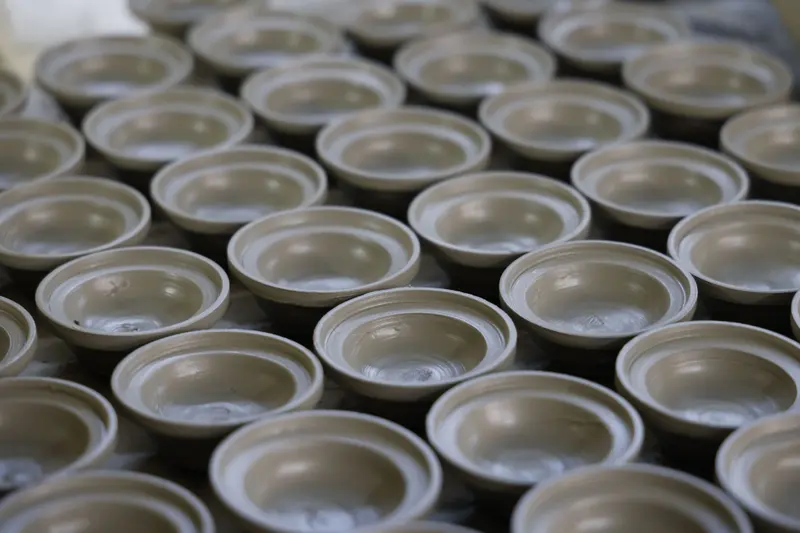
The cost per kilogram is the most useful figure for pricing your work. At 47 cents a kilogram, a 400 g mug carries about 19 cents of electricity for each firing, or under 40 cents across a bisque and a glaze. A half-empty kiln costs nearly as much to fire as a full one, so packing the kiln well is the easiest saving of all.
That’s also why shared firings make sense for many potters. When the electricity is split across a full kiln, each piece costs very little. If you fire only occasionally, a kiln firing service may cost less than running your own kiln half full.
Common mistakes when costing a kiln
The most common mistake is using the kiln’s full rating for the whole firing, which overstates the cost by around two thirds if the real duty factor is 0.6. The second is forgetting that the daily supply charge is paid whether the kiln runs or not, so it isn’t really a firing cost, though it is part of your bill.
The third is ignoring installation. Woodrow, an Australian maker, says all its kilns need a dedicated connection like an oven or an air conditioner, because a normal power point is rated at only 10 amps. Larger kilns can need a three-phase supply. The electrician’s quote can be a bigger number than years of electricity, so get it before you buy. The pyrometric cone chart will help you plan the firing temperatures that drive these costs.
Frequently asked questions
Is a kiln really that cheap to run?
The electricity for one firing is modest, usually a few dollars for a small kiln. The bigger costs of owning a kiln are the kiln itself, the electrical installation, kiln shelves and posts, replacement elements and thermocouples, which this calculator doesn’t include.
Why not just use the kiln’s full kW rating?
Because the elements aren’t on all the time. The controller switches them on and off to follow the schedule, so the average draw is lower. Skutt suggests multiplying by 0.5 to 0.7; we use 0.6 and flag it as an assumption.
Can I plug a small kiln into a normal power point?
Check with the maker and a licensed electrician before you do. Woodrow says all its kilns need a dedicated connection, because a normal power point is rated at only 10 amps, and many kilns draw 15 amps or more.
Does the calculator include GST?
Yes. The Victorian Default Offer rates built into the tool include GST, and your bill’s rates should too. If you enter your own rate, use the GST-inclusive figure from your bill.
What does Le Studio Art Space fire in?
Le Studio Art Space in Mordialloc fires in electric kilns, with no reduction firings. The firing service runs bisque at cone 06, earthenware glazes at cone 03 and mid-fire glazes at cone 6.
Sources and method
Electricity rates are the Victorian Default Offer for 2026-27 (1 July 2026 to 30 June 2027, GST included) published by the Essential Services Commission of Victoria, cross-checked against energyplans.com.au’s Melbourne average of 25.85 cents per kWh in October 2026. The cost method and the 0.5 to 0.7 adjustment factor are from Skutt’s kiln FAQ. Kiln ratings are from the makers’ and Australian retailers’ specifications: Woodrow DK30 3.4 kW and Tetlow K2FL 3.6 kW on 15 amp supplies, Skutt KM818 about 6.4 to 6.7 kW and Skutt KM1027 three-phase 11 kW. The wiring advice is from Woodrow.
The 0.6 duty factor is our assumption. The calculator excludes daily supply charges, demand charges and solar feed-in. Costs are rounded to the nearest cent.
Figures last checked .
Use this tool on your site
You’re welcome to embed the kiln electricity cost calculator on your own site, studio page or class notes. Copy the code below. Please keep the credit link, it’s how other potters find the full version.
Cite this tool
Le Studio Art Space (2026). Kiln Electricity Cost Calculator. The Potter’s Bench. https://lestudioartspace.com/potters-bench/kiln-electricity-cost-calculator/ (accessed 27 October 2026).
This kiln electricity cost calculator from Le Studio Art Space is general educational content. Costs are estimates: real use depends on your kiln, its elements, the load, the firing schedule and your retail plan, and the duty factor is an assumption. Kilns must be installed by a licensed electrician. Always follow the clay and glaze manufacturer’s data, and for glaze and food safety decisions follow the manufacturer’s guidance and local regulations.