To price pottery, add up materials, firing and your time at an hourly rate, add a share for overheads, then add a profit margin to get a wholesale price. Retail is usually twice wholesale, called keystone. A 500 g mug that takes 45 minutes at $30 an hour costs about $28 to make, wholesales for about $35 and retails for about $71.
Pottery Pricing Calculator: How to Price Your Handmade Pottery
This pottery pricing calculator takes the guesswork out of putting a price on your work. Enter what goes into a piece, from clay and glaze to the time you spend throwing, trimming and glazing, and it builds up a cost, a wholesale price and a retail price. It also shows what you’d actually keep selling direct, wholesale or through a gallery that takes commission.
Suggested retail price
$70.94
A tidy shelf price would be $75. Wholesale $35.47.
- Cost to make
- $28.37$3.30 materials, $22.50 labour, $2.58 overheads
- Wholesale price
- $35.47$7.09 profit
- Selling direct
- $70.94$42.56 profit
- On consignment
- $42.56 to you$14.19 profit after 40%
Where the retail price goes
Retail price if your time or rate changes
| Hourly rate | 0.56 h | 0.75 h | 0.94 h |
|---|---|---|---|
| $20 an hour | $40.00 | $50.31 | $60.62 |
| $30 an hour | $55.47 | $70.94 | $86.41 |
| $40 an hour | $70.94 | $91.56 | $112.19 |
This tool at a glance
- What it does
- Works out what a handmade pot costs to make and suggests wholesale and retail prices, then shows your profit selling wholesale, direct or on consignment.
- Inputs
- Clay per piece and its price per kg, glaze and other materials, firing, time per piece, hourly rate, overhead percentage, wholesale profit margin, retail multiplier and gallery commission.
- Method
- Materials = clay g / 1000 x price per kg + glaze + firing. Labour = hours x rate. Cost = (materials + labour) x (1 + overhead / 100). Wholesale = cost / (1 – margin / 100). Retail = wholesale x multiplier. Consignment take-home = retail x (1 – commission / 100).
- Outputs
- Cost to make, wholesale and retail prices, a tidy shelf price, profit per piece at wholesale, direct and on consignment, a breakdown of the retail price, and a table of retail prices for different hourly rates and times.
Pottery pricing examples at $30 an hour
Example prices from the calculator at $30 an hour, 10% overheads, a 20% wholesale margin and keystone (x 2) retail, with clay at $2.59 a kg. The times and material costs are illustrations, not standards, so load one and replace them with your own.
| Piece | Clay | Time | Cost to make | Wholesale | Retail | Try it |
|---|---|---|---|---|---|---|
| Small cup or tumbler | 350 g | 0.5 h | $19.15 | $23.93 | $47.87 (about $50) | |
| Mug with a handle | 500 g | 0.75 h | $28.37 | $35.47 | $70.94 (about $75) | |
| Cereal bowl | 750 g | 0.75 h | $29.36 | $36.70 | $73.40 (about $75) | |
| Dinner plate | 1800 g | 1 h | $41.98 | $52.47 | $104.95 (about $105) | |
| Serving bowl | 2500 g | 1.5 h | $62.67 | $78.34 | $156.68 (about $160) | |
| Medium vase | 1500 g | 1.5 h | $58.17 | $72.72 | $145.43 (about $150) |
How the pottery pricing calculator works
The pottery pricing calculator uses the cost-plus method most pricing guides for makers describe. First it adds your materials: the clay in the piece at your price per kilogram, plus glaze and other materials, plus firing. Then it adds labour, your time multiplied by your hourly rate. Overheads go on top as a percentage, and that total is what the piece costs you to make.
With the defaults, a 500 g mug uses $1.30 of clay at $2.59 a kilogram, plus $1 of glaze and $1 of firing, so materials come to $3.30. Forty-five minutes at $30 an hour is $22.50 of labour. A 10% overhead adds $2.58, giving a cost of about $28.37.
The wholesale price adds your profit margin: at 20%, the cost is divided by 0.8 to give $35.47, so a fifth of the wholesale price is profit. Retail is wholesale times your multiplier, here 2, which gives $70.94. The tool also suggests a tidy shelf price, rounded up to $75, because $70.94 looks odd on a price tag.
How do you price pottery?
You price pottery by covering every cost, including your time, and then adding profit. The simplest reliable formula is materials plus labour plus overheads equals cost, cost plus profit equals wholesale, and wholesale times two equals retail. Ceramic Arts Network’s worked example uses the same structure with a 10% overhead allowance, which is our default.
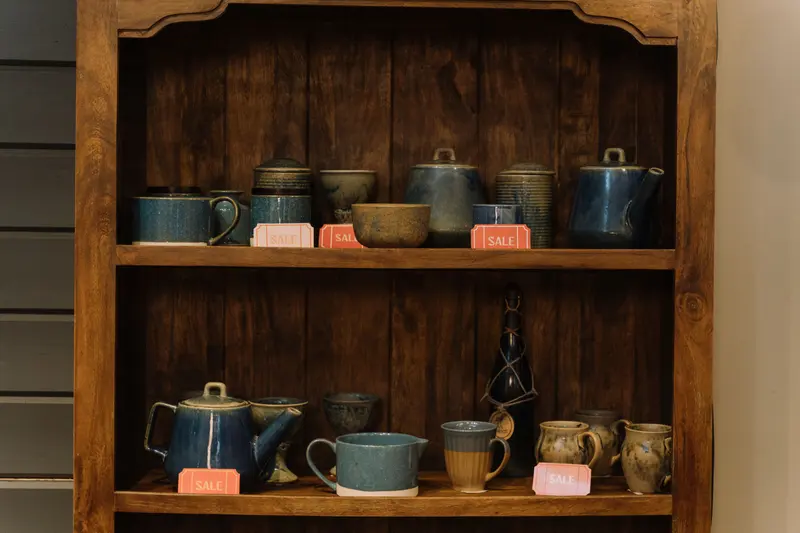
The step most potters skip is paying themselves. If you leave labour out, your price only covers clay and glaze, and every sale quietly loses money against the hours you put in. Counting your time, even at a modest rate, is what turns a hobby price into a sustainable one.
Your market still has the final say. If the calculator suggests $75 for a mug and similar handmade mugs at your local market sell for $45, you’ll need to make faster, use less clay, or find buyers who value the extra work. The calculator tells you what a piece needs to sell for; only selling tells you what people will pay.
Wholesale, retail and keystone pricing explained
Wholesale is what a shop pays you, and retail is what the shop’s customer pays. Keystone pricing means retail is double wholesale, so the shop’s mark-up is 100% of what it paid, which is a 50% margin on the retail price. Many shops expect keystone, and some multiply by 2.5 to 3 when the market bears it.
The key rule is that your retail price when you sell direct should match what a shop would charge. If you sell a mug for $45 at your own stall but wholesale it to a shop that has to charge $71, the shop can’t compete with you, and wholesale accounts don’t last. Price retail first, then make sure the wholesale price still covers your cost and profit.
That’s why the calculator builds wholesale from your costs and retail from wholesale. If the retail figure feels too high for your market, the fix is usually on the cost side, faster making or cheaper materials, rather than cutting the wholesale margin to nothing.
Selling through galleries and shops: commission
Galleries and shops that sell on consignment take a commission when your piece sells, typically 25 to 60% in Australia according to Ceramic Arts Queensland’s guide to doing the sums. At 40%, a $70.94 mug returns $42.56 to you, which leaves $14.19 profit after the $28.37 cost.
Set the commission box to the rate you’ve been offered. If your take-home falls below the cost to make, the calculator flags it, because selling at that price loses money on every piece. Higher commissions usually come with more for your money, such as a well-placed shop, marketing, staff and an established buyer list, so it’s worth weighing both.
For pieces you sell both directly and on consignment, keep the retail price the same in both places. The gallery’s commission comes out of your share, not out of the buyer’s pocket.
What hourly rate should you pay yourself?
Choose an hourly rate you’d be content to earn for skilled work, then test it against your market. The sensitivity table in the tool shows how the retail price moves if your rate goes $10 up or down, or a piece takes a quarter more or less time, so you can see which matters more.
With the defaults, the mug’s retail price ranges from $40 at $20 an hour and 34 minutes, up to $112.19 at $40 an hour and 56 minutes. Time is often the lever with the most room: throwing in batches, trimming several pieces at once and glazing by dipping instead of brushing all cut the time per piece without cutting your rate.
Count all the time, not just the wheel. Wedging, trimming, attaching handles, waxing, glazing, loading the kiln, photographing, packing and selling all belong in the time per piece, spread across a batch.
A simple way to find your real time is to time a whole batch. Note when you start wedging for a dozen mugs and add up every session until they’re packed and priced, then divide by twelve. Most potters are surprised by the answer, and it’s nearly always longer than the time spent at the wheel. Once you have that figure for your common pieces, the calculator does the rest in seconds.
Common pottery pricing mistakes
The most common mistake is pricing by what feels comfortable rather than by cost, which usually means pricing too low. The second is forgetting losses: some pieces crack, warp or come out of the glaze firing wrong, and the good ones have to pay for them. Raise the overhead percentage to cover your typical loss rate.
The third is leaving out selling costs, such as market stall fees, card payment fees, packaging and postage. And the last is never revisiting prices. Clay, electricity and firing costs rise, and so does your skill, so rerun your numbers every year. The kiln electricity cost calculator and clay weight calculator help you pin down the material side.
Frequently asked questions
Is $75 really a fair price for a handmade mug?
It’s what the default inputs need, not a market price. If similar mugs in your area sell for less, change the inputs to match your real costs and time, and see whether faster making or cheaper materials gets you closer. The calculator shows what a piece needs to earn; your market decides what it can.
Why add a profit margin if I’m already paying myself?
Because your hourly rate is your wage and profit is the business’s return. Profit pays for new equipment, slow months and growth, so a business that only covers wages has nothing left over when the kiln needs new elements.
Should my direct price be lower than the gallery’s?
No. Keep retail the same everywhere so shops and galleries can compete fairly. If you undercut them at your own stall, they’ll stop stocking your work.
Does the calculator handle GST?
No. Enter costs the way you track them and treat the results as prices before any GST you may need to charge. If you’re unsure whether you need to register, talk to an accountant.
How should I count firing costs?
Use your share of each bisque and glaze firing, or what a firing service charges for the piece. Le Studio Art Space’s firing service in Mordialloc fires bisque at cone 06, earthenware glazes at cone 03 and mid-fire glazes at cone 6, and its firing service page explains how to bring work in.
Sources and method
The cost-plus method and the 10% overhead example are from Ceramic Arts Network’s guide to pricing pottery. Keystone pricing, where retail is twice wholesale (a 100% mark-up or 50% margin), and retail multipliers of 2.5 to 3 follow common retail practice described in pricing guides for makers. The 25 to 60% consignment commission range is from Ceramic Arts Queensland’s “Doing the sums” guide. The default clay price of $2.59 a kg is a $25.90 10 kg bag from our pottery equipment cost calculator.
The default time, glaze, firing, hourly rate and margin are illustrations, not recommendations. The tidy price rounds up to the next $1 under $20, $5 under $200 and $10 above. All other figures are rounded to the cent.
Figures last checked .
Use this tool on your site
You’re welcome to embed the pottery pricing calculator on your own site, studio page or class notes. Copy the code below. Please keep the credit link, it’s how other potters find the full version.
Cite this tool
Le Studio Art Space (2026). Pottery Pricing Calculator. The Potter’s Bench. https://lestudioartspace.com/potters-bench/pottery-pricing-calculator/ (accessed 27 October 2026).
This pottery pricing calculator from Le Studio Art Space is general educational content. Prices are estimates from the figures you enter and a common cost-plus method; they are not business, tax or legal advice, and what your work sells for depends on your market. Always follow the clay and glaze manufacturer’s data, and for glaze and food safety decisions follow the manufacturer’s guidance and local regulations.