A one-off pottery taster class typically costs about $85 to $120, a six-week wheel course about $310 to $525, and open studio membership about $175 to $450 a month. Firing outside a class price usually runs $8 to $16 per kilogram. A taster followed by a six-week course typically comes to about $555 in total.
Pottery Class Cost Estimator: Tasters, Courses and Memberships
This pottery class cost estimator helps you budget for learning clay, from a first taster to a regular spot in a studio. Add up the classes, courses and months you’re thinking about and it shows a typical cost, plus the low and high ends, based on prices studios actually publish. It’s a planning tool, not a quote, so always check the current price with the studio you choose.
Typical cost of your plan
$555
Published prices put it between $394 and $645.
| Part of the plan | Low | Typical | High |
|---|---|---|---|
| Taster class x 1 class | $85 | $105 | $120 |
| Six-week wheel course x 1 course | $309 | $450 | $525 |
| Total | $394 | $555 | $645 |
Indicative only. Prices change, and what is included (clay, glazes, firing, studio time) differs from studio to studio, so check before you book.
This tool at a glance
- What it does
- Estimates what a plan of pottery classes, courses, studio membership and firing is likely to cost, as a low, typical and high figure.
- Inputs
- Number of taster classes, six-week wheel courses, months of membership, and kilograms of work fired outside a class price.
- Method
- For each part, cost = quantity x the lowest, median and highest published price in our sample. The plan total adds the parts. Samples: 6 taster prices, 5 six-week course prices, 7 monthly membership prices and 7 per-kilogram firing prices.
- Outputs
- Typical total, the low to high range, and a breakdown of each part of the plan.
What pottery classes cost: indicative ranges
Lowest, typical (median) and highest published prices from a sample of Melbourne studios and teachers, including GST, checked on 26 October 2026. Inclusions differ, so compare what each price covers.
| Type | Lowest | Typical | Highest | Prices sampled |
|---|---|---|---|---|
| Taster class | $85 | $104.50 | $120 | 6 |
| Six-week wheel course | $309 | $450 | $525 | 5 |
| Studio membership, per month | $175 | $280 | $450 | 7 |
| Firing, per kg | $8 | $11 | $16 | 7 |
How the pottery class cost estimator works
The pottery class cost estimator multiplies each part of your plan by the lowest, middle and highest price in a sample of published studio prices, then adds them up. The middle figure is the median, the price halfway along the list, which is less thrown by one very cheap or very expensive studio than an average would be.
With the default plan of one taster class and one six-week wheel course, the low end is $85 plus $309, or $394. The typical figure is $104.50 plus $450, about $555, and the high end is $120 plus $525, or $645. Add three months of membership and the typical total rises by $840, since the median membership in our sample is $280 a month.
Firing is the only part priced by weight. Many classes include firing your pieces in the price, so leave it at zero unless you’re paying for it separately, as some memberships and firing services do.
How much does a pottery class cost?
A pottery class costs about $85 to $120 for a one-off taster and about $310 to $525 for a six-week wheel course, based on the prices studios publish. Ongoing studio membership, for people who’ve finished a course and want time on the wheel, runs about $175 to $450 a month.
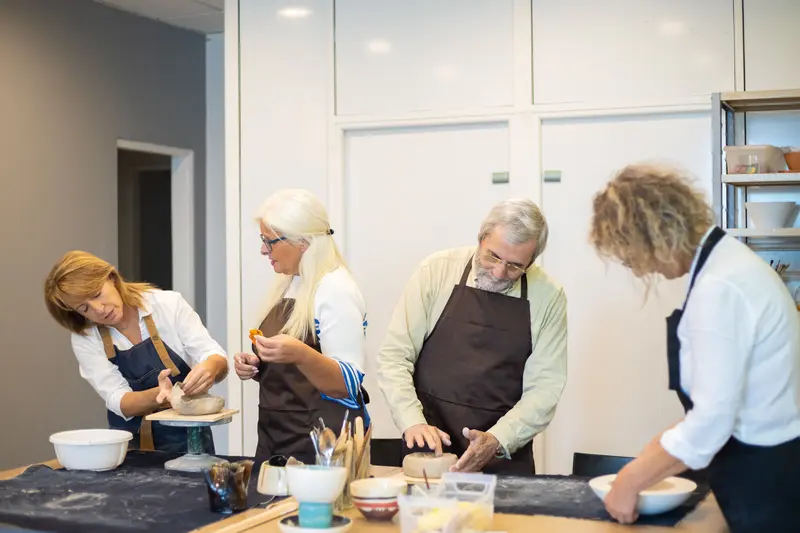
The typical figures in our sample are about $105 for a taster, $450 for a six-week course and $280 a month for membership. A six-week course works out to about $75 a session at the typical price, cheaper per session than a taster, which is one reason most people do a single taster and then commit to a course if they enjoy it.
Firing prices, where they’re charged separately, ranged from $8 to $16 per kilogram, with bisque often cheaper than a mid-fire glaze firing at the same studio. A mug weighs well under half a kilogram once fired, so firing a dozen mugs at the typical $11 a kilogram costs less than many people expect.
What’s usually included in the price?
It varies more than the price does, which is why comparing classes takes a little care. Ask whether the price covers clay, glazes, firing, use of tools and aprons, and how many finished pieces you can take home. A cheaper course that charges for firing and clay can end up costing more than a dearer one that includes them.
Also ask how long each session runs and how many students share a teacher. A two and a half hour session with a small group gives you far more time at the wheel than a crowded ninety-minute class, even if the headline price looks similar. Some courses include practice time between sessions, which is worth a lot when you’re learning to centre.
For memberships, check what’s included each month: wheel time, shelf space, firing allowances and access hours differ widely. One studio in our sample includes 2 kg of firing in its membership, for example, while others charge every kilogram separately.
It’s also worth asking what happens if you miss a session. Some courses offer a catch-up session or let you make up time in open studio, and others don’t. Over six weeks, one missed class is a sixth of what you paid, so a flexible policy can be worth more than a small price difference.
Taster, course or membership: which is better value?
For a complete beginner, a taster is the cheapest way to find out whether you like the wheel, and a course is the best value way to actually learn it. Membership is the better deal once you can centre and throw on your own and want regular, unsupervised time.
The progression matters because skills build on each other. A course teaches centring, opening, pulling walls and trimming in order, with feedback each week. Jumping straight to a membership without that foundation can mean months of frustration and a lot of reclaimed clay. Our guide to how long it takes to learn wheel throwing covers what to expect at each stage.
If you already know you’ll want your own space later, it’s worth comparing a membership with renting space or buying equipment. The pottery equipment cost calculator compares owning a wheel or kiln with a membership over several years.
Planning your first year of pottery: worked examples
Say you start with a taster, take a six-week course, and then join a studio for six months. Using the typical prices, that’s about $105 plus $450 plus $1,680, roughly $2,235 for your first year. The low end of the range is about $1,444 and the high end about $3,345, mostly depending on which membership you choose.

A lighter plan of two tasters and one course comes to about $659 at typical prices. If you’re mainly hand building at home and paying to fire, ten kilograms of firing at the typical $11 a kilogram adds about $110 to whatever else you choose.
Run your own plan through the estimator and share the link with whoever is helping you budget, or use the copy button to paste the breakdown into a note.
Pottery also makes a popular gift, and the same sums apply. A taster class is the easy present for someone curious about clay, while a six-week course is a bigger gesture for someone who has already caught the bug. If you’re buying for two, double the figures, since most studios price per person, and check whether the studio sells gift vouchers so the person can choose their own dates.
Common mistakes when comparing class prices
The most common mistake is comparing headline prices without checking inclusions. The second is booking a long membership before you know you’ll use it, when a course would teach you more for less. The third is forgetting the extras that add up over a year, such as your own tools, an apron and the cost of firing finished work.
Another mistake is judging a class on price per hour alone. The teacher, the size of the group, the quality of the wheels and the feel of the studio all shape how quickly you learn and whether you keep coming back. A slightly dearer course where you feel welcome and get real feedback is often the better investment, because the skills stay with you long after the course ends.
Prices also change, often once or twice a year, so treat every figure here as a snapshot from the date shown and confirm the current price before you book.
Frequently asked questions
Are these prices from Le Studio Art Space?
No. Le Studio Art Space’s own class prices aren’t included, so the estimator stays neutral. The ranges come from prices other studios and teachers publish online. For Le Studio’s current classes, see the workshops and classes page.
Why is a six-week course so much cheaper per session than a taster?
A course spreads the teacher’s time and the studio’s setup over several sessions with the same group, so studios can charge less per session. At typical prices a course works out to about $75 a session against about $105 for a taster.
Is a membership worth it if I’ve only done one course?
It can be, if you can centre and open a pot on your own and will use the time every week. If you still need help with the basics, a second course or a few drop-in sessions are often better value than a monthly fee you don’t fully use.
How reliable are these ranges?
They’re a snapshot of 25 published prices checked on one day, so they’re indicative only. They show the usual spread rather than every studio’s price, and inclusions differ, so always confirm the current price and what it covers.
Do I need to pay for firing as well?
Often not, since many classes include firing in the price. Where it’s charged separately, published rates in our sample ranged from $8 to $16 a kilogram. Ask before you book.
Sources and method
Taster prices are the published prices of twelve80, Sarah Schembri, Robert Gordon, Diana Ceramic and SaJo. Six-week wheel course prices are from Diana Ceramic, Mayfield, Robert Gordon, Sarah Schembri and Northcote Pottery. Monthly membership prices are from Creative Hands, Mayfield, Lygon St, Kilnfolk (two tiers), Bisque Studios and twelve80. Per-kilogram firing prices are from Mayfield (bisque and cone 6), The Kiln Room, Bisque Studios, Kilnfolk and Beldari. All prices include GST and were checked on 26 October 2026.
Le Studio Art Space’s own class and membership prices are not published and are not included. Ranges use the lowest, median and highest price in each sample, and totals are rounded to the nearest dollar.
Figures last checked .
Use this tool on your site
You’re welcome to embed the pottery class cost estimator on your own site, studio page or class notes. Copy the code below. Please keep the credit link, it’s how other potters find the full version.
Cite this tool
Le Studio Art Space (2026). Pottery Class Cost Estimator. The Potter’s Bench. https://lestudioartspace.com/potters-bench/pottery-class-cost-estimator/ (accessed 27 October 2026).
This pottery class cost estimator from Le Studio Art Space is general educational content. Prices are indicative ranges from published prices on the date shown; they change often and inclusions differ, so check the current price and what it covers with the studio before booking. Always follow the clay and glaze manufacturer’s data, and for glaze and food safety decisions follow the manufacturer’s guidance and local regulations.