Good beginner ceramics projects build skills in a sensible order: start with pinch pots and small dishes to learn how clay behaves, move to coil and slab projects that teach joining and structure, try simple cylinders and bowls on the wheel, then practise underglaze and glazing. Repeating projects and learning from every firing helps skills grow faster than constantly jumping to new ideas.
You’ve made your first piece or two, maybe a wobbly pinch pot or a small dish, and you’re hooked. Now comes the question every new potter asks: what should I make next? It’s tempting to jump straight to a teapot or a big vase, but a thoughtful sequence of beginner ceramics projects will build real skills and make those ambitious pieces possible sooner.
At Le Studio Art Space in Mordialloc, we often help members plan a learning path, a bit like a gentle coach. This guide lays out a practical progression, from simple forms through hand building, the wheel, and glazing, along with the bits most guides skip, like repetition and learning from firings.
Starting With Simple Forms
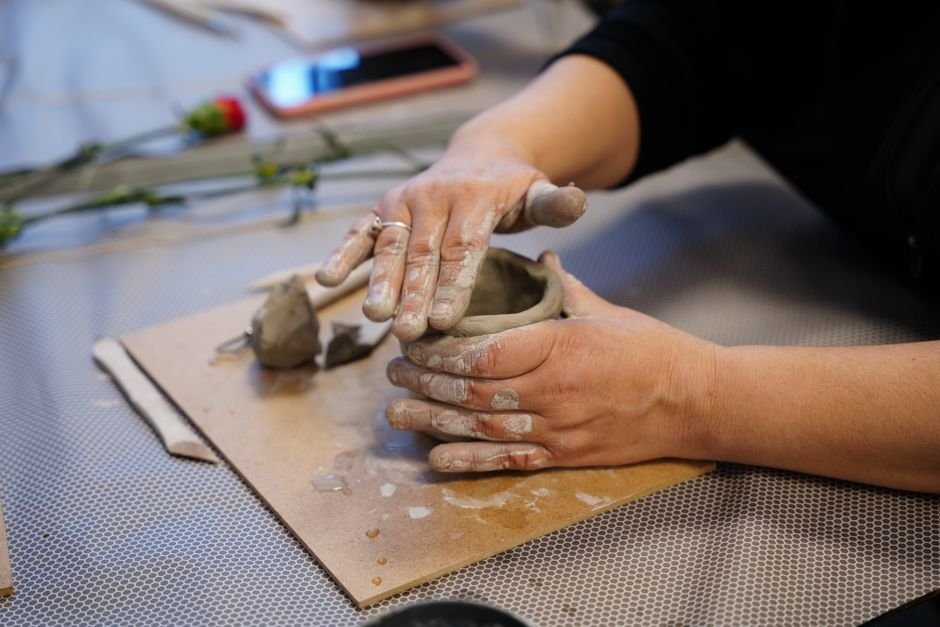
Pinch pots are the perfect first project. Pressing your thumb into a ball of clay and pinching the walls outward teaches you how clay responds to pressure, how thin you can go before it tears, and how moisture affects everything.
Try making several pinch pots in a row. Aim for even walls, a smooth rim, and a stable base. You’ll learn more from five pinch pots than from one, because each one shows you something slightly different.
Small dishes and trinket bowls are the next step. Press clay into a shallow form, or shape a flat disc and lift the edges. These teach you about drying evenly and how flat pieces can warp if rushed.
Simple sculptural forms, like small animals or abstract shapes, are great too. They help you get comfortable shaping clay freely. Our guide to easy clay models for absolute beginners has plenty of ideas.
At this stage, focus on feel rather than perfection. You’re learning the language of clay through your hands, and every piece teaches you something.
A great exercise here is joining two pinch pots rim to rim to make a hollow sphere. It teaches scoring, slip, and the need for an air hole, and the hollow form can become a rattle, a bird, or a little sculpture. It’s a simple bridge between pinching and more structured building.
Adding Coils And Slabs
Coil building is a natural next step. Rolling even coils and stacking them into a pot teaches you about joining, scoring, and slip, as well as building height gradually. A simple coil pot or cylinder is a classic project.
Try smoothing the coils on the inside and leaving them visible on the outside, or smoothing both sides completely. Each approach teaches different skills and gives a different look.
Slab projects introduce structure. Rolling a slab to an even thickness, cutting it with a template, and joining pieces into a box, cylinder, or tray teaches you about leather hard timing and strong joins.
Good beginner slab projects include a small square box, a cylindrical mug made by wrapping a slab, a simple tray, or a set of tiles. These help you understand how clay behaves when flat, folded, and joined.
Adding a handle to a mug is a valuable skill at this stage. It teaches you how to attach pieces securely and balance a form. Our guide to common hand building mistakes helps you avoid the usual pitfalls.
Moving To The Wheel
If you’d like to try the wheel, start with centring. It’s the foundation of everything else, and early sessions are often mostly about getting clay centred. That’s normal.
Your first wheel project should be a simple cylinder. Cylinders teach opening, pulling up walls, and keeping walls even. They’re the basis for mugs, vases, and jars.
Next, try small bowls. Bowls teach you to open wide and shape outward, which is a different skill from pulling up straight walls.
Don’t worry if many early pieces collapse. Most beginners lose plenty of pots on the wheel at first. Our guide to why your pot keeps collapsing on the wheel explains the common causes, and our guide on how long it takes to learn wheel throwing gives a realistic picture.
Once you can throw a reasonable cylinder and bowl, trimming becomes the next skill. Trimming leather hard pieces teaches you to refine forms and create foot rings.
A useful wheel exercise is to throw a cylinder, then cut it in half vertically with a wire once you’ve finished. Looking at the cross section shows you exactly where the walls are thick or thin, which teaches you more about your throwing than any finished pot can. Many teachers recommend doing this regularly in the early weeks.
Learning Surface And Glaze Skills
Decorating is a skill in its own right. Start with underglaze painting on a few small pieces, like tiles, dishes, or pinch pots. Underglaze is forgiving and lets you practise brushwork and design. Our guide to what underglaze is and how to use it explains the basics.
Try sgraffito, where you apply underglaze or slip and scratch through it to reveal the clay below. It’s a satisfying way to add detailed designs.
Glazing comes next. Practise dipping, brushing, or pouring glaze on a few test pieces. Learn how thick to apply it, how to keep it off the bottom, and how different glazes look on different clays.
Wax resist is a useful skill here. Waxing the bases of pieces prevents glaze from sticking to the kiln shelf, and it can be used decoratively too.
Test tiles are your friend. Making a few small tiles to try glazes before using them on a whole piece saves disappointment and teaches you how glazes behave.
Once you’re comfortable, try layering two glazes on a test tile or a small bowl. Overlapping glazes can create beautiful effects, but they can also run, so testing first is wise. It’s a fun way to learn while building your own reference collection.
What Competing Guides Leave Out About Beginner Ceramics Projects
Most lists of beginner ceramics projects focus on variety, offering a new idea every time. What they rarely mention is the power of repetition. Making the same project several times, such as ten cylinders or five pinch pots, builds skill faster than constantly switching.
Repetition lets you compare pieces and notice improvements. You’ll see walls getting thinner, rims getting smoother, and shapes becoming more confident. That progress is motivating.
Competing guides also skip learning from every firing. Each time a piece comes out of the kiln, look closely. Did it warp, crack, or change colour? Was the glaze too thick or thin? Keeping simple notes on what you did and what happened turns every firing into a lesson.
Failures are part of the process. A cracked piece tells you something about drying or joining. A glaze that ran tells you something about thickness or firing. Many potters say their failures taught them more than their successes.
Finally, few guides mention sharing work with teachers or other potters. A quick chat about a finished piece can reveal things you might not notice yourself.
Planning Your Own Learning Path
Choose your next project based on what you want to learn, not just what you want to make. If your joins keep cracking, try more slab projects. If centring is tricky, spend more time on cylinders.
Set small goals. Maybe it’s throwing a cylinder of a certain height, or making a mug with a handle that stays attached. Small wins keep you motivated, and ticking them off feels great.
Balance skill building with fun. It’s fine to make something just because you love the idea. Enjoyment keeps you coming back.
Ask for guidance. Our workshops and classes offer structured learning, members of our ceramic studio can work through their own progression with support, and our firing service takes care of the kiln so you can focus on making.
Most of all, be patient. Skills build gradually, and results vary from person to person. Many potters find that looking back at their first pieces after a few months is surprisingly encouraging.
Ready to build real skills one project at a time? Start your learning path with a class at Le Studio Art Space in Mordialloc, and get friendly guidance from pinch pots all the way to the wheel.
Frequently Asked Questions
What is the easiest ceramics project for a beginner?
A pinch pot is usually the easiest. It needs no tools or wheel and teaches you how clay responds to pressure and moisture.
Should I start with hand building or the wheel?
Either is fine. Many people start with hand building for quicker results, while others go straight to the wheel. Our classes cover both.
Why do my beginner pieces keep cracking?
Cracks often come from uneven drying, weak joins, or walls of uneven thickness. Slowing drying and using scoring and slip usually helps.
How many times should I repeat a project?
There’s no fixed number, but making the same form several times in a row often builds skill faster than trying something new every session.
Can Le Studio Art Space help me plan what to make next?
Yes. Teachers at Le Studio Art Space are happy to suggest next projects based on your skills and interests, whether you’re in a class or a studio member.
This article is provided for general educational purposes by Le Studio Art Space. Learning pace and results vary from person to person.