A mud knife is a long, flat, usually flexible blade used in pottery for slicing clay, cutting slabs, trimming edges, scraping, and cleaning surfaces. Its length and flexibility make it handy for long straight cuts and wide surfaces where a small fettling knife or needle tool would be awkward. It’s a useful hand building tool, though beginners can manage without one at first.
If you’ve looked through pottery tool lists or watched hand builders at work, you might have seen a long, slim blade being used to slice slabs or tidy up edges. That’s a mud knife, and while it’s not as famous as a needle tool or a rib, many potters find it becomes one of their favourite everyday tools once they start using it.
At Le Studio Art Space in Mordialloc, we use all sorts of cutting tools in hand building classes, and the mud knife is a simple but handy one. This guide explains what a mud knife is, how it’s used, how it compares with other cutting tools, how to choose and care for one, safety tips for shared studios, and how to use it well.
What A Mud Knife Is
A mud knife is a long, flat blade, usually made from stainless or carbon steel, with a simple handle. The blade is often thin and flexible, so it can bend slightly as you work. Some models are stiffer, depending on what they’re designed for.
Compared to an ordinary craft knife, a mud knife is longer and has a more rounded or blunt profile. It’s designed for clay rather than paper or wood, so it doesn’t need a razor sharp edge, although it should be sharp enough to cut cleanly.
The name comes from its main job: working with soft, wet clay, sometimes informally called mud. Some brands use slightly different names, and you might see similar tools sold as clay knives, slab knives, or palette style knives.
Mud knives come in different lengths. Shorter versions suit smaller work and detailed edges, while longer blades suit cutting large slabs or long, straight lines.
Some potters also use long, flexible artists’ palette knives in a similar way, especially for scraping and smoothing. The line between these tools can be blurry, and it often comes down to personal preference.
Everyday Uses For A Mud Knife In The Studio
Slicing clay is one of the most common uses. A mud knife can cut through soft clay cleanly, whether you’re portioning a lump or cutting a block in half. For very large blocks, a wire is usually easier, but for smaller pieces the knife works well.
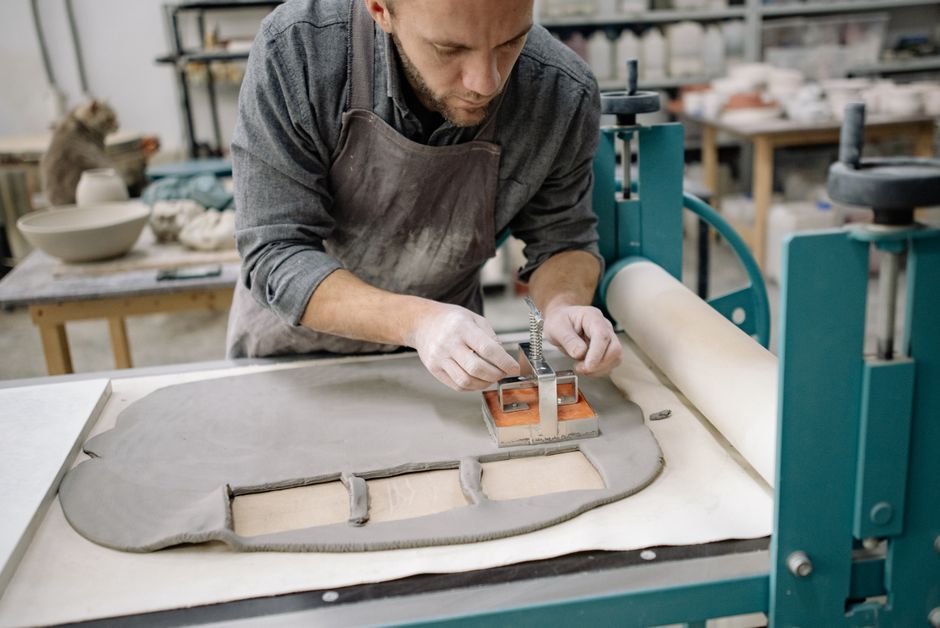
Cutting slabs is where the mud knife really shines. When you’ve rolled out a slab for a box, plate, or tile, a long blade lets you cut straight lines in a single smooth stroke, often against a ruler or template. Our guide to the core hand building methods covers slab work in more detail.
Trimming edges is another everyday task. You can use the knife to neaten the rim of a slab built form, trim excess clay from a join, or straighten uneven edges.
Scraping and cleaning surfaces is a handy secondary use. A flexible blade held at a low angle can smooth slab surfaces, scrape away excess slip, or clean clay off boards and work tables at the end of a session.
Some potters also use a mud knife to lift slabs from a surface, slipping the thin blade underneath to release clay without distorting it.
Bevelled cuts are another handy trick. Holding the blade at a 45 degree angle when cutting slab edges creates mitred joins, so two slabs meet neatly at a corner with more surface area for scoring and slip. Many hand builders find this gives stronger, cleaner box corners than butting two square edges together.
How A Mud Knife Compares To Other Cutting Tools
A needle tool is a fine, pointed tool used for scoring, cutting small details, piercing air holes, and trimming rims on the wheel. It’s great for precision but not ideal for long straight cuts through slabs.
A fettling knife has a shorter, stiffer blade, often tapered, and is used for trimming, carving, and cutting leather hard clay. It’s excellent for detail work and firmer clay, but its shorter length makes long cuts less smooth.
A wire cutter is used for slicing large blocks of clay, wedging, and releasing pots from the wheel. It’s unbeatable for cutting through big lumps but can’t make precise straight edges on slabs.
The mud knife sits between these tools. It’s longer than a fettling knife, more controllable on slabs than a wire, and broader than a needle tool. Many potters use all four, each for its own job. Our guide to essential clay sculpting tools for beginners explains where each fits.
If you’re curious about other tool brands and types, our guides to Kemper tools and Mudtools look at popular ranges.
Choosing And Caring For A Mud Knife
Blade flexibility is the first thing to consider. A flexible blade is great for scraping, smoothing, and lifting slabs, while a stiffer blade gives more control for cutting. Some potters keep one of each.
Length matters too. A blade around the length of your hand suits most slab work, while longer blades help with big slabs. Shorter blades are easier to control for small pieces.
Handle comfort is important. Look for a handle that sits comfortably in your hand and doesn’t slip when wet. Wooden handles are common, but some tools have plastic or rubberised grips.
Caring for a mud knife is simple. Rinse it after each session, wipe it dry, and store it somewhere it won’t get bent or damaged. Carbon steel blades can rust if left wet, so dry them thoroughly. Stainless blades are more forgiving.
Avoid using your mud knife on very hard or bone dry clay, as it can dull the edge and create dust. A fettling knife or other trimming tools are better at that stage.
What Competing Guides Leave Out About The Mud Knife
Most tool guides describe the mud knife in a sentence and move on. They rarely mention safe handling in a shared studio. Even though mud knives aren’t razor sharp, they can still cut, and long blades can catch people unexpectedly.
In a shared space, always place knives flat on the table with the blade facing away from the edge, never hanging over the side. Don’t leave them buried under clay scraps or in sinks where someone might reach in. Carry them blade down and pass them handle first.
Cleaning safely matters too. Wipe the blade away from your body, and don’t run your fingers along the edge.
Competing guides also skip whether a beginner needs one. Honestly, it’s not essential at first. A craft knife, fettling knife, or needle tool can handle most beginner cutting tasks, and many teaching studios provide tools. If you get into slab building, a mud knife becomes much more useful. Our guide to building a starter tool kit on a budget helps you decide what to buy first.
Using A Mud Knife Well
Let the clay firm up slightly before cutting slabs. Very soft clay drags and distorts, while slightly stiffened slabs cut cleanly.
Use a straight edge for long cuts. A ruler, timber batten, or template keeps your lines straight, and paper templates are easy to make for repeated shapes. Hold the blade upright for a clean vertical edge, or at an angle for bevelled joins.
Cut in one smooth motion rather than sawing back and forth. Sawing can tear clay and leave rough edges.
Keep the blade clean as you go. Wiping off clay buildup with a damp sponge helps the knife glide smoothly and cut cleanly.
Protect your work surface too. Cutting on canvas, a wooden board, or a cutting mat keeps the blade from dulling on hard tabletops and stops you scoring the table. Keep your other hand well clear of the blade’s path, especially when cutting towards yourself.
Our workshops and classes introduce tools like the mud knife in hand building sessions, members of our ceramic studio have access to shared tools, and our firing service fires the slab pieces you make with them.
Curious how a mud knife feels in your hand? Try studio tools like the mud knife in a hand building class at Le Studio Art Space in Mordialloc, and learn which tools suit the way you like to work.
Frequently Asked Questions
Is a mud knife sharp?
It’s sharp enough to cut clay cleanly but usually not razor sharp. It can still cut skin, so handle it carefully.
Can I use a kitchen knife instead of a mud knife?
You can for some tasks, but kitchen knives are often too stiff and may rust. Keep any knife used for clay separate from food use.
What is the difference between a mud knife and a fettling knife?
A mud knife is longer and often more flexible, suited to slabs and long cuts. A fettling knife is shorter and stiffer, better for trimming and carving firmer clay.
Do beginners need a mud knife?
Not straight away. Basic tools cover most beginner tasks, and many studios provide tools. A mud knife becomes more useful as you do more slab work.
Can I try a mud knife at Le Studio Art Space?
Yes. Le Studio Art Space provides tools in classes and for members, so you can try a mud knife before deciding whether to buy one.
This article is provided for general educational purposes by Le Studio Art Space. Always handle cutting tools carefully and follow studio safety guidance.