A glaze chart shows what a glaze or glaze combination looks like fired, along with the cone it was fired to and how it was applied. This library gathers what four brands publish: 174 AMACO Potter’s Choice layering combinations, 35 Mayco combinations, 48 Speedball underglaze colours and 96 Mason stains. Search them all at once, then open a brand’s full chart to print it.
Glaze Chart Library: AMACO, Mayco, Speedball and Mason Brand Charts
This glaze chart library saves you from hunting through flyers, PDFs and product pages when you’re planning a glaze firing. Type a code like PC-20 or a colour like teal, narrow it to a brand or colour group, and every matching entry shows with a swatch and its firing notes. Every entry is something the maker has published, so you’re starting from a tested result, not a guess.
353 results in this chart.
PC-1 Saturation Metallic over PC-12 Blue Midnight
AMACO, Potter’s Choice base. Colour group: greys.
Cone 5 to 6. One thick coat of base, three of top. Tested on AMACO Buff Stoneware #46.
PC-4 Palladium over PC-12 Blue Midnight
AMACO, Potter’s Choice base. Colour group: greys.
Cone 5 to 6. One thick coat of base, three of top. Tested on AMACO Buff Stoneware #46.
PC-20 Blue Rutile over PC-12 Blue Midnight
AMACO, Potter’s Choice base. Colour group: blues.
Cone 5 to 6. One thick coat of base, three of top. Tested on AMACO Buff Stoneware #46.
PC-23 Indigo Float over PC-12 Blue Midnight
AMACO, Potter’s Choice base. Colour group: blues.
Cone 5 to 6. One thick coat of base, three of top. Tested on AMACO Buff Stoneware #46.
PC-25 Textured Turquoise over PC-12 Blue Midnight
AMACO, Potter’s Choice base. Colour group: blues.
Cone 5 to 6. One thick coat of base, three of top. Tested on AMACO Buff Stoneware #46.
PC-27 Tourmaline over PC-12 Blue Midnight
AMACO, Potter’s Choice base. Colour group: greens.
Cone 5 to 6. One thick coat of base, three of top. Tested on AMACO Buff Stoneware #46.
PC-28 Frosted Turquoise over PC-12 Blue Midnight
AMACO, Potter’s Choice base. Colour group: browns.
Cone 5 to 6. One thick coat of base, three of top. Tested on AMACO Buff Stoneware #46.
PC-29 Deep Olive Speckle over PC-12 Blue Midnight
AMACO, Potter’s Choice base. Colour group: browns.
Cone 5 to 6. One thick coat of base, three of top. Tested on AMACO Buff Stoneware #46.
PC-30 Temmoku over PC-12 Blue Midnight
AMACO, Potter’s Choice base. Colour group: browns.
Cone 5 to 6. One thick coat of base, three of top. Tested on AMACO Buff Stoneware #46.
PC-33 Iron Lustre over PC-12 Blue Midnight
AMACO, Potter’s Choice base. Colour group: oranges.
Cone 5 to 6. One thick coat of base, three of top. Tested on AMACO Buff Stoneware #46.
PC-34 Light Sepia over PC-12 Blue Midnight
AMACO, Potter’s Choice base. Colour group: yellows.
Cone 5 to 6. One thick coat of base, three of top. Tested on AMACO Buff Stoneware #46.
PC-35 Oil Spot over PC-12 Blue Midnight
AMACO, Potter’s Choice base. Colour group: browns.
Cone 5 to 6. One thick coat of base, three of top. Tested on AMACO Buff Stoneware #46.
Showing the first 12. Narrow the search, or open a brand chart below to see them all.
This tool at a glance
- What it does
- Searches the glaze combinations, underglaze colours and stains that AMACO, Mayco, Speedball and Mason publish, and links to a full chart for each brand.
- Inputs
- Search words (a code, a number or a colour name), a brand and a colour group.
- Method
- No calculation. Entries are transcribed from each maker’s own published charts and guides; a result matches when every search word appears in its name, code, details or colour group. Swatch colours are our approximate readings, not colour matches.
- Outputs
- Matching entries with an approximate swatch, brand, firing range and application notes, each linked to the full brand chart.
The glaze brand charts in the library
Four charts, each built only from what the maker publishes. Open a chart to filter it, print it or see the details of every entry.
| Chart | What it covers | Entries | Firing | Source |
|---|---|---|---|---|
| AMACO chart | Potter’s Choice layering combinations | 174 | Cone 5 to 6 | AMACO layering flyers |
| Mayco chart | Published glaze combinations | 35 | Cone 6 and 10 (stoneware), cone 06 (low fire) | Mayco glaze combinations page |
| Speedball chart | Underglaze colours | 48 | Cone 05 to 6, also fired to 10 | Retailer colour lists |
| Mason chart | Ceramic stains | 96 | Up to 1260 °C for most stains | Mason Color reference guide |
How the glaze chart library works
The glaze chart library is a search across four charts we transcribed from each maker’s own material. AMACO’s entries come from its Potter’s Choice layering flyers, Mayco’s from the combinations it publishes on its website, Mason’s from Mason Color’s reference guide, and Speedball’s from the underglaze colour lists its stockists publish.
When you search, every word you type has to appear somewhere in an entry: in its code, its name, its details or its colour group. So “blue celadon” finds blue tops over AMACO’s celadon bases, “6600” finds Mason’s Best Black, and “PC-59” finds every AMACO combination that uses Deep Firebrick, as either the top or the base. The colour filter narrows results to one colour group, and the brand filter keeps them to one chart.
Each result links to its brand chart, where you can see every entry, filter by base glaze or stain group, and print the lot. The swatch beside each entry is an approximate colour. For AMACO it’s our reading of the colour in AMACO’s photo; for the other three it’s the colour the product name suggests. Treat it as a reminder, not a colour match.
Why only published glaze combinations?
Because a published combination has been fired and photographed by the maker, which makes it a far safer starting point than a combination someone remembers seeing. Glaze makers test their combinations on a named clay, at a stated cone, with a stated number of coats, and that information travels with every entry here.
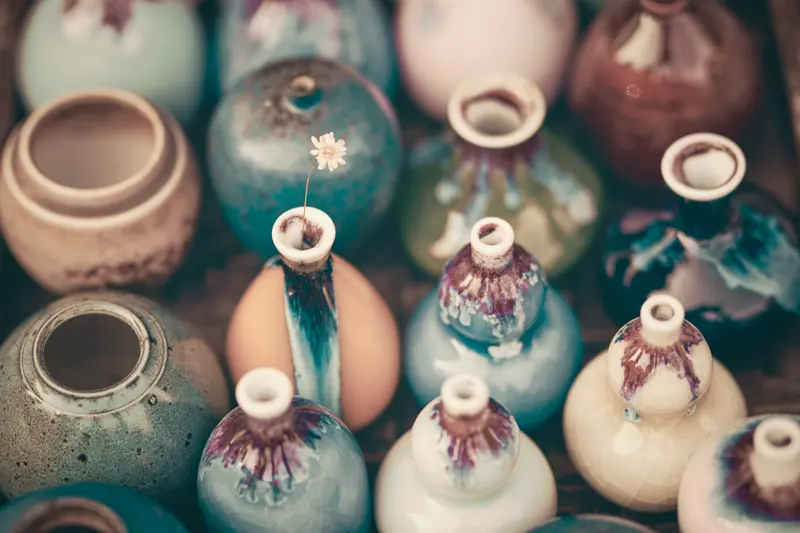
It also keeps the library honest. Online galleries are full of beautiful glaze combinations, but many don’t say what clay, how thick, or what firing schedule produced them, so the same pair can look completely different in your kiln. By sticking to what AMACO, Mayco, Speedball and Mason publish, every entry can be traced back to its source, and if a maker renames or drops a product, we can check it against their own list.
The trade-off is that the library is smaller than a crowd-sourced gallery. That’s deliberate. Use it to find a tested starting point, then make your own test tiles and keep notes on what your kiln does.
Reading a glaze combination chart
A combination is written top over base, so “PC-20 Blue Rutile over PC-12 Blue Midnight” means PC-12 goes on first and PC-20 goes on top. The order matters a great deal. Swap the two and you’ll usually get a different result, because the top glaze melts into and flows over the one underneath.
The number of coats matters almost as much. AMACO’s flyers specify two coats of base and two of top for most Potter’s Choice bases, one thick coat of PC-12 with three on top, and three and three for the celadon bases. Mayco’s combinations use two coats of each. Thinner or thicker application changes how much the glazes mix and how far they run.
The cone and the clay complete the picture. AMACO tested its layering on its own buff and white stoneware clays at cone 5 to 6, while Mayco publishes stoneware pairs at cone 6 and 10 and a low-fire set at cone 06. If you fire hotter, expect more movement. If your clay is darker or speckled, expect the glaze to look different over it. The pyrometric cone chart helps you check those firing ranges.
Underglazes and stains: the other two charts
Speedball underglazes and Mason stains aren’t combinations, but they fill out the library because they’re how many potters add colour. Underglazes are coloured slips you paint on greenware or bisque, usually covered with a clear glaze. Mason stains are concentrated, pre-fired colourants that potters mix into their own glazes, slips and clay bodies.
The Speedball chart lists 48 colour names, and the Mason chart all 96 stains in Mason Color’s reference guide, with Mason’s own notes on zinc, calcium and firing limits. Those notes matter: some Mason pinks need a glaze with no zinc and plenty of calcium, and the wrong base glaze can turn them brown. Our guide to Mason stains goes deeper into how they work.
Testing before you glaze a whole piece
Always fire a test tile before trusting any chart. Use the clay you’ll use for the finished work, apply the same number of coats, fire in your own kiln to your usual schedule, and label the back of the tile with the glazes, coats and cone.
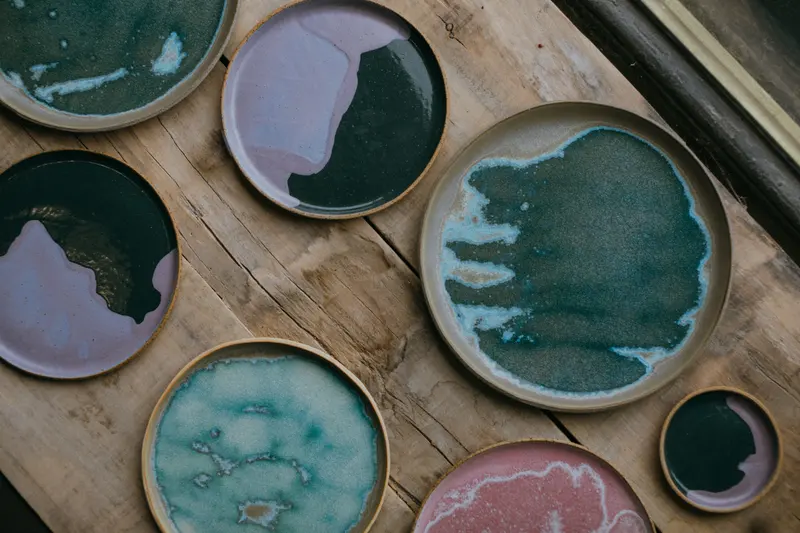
Vertical test tiles are worth the small effort to make, because many layered glazes run, and a flat tile won’t show it. A tile with a little texture also shows how the glaze breaks over edges, which is often the most interesting part of a combination. Keep the finished tiles together on a board or a string so you can compare them at a glance.
Firing matters as much as the glaze. Our kiln firing service in Mordialloc fires mid-fire glazes at cone 6 in electric kilns, the range most of these combinations were tested for, so test tiles can go in with your work.
Common mistakes with glaze charts
The most common mistake is expecting your result to match the photo exactly. Clay colour, coat thickness, kiln atmosphere and cooling speed all shift the result, and printed or on-screen colours vary too. The second is ignoring the coat count, which is often the difference between a soft blend and a glaze that runs onto the shelf.
The third is mixing ranges. A cone 06 combination won’t mature properly in a cone 6 firing without running, and a stoneware glaze fired to cone 06 will be dry and underfired. Check the cone on every entry before you plan a load. And with layered glazes that move, use a waste slab or cookie under the piece until you know how far it runs.
Finally, keep your own records. Note the glazes, coats, clay, cone and kiln position on the back of every tile and in a notebook or phone. After a few firings, your own tiles become a more useful glaze chart than any printed one, because they show exactly what your kiln does with your clay.
Frequently asked questions
Are the swatch colours accurate?
No, and they’re not meant to be. AMACO swatches are our approximate reading of AMACO’s own photos, and the others are colours suggested by the product names. Use them to jog your memory, then look at the maker’s photo and fire your own test tile.
Why aren’t there more Mayco combinations?
We only include what Mayco currently publishes on its glaze combinations page, which showed 35 combinations when we checked. Mayco’s older combination sheets aren’t included because we couldn’t confirm they’re still current.
Can I trust a combination at a different cone?
Not without testing. The maker tested each combination at the cone listed, and firing hotter or cooler changes how the glazes melt and mix. Fire a test tile at your own temperature first.
Are these glazes food safe?
The chart doesn’t say whether a combination is food safe. Check each glaze’s label and the maker’s guidance, and remember that layering, application and firing can affect the result. Our article on food safe glaze explains what to look for.
Can Le Studio Art Space fire my test tiles?
Yes. The Le Studio Art Space firing service in Mordialloc fires mid-fire glazes at cone 6, which suits the AMACO and Mayco stoneware combinations here, plus bisque at cone 06 and earthenware at cone 03. Label each tile clearly with the glazes and coats.
Sources and method
AMACO combinations are transcribed from AMACO’s Potter’s Choice layering flyers for bases PC-12, PC-20, PC-29 and PC-59 and its Potter’s Choice Celadon flyers for C-1, C-10 and C-11. Mayco combinations are from Mayco’s glaze combinations page. Mason stains are from Mason Color’s online reference guide. Speedball underglaze colours come from M&N Clay’s Speedball list and Stone Leaf Pottery’s item numbers, with firing guidance from Speedball. All were checked on 27 October 2026.
One AMACO flyer tile whose label didn’t match its base was left out. Swatch colours are our own approximations and are not taken from the makers’ images. Product names and codes are the makers’ trademarks, used to identify their products.
Figures last checked .
Use this tool on your site
You’re welcome to embed the glaze brand chart library on your own site, studio page or class notes. Copy the code below. Please keep the credit link, it’s how other potters find the full version.
Cite this tool
Le Studio Art Space (2026). Glaze Brand Chart Library. The Potter’s Bench. https://lestudioartspace.com/potters-bench/glaze-brand-chart-library/ (accessed 27 October 2026).
This glaze brand chart library from Le Studio Art Space is general educational content. Charts list only combinations and products the makers publish, and swatch colours are approximate: fired results vary with clay, application thickness, kiln and schedule, so always fire test tiles first. Always follow the clay and glaze manufacturer’s data, and for glaze and food safety decisions follow the manufacturer’s guidance and local regulations.