Kiln capacity is usually quoted in litres or cubic feet of internal volume, but what matters for a firing is how many pieces fit on the shelves. A 140 litre front-loader with 40 cm shelves holds about 27 mugs in a glaze load, three layers of nine. This calculator works it out for your own kiln, shelves and pieces.
Kiln Capacity Calculator: How Many Pieces Fit in a Load?
Kiln capacity on a spec sheet is a single number in litres, and it rarely tells you what you actually want to know: how many mugs, bowls or plates will fit in one firing. This calculator starts from your kiln’s inside dimensions and your shelves, stacks layers the way a potter would load them, and counts the pieces on each shelf.
It also divides the electricity cost of a firing by the pieces in the load, so you can see what each one costs to fire.
Pieces per glaze load
About 27 mugs
3 layers of 9, on a simple grid. Careful packing can fit a few more.
- Kiln volume
- 134 litresinside dimensions
- Usable space
- 65 litresabove the shelves
- Electricity per piece
- $0.17at $4.46 a firing
Bisque loads can be packed tighter, because unglazed pieces may touch and small pieces can sit inside larger ones, so a bisque firing usually holds more than this. Work out what each firing costs with our kiln electricity cost calculator.
This tool at a glance
- What it does
- Works out how much a kiln holds: its volume, how many shelf layers fit and how many pieces go in one glaze load.
- Inputs
- Kiln shape and inside dimensions, shelf size and thickness, the pieces you’re firing (width and post height), the gap between pieces and the electricity cost per firing.
- Method
- Volume is width times depth times height, or pi r squared times height for a round kiln. Layers are the inside height, less a 2.5 cm floor post and 2.5 cm under the lid, divided by shelf thickness plus post height. Pieces per shelf are counted on a square grid with your gap.
- Outputs
- Pieces per glaze load, layers and pieces per shelf, kiln volume, usable space above the shelves and electricity cost per piece.
Kiln capacity: pieces per glaze load in example kilns
Approximate pieces per glaze load on a simple grid with a 1.3 cm gap, 2.5 cm floor posts, 2.5 cm under the lid and 2 cm shelves. Mugs are taken as 12 cm wide with the handle and 11 cm tall, tumblers 8 by 11 cm, cereal bowls 15 by 8 cm and dinner plates 26 by 4 cm.
| Kiln | Mugs | Tumblers | Cereal bowls | Dinner plates | |
|---|---|---|---|---|---|
| Round top-loader, 45 cm by 46 cm deep (illustrative) | 10 | 24 | 12 | 4 | |
| Woodrow SK140, 140 litres | 27 | 48 | 16 | 7 | |
| Woodrow EDU420, 420 litres | 64 | 144 | 45 | 32 |
How the kiln capacity calculator works
The calculator works in three steps. First, it finds the kiln’s volume from its inside dimensions: width times depth times height for a square front-loader, or pi times the radius squared times the height for a round top-loader. That’s the figure makers quote, and it’s useful for comparing kilns.
Second, it works out how many shelf layers fit. It starts with a 2.5 cm post on the floor, as Skutt recommends, leaves 2.5 cm under the lid or roof, and divides the rest of the height by the shelf thickness plus the post height. Each layer is a shelf with your pieces standing on it.
Third, it counts the pieces on each shelf, laying them out on a square grid with the gap you choose. For round shelves it tries two grid positions and keeps the better one. A skilled loader mixing sizes and staggering rows can usually fit a few more, so treat the answer as a reliable minimum rather than a maximum.
Every size can be entered in centimetres or inches, and the volume switches between litres and cubic feet to match. The presets for mugs, tumblers, cereal bowls and dinner plates fill in a typical width and post height, which you can then change to suit your own work. Measure the widest point of each piece, including handles, because that is what decides how many fit side by side.
Kiln volume vs usable kiln capacity
A kiln’s quoted volume includes space you can’t fill. The shelves themselves take up height, there’s a gap below the first shelf and above the top one, and shelves have to sit clear of the walls and elements. The calculator shows both figures: the full inside volume and the usable space above the shelves.
In the default example, a front-loader measuring 44 by 47 by 65 cm inside has about 134 litres of volume, close to the 140 litres its maker quotes. But only about 65 litres sits above the three 40 cm shelves, which is less than half. That gap between volume and usable space is why two kilns with the same litre rating can hold quite different loads.
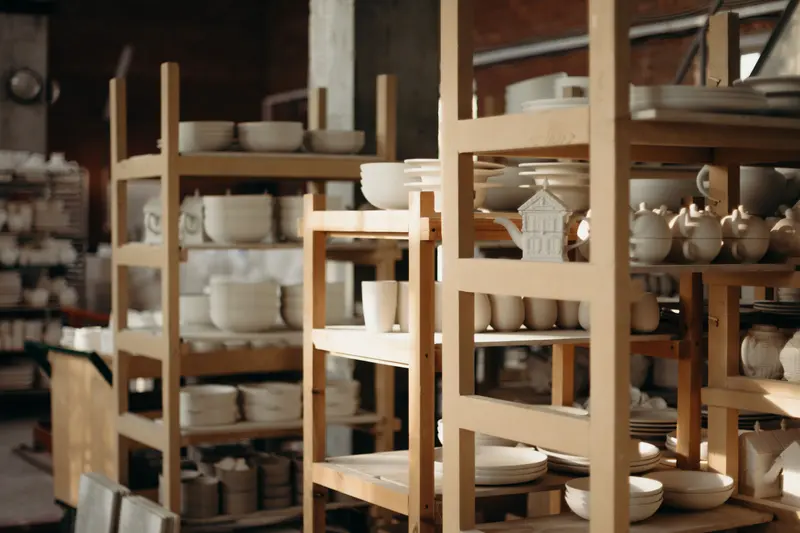
Shape matters too. A round top-loader wastes the corners of its square posts and shelves less than you’d think, but round shelves hold fewer wide pieces like plates, because the grid loses space at the curved edge.
Shelves, posts and loading for an even firing
The post height you choose sets how many layers fit. Short posts pack in more shelves, but Skutt warns that the tighter the shelf layers, the harder it is for radiant heat from the elements to reach the work evenly, and that tightly stacked shelves at the top and bottom of a kiln are more likely to underfire.
Skutt’s own loading pattern starts with a one-inch post on the floor, then uses taller posts of about five to six inches between the lower layers so each layer sees the elements. It also recommends about an inch or more between the edge of a shelf and the kiln wall, and keeping the top shelf well below the lid. The calculator warns you when your shelves leave less than 2 cm a side.
A good rule of thumb is a post about 2.5 cm taller than the tallest piece on that shelf, which is how the presets work. If you’re firing mixed heights, put the tall pieces together on one layer and the short ones on another.
Glaze loads vs bisque loads
The calculator assumes a glaze load, where glazed pieces must not touch each other or they’ll fuse together. A gap of about 1.3 cm is typical, though some potters work tighter. Glazes can run, so keep glaze off the foot and use kiln wash on the shelves.
Bisque loads are different. Unglazed pieces can touch, small bowls can sit inside larger ones and some pieces can be stacked rim to rim, so a bisque firing usually holds noticeably more than a glaze firing of the same work. To estimate a bisque load, set the gap to zero, and remember that nesting can add more again.
Whatever you fire, don’t pack the kiln so densely that heat can’t move. A very tightly packed load heats more slowly and less evenly, and the pieces in the middle may come out underfired.
Cost per piece and fuller kiln loads
Once you know how many pieces fit, the cost per piece is simple: the cost of a firing divided by the number of pieces. A firing costs about the same whether the kiln is full or half empty, so full loads are far cheaper per piece.

Our kiln electricity cost calculator works out what a firing costs for your kiln and tariff. The $4.46 default here is that calculator’s example, a 3.4 kW kiln running for eight hours. If you sell your work, add the per-piece firing cost to the materials in our pottery pricing calculator.
If you don’t have enough work to fill a kiln, a shared firing can be cheaper. A kiln firing service fires your pieces alongside other people’s, so you pay for your share rather than a whole firing.
Choosing a kiln size
When you’re buying a kiln, think about how long it takes you to make a full load. A large kiln that takes two months to fill means waiting, while a small one you can fill every week keeps work moving. Many potters find a kiln they can fill within a week or two is the right size.
Check the shelf size as well as the volume, because the widest piece you can fire is set by the shelf, not the kiln. And remember that larger kilns usually need a dedicated electrical circuit, which adds to the cost of installing one.
Think about the shape of your work, too. If you make mostly plates and platters, shelf width matters more than height, and a front-loader with wide square shelves may suit you better than a deep round top-loader. If you make tall vases, look for height and taller posts, and accept fewer layers per firing.
Frequently asked questions
How is kiln capacity measured?
Makers usually quote internal volume in litres or cubic feet. That’s useful for comparing kilns, but the number of pieces you can fire depends on the shelf size, post heights and the shape of your work.
How many mugs fit in a kiln?
It depends on the kiln and the mugs. A 140 litre front-loader with 40 cm shelves holds about 27 mugs in a glaze load, while a 45 cm round top-loader holds about 10 on two layers. Use the calculator with your own sizes.
How much space should be between pieces in a glaze firing?
Enough that they can’t touch, because glaze fuses pieces together. Around 1.3 cm is a common working gap, and more for runny glazes. In a bisque firing, pieces can touch.
Why does my kiln hold less than its volume suggests?
Shelves, posts, the floor gap and the space under the lid all take up room, and shelves must sit clear of the walls. Often less than half the quoted volume is usable space above the shelves.
Is it cheaper to fire a full kiln?
Yes. A firing uses about the same electricity whether the kiln is full or not, so a full load costs much less per piece. Shared firing services are a good option when you have only a few pieces.
Can Le Studio Art Space fire my work?
Yes. Le Studio Art Space in Mordialloc runs a firing service for bisque, low-fire earthenware and mid-fire cone 6 work in its electric kilns. See the firing service page for details.
Sources and method
Loading guidance, including the one-inch floor post, taller posts between layers, about an inch between shelf and wall, and the risk of underfiring tight layers, is from Skutt’s “Best Practices for Loading and Firing Your Skutt Kiln”. The Woodrow SK140 and EDU420 inside and shelf dimensions are as published by UNSW Making. The round top-loader in the table is an illustrative size, not a specific model. The $4.46 firing cost is the worked example from our kiln electricity cost calculator.
Piece sizes, the 1.3 cm gap, the 2.5 cm clearance under the lid and the square-grid packing are our own simplifications. Real loads vary with the work, so treat the result as a guide.
Figures last checked .
Use this tool on your site
You’re welcome to embed the kiln capacity calculator on your own site, studio page or class notes. Copy the code below. Please keep the credit link, it’s how other potters find the full version.
Cite this tool
Le Studio Art Space (2026). Kiln Capacity Calculator. The Potter’s Bench. https://lestudioartspace.com/potters-bench/kiln-capacity-calculator/ (accessed 28 October 2026).
This kiln capacity calculator from Le Studio Art Space is general educational content. Results are estimates: firing results vary from kiln to kiln and with your clay, glaze, cone placement and firing schedule. Always follow the clay and glaze manufacturer’s data, and for glaze and food safety decisions follow the manufacturer’s guidance and local regulations.