The main types of clay for pottery are earthenware, stoneware, porcelain and bone china, and they differ mostly in how hot they’re fired. Earthenware is fired low (around cone 06 to 04) and stays porous, stoneware and porcelain are fired to cone 6 or cone 10 and become dense, and bone china is a specialist slip-casting body. For most beginners, a grogged mid-fire stoneware is the easiest place to start.
Types of Clay for Pottery: Clay Body Selector
Choosing between the types of clay for pottery is less about which clay is best and more about which clay suits your kiln, your project and your hands. This selector asks the questions a studio tech would ask you at the counter, rules out anything your kiln can’t fire properly, and ranks the rest with plain reasons.
It won’t name a brand for you, because every supplier mixes its bodies a little differently. What it gives you is the type of clay, the texture and the cone to look for on the bag.
Best match for you
Stoneware
Look for a grogged stoneware rated cone 5 to 6 (mid-fire, about 1222 °C).
Every clay type, ranked
Stoneware 3 points
dense and strong, the usual choice for mugs and bowls.
Porcelain 2 points
dense and hard-wearing, but less forgiving to make.
Bone china 0 points
strong for its thinness, but cast rather than thrown.
Earthenware Ruled out
needs a low-fire firing, which your firing range or kiln doesn’t reach; porous unless well glazed, and chips more easily in daily use.
Stoneware: everyday tableware, learning the wheel, hand building and sculpture. Typical fired absorption about 0 to 3% at its rated cone. Clay bodies differ between suppliers, so check the maker’s data sheet for the cone, shrinkage and absorption before you buy.
At Le Studio Art Space in Mordialloc, the firing service runs electric kilns for bisque at cone 06, earthenware at cone 03 and mid-fire glazes at cone 6, so earthenware and mid-fire stoneware or porcelain suit it. For high-fire clays or bone china, ask the studio before you buy.
This tool at a glance
- What it does
- Ranks the four main types of clay for pottery for your firing, project and budget, and tells you what to look for when you buy.
- Inputs
- Kiln access, the firing range you want (low, mid, high or not sure), main use, fired colour, smooth or grogged texture, and budget.
- Method
- A clay that can’t mature in a firing your kiln reaches is ruled out. The rest score points for each answer from the table on this page (from minus 3 to plus 3), and the highest total wins. Ties go to the more forgiving clay.
- Outputs
- The best-matching clay with a smooth or grogged suggestion and the cone to buy at, all four clays ranked with reasons, typical absorption and a note on Le Studio’s kilns.
Types of clay for pottery compared
The four main clay bodies side by side. Temperatures for the first three are Orton cone values at 60 °C an hour, and bone china shows the range its makers publish; absorption is for clay fired to its rated cone. Prices are typical 10 kg bags from Australian suppliers in October 2026, and every supplier’s body differs, so treat the rows as a guide and check the data sheet for the clay you buy.
| Clay | Firing range | Temperature | Fired absorption | Strength | Colour | Working it | Typical cost |
|---|---|---|---|---|---|---|---|
| Earthenware | cone 06 to 04 glaze firing | 998 °C (1828 °F) to 1063 °C (1945 °F) | about 10 to 15% | Lowest; chips more easily | Mostly red terracotta, also white and buff | Soft and forgiving | About $33 to $40 a 10 kg bag in Australia |
| Stoneware | cone 5 to 6 (mid) or 9 to 10 (high) | 1222 °C (2232 °F) to 1285 °C (2345 °F) | about 0 to 3% at its rated cone | Strong and durable | Buff, grey, brown, red or off-white | Plastic and forgiving, especially with grog | About $22 to $38 a 10 kg bag in Australia |
| Porcelain | cone 6 or cone 10 bodies | 1222 °C (2232 °F) to 1285 °C (2345 °F) | close to 0% at its rated cone | Very hard and dense, but warps more | White, translucent when thin | Less plastic, slumps and cracks more easily | About $44 a 10 kg bag in Australia |
| Bone china | specialist schedules, often a high bisque around 1220 to 1300 C | 1220 °C (2228 °F) to 1300 °C (2372 °F) | close to 0% | Strong for its thinness | The whitest and most translucent | Very short; almost always slip cast in moulds | A specialty import; casting slip is priced by the litre |
How the clay body selector works
The selector first checks firing, then scores everything else. A clay is ruled out if it can’t mature in the firing range you chose, or in the highest range your kiln access reaches, because a body fired too low stays weak and porous and one fired too hot can slump, bloat or melt onto the shelf.
Earthenware needs a low firing. Stoneware, porcelain and bone china need mid or high. If you pick a firing service, the tool assumes low and mid-fire are available, which is what most community studios offer. If you choose a range your kiln can’t reach, it says so and ranks for your kiln’s top range instead.
Every clay that’s still in then collects points from your other four answers, using the table below. The scores run from minus 3 (a poor match) to plus 3 (a strong one), and the clay with the highest total comes first. When two clays tie, the more forgiving one goes first, in the order earthenware, stoneware, porcelain, bone china.
| Answer | Earthenware | Stoneware | Porcelain | Bone china |
|---|---|---|---|---|
| Functional ware | 1 | 3 | 2 | 1 |
| Decorative pieces | 3 | 2 | 2 | 2 |
| Sculpture | 2 | 3 | -2 | -3 |
| Learning the wheel | 2 | 3 | 1 | -3 |
| Hand building | 3 | 3 | 1 | -3 |
| White | 1 | 1 | 2 | 2 |
| Buff or grey | 0 | 2 | 0 | 0 |
| Red or brown | 2 | 1 | 0 | 0 |
| Smooth | 1 | 0 | 1 | 1 |
| Grogged | 1 | 2 | -2 | -3 |
| Tight budget | 1 | 1 | -1 | -2 |
| Moderate budget | 0 | 0 | 0 | -1 |
“No preference”, “Either” and a flexible budget add nothing. The points are our studio judgement, not a published standard, so read the reasons as well as the totals.
The main types of clay for pottery, explained
The four types of clay for pottery are separated by firing temperature and by how dense the fired clay becomes. The lower a clay is fired, the more open and porous it stays; the higher it goes, the more it fuses into a dense, glassy body.
Earthenware is the low-fire family. Digitalfire defines it as clay fired at cone 010 to 04, and most potters glaze-fire it around cone 06 to 04, roughly 1000 to 1060 °C. It’s usually red terracotta, though white and buff earthenwares exist. It stays porous after firing, often 10% or more, so it relies on glaze to hold water and it chips more easily than higher-fired ware. In return it’s soft to work and takes bright, saturated glazes.
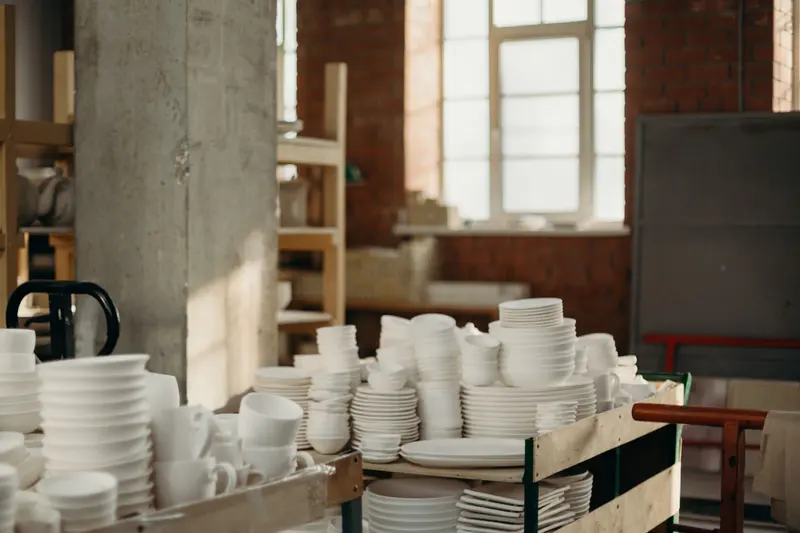
Stoneware is the workhorse. Fired to cone 5 or 6 (about 1222 °C) or cone 9 to 10 (about 1285 °C), it becomes dense enough for tough, everyday functional ware, with porosity of only a few percent at its rated cone. It fires buff, grey, brown or off-white and is usually the most forgiving to throw and hand build, especially with grog in it.
Porcelain is the refined white body. It’s fired to cone 6 or cone 10, gets very close to zero absorption and can be translucent where it’s thin. Digitalfire notes it’s less plastic than stoneware and earthenware, more brittle at leather hard and more prone to warping, because it’s fired close to its melting point. Bone china is a cousin made with bone ash for extreme whiteness and translucency. It’s very short, almost always slip cast in moulds, and fired on specialist schedules.
Which is the best clay for beginners?
For most beginners, the best clay is a grogged mid-fire stoneware. Grog (fired clay ground into sand-sized particles) gives the clay tooth, so walls stand up on the wheel, slabs crack less and pieces dry more evenly.
That’s why teachers in most community studios start new students on a buff or speckled stoneware rated cone 5 to 6. It’s plastic enough to centre, tough enough to survive learning, and dense enough after firing to make a mug you can actually use. A smooth white stoneware is lovely for bright glazes, but without grog it’s less forgiving while it dries.
Earthenware is a fair choice if your kiln only reaches low-fire temperatures, or if you love terracotta and bright colour. Porcelain is worth trying once you can centre reliably and pull even walls, because it rewards control and punishes rushing. Bone china is a project for later, and usually one for a slip-casting course rather than the wheel.
Stoneware vs porcelain vs earthenware for functional ware
For mugs, bowls and plates used every day, stoneware or porcelain fired to its full rated cone is the safer choice, because both become dense and strong. Earthenware can be functional too, but it needs a well-fitted glaze covering every surface that touches food or drink.
The difference comes down to absorption. A well-fired stoneware or porcelain soaks up almost no water, so even an unglazed foot doesn’t wick moisture. A porous earthenware body under a crazed glaze can take on water, which weakens the piece over time and leaves cracks where food can sit. If you’re making tableware in earthenware, choose a glaze its maker rates for food contact and test it on your clay.

Strength follows the same pattern. Stoneware handles the dishwasher and knocks of daily life well. Porcelain is very hard but thinner pieces can chip at the rim, and its tendency to warp means plates and wide bowls need care in the kiln. Our pottery fault finder covers warping, crazing and the other faults that show up most in functional ware.
Match your clay to the kiln that will fire it
Buy clay rated for the cone your kiln or firing service actually fires to, because a clay is designed to mature at one temperature range. This is the step the generic guides skip, and it’s the one that ruins the most work.
Fire a cone 10 stoneware at cone 6 and it stays porous and weak, with glazes that may craze or leach. Fire an earthenware at cone 6 and it can bloat, slump or melt onto the kiln shelf, which can damage someone else’s work and the kiln. Many community studios, including our kiln firing service in Mordialloc, run separate bisque, low-fire and mid-fire loads, so tell the studio which clay you used and check that they fire to its cone.
It also pays to stick to one clay body while you learn. Mixing bodies in one piece can lead to cracks where they join, because different clays shrink by different amounts. Our clay shrinkage calculator shows how much your clay will shrink once it’s fired, and the pyrometric cone chart gives the temperature for every cone.
Common mistakes when choosing clay
The most common mistake is choosing clay by colour alone, then finding out it needs a firing you don’t have. Check the cone first, the colour second.
The second is buying porcelain for a first wheel course. It throws, but it collapses and cracks more readily, and the frustration can put people off before they’ve learned to centre. A grogged stoneware lets you build skill first. The third is assuming all clay of one type behaves the same. A red stoneware from one supplier can shrink and absorb very differently from another, so read the data sheet and run a test tile before committing to a whole set.
Finally, don’t overlook what the studio already uses. Studios choose house clays that fire well in their kilns, and the teachers know how those clays behave, which is worth a lot when you’re learning.
Frequently asked questions
Do I really need to care about clay type as a beginner?
A little, yes, but you don’t need to become an expert. Use what your studio or teacher recommends, check that it matches the cone your kiln fires to, and you’ll avoid the two problems that cause most early disappointments: weak underfired pots and melted overfired ones.
Isn’t porcelain just better than stoneware?
Not better, just different. Porcelain is whiter and can be translucent, but it’s less plastic, warps more and is harder to learn on. Stoneware is tougher to make mistakes with and makes durable everyday ware, which is why most potters use it for most things.
Can I fire earthenware and stoneware in the same kiln load?
You can bisque them together, since bisque usually runs around cone 06. Glaze firings are different: earthenware is glaze-fired low and stoneware much hotter, so they normally go in separate loads, and earthenware fired to stoneware temperature can melt.
Is terracotta safe for plates and mugs?
It can be, if it’s covered with a glaze its maker rates for food use and the glaze fits the clay without crazing. Because terracotta stays porous, many potters keep it for planters and serving pieces and use stoneware for daily mugs.
Why won’t the selector recommend a brand?
Because suppliers mix their bodies differently and stock changes, a brand that suits one kiln may not suit another. The tool tells you the type, texture and cone to look for, and the supplier’s data sheet confirms the details.
Which clays can Le Studio Art Space fire?
Le Studio Art Space’s firing service in Mordialloc fires electric kilns for bisque, low-fire earthenware and mid-fire cone 6 work. Ask the studio before you buy clay for work you’d like fired there, so the body matches the firing.
Sources and method
Clay type definitions, firing ranges and porosity figures are from Digitalfire’s reference library (earthenware, stoneware, porcelain and bone china entries), checked against ThePotteryWheel’s and Seattle Pottery Supply’s guides to clay types. Cone temperatures are Orton large cone values at 60 °C an hour, as on our pyrometric cone chart. The stoneware absorption example (14.8% at bisque, under 2% at cone 6, 0% at cone 8) is from the Walker No 10 stoneware data published by Pottery Supplies Online. Bone china composition and firing are from Digitalfire, The Potteries and Potterycrafts’ published slip data. Australian clay prices are 10 kg bags listed by Walker stockists, Pottery Supplies Online and Northcote Pottery Supplies in October 2026.
The point scores and the beginner recommendation are our own studio judgement, informed by Seattle Pottery Supply’s and community studios’ published beginner advice. They are not a standard, and supplier bodies vary.
Figures last checked .
Use this tool on your site
You’re welcome to embed the clay body selector on your own site, studio page or class notes. Copy the code below. Please keep the credit link, it’s how other potters find the full version.
Cite this tool
Le Studio Art Space (2026). Clay Body Selector. The Potter’s Bench. https://lestudioartspace.com/potters-bench/clay-body-selector/ (accessed 28 October 2026).
This clay body selector from Le Studio Art Space is general educational content. Results are estimates: firing results vary from kiln to kiln and with your clay, glaze, cone placement and firing schedule. Always follow the clay and glaze manufacturer’s data, and for glaze and food safety decisions follow the manufacturer’s guidance and local regulations.