The slip casting ratio of water to dry clay is set by the slip’s specific gravity. For a typical casting slip at 1.75, with dry material at 2.6, one litre holds about 1,220 g of dry clay and 530 ml of water, which is roughly 30% water by weight. The formula is dry = V x g x (s – 1) / (g – 1). Casting slips also need deflocculant to pour well at that thickness.
Slip Casting Ratio Calculator: Water and Dry Clay for Slip
Getting the slip casting ratio right is the difference between a slip that casts evenly and one that’s too thin, too slow or full of shrinkage problems. This calculator works out exactly how much dry material and water you need for the specific gravity you want, and shows the working so you can check it.
It can also adjust an existing slip: tell it what your slip measures now and what you want, and it says how much water or dry material to add.
For 5 litres at SG 1.75
6.09 kg dry material
plus 2.66 litres of water
- Water by weight
- 30.4%
- Solids by weight
- 69.6%
- Dry material per litre
- 1.22 kg
The working
Dry = V × g × (s − 1) ÷ (g − 1) = 5 × 2.6 × 0.75 ÷ 1.6 = 6.094 kg
Water = s × V − dry = 1.75 × 5 − 6.094 = 2.656 kg, which is 2.656 litres
V is the slip volume in litres, s the slip’s specific gravity and g the dry material’s. Both lines come from balancing mass and volume: this is Brongniart’s formula.
Specific gravity sets how much water is in the slip, not how well it pours. A casting slip at 1.75 needs deflocculant to flow, so follow your recipe or supplier for the amount and add it in small steps.
This tool at a glance
- What it does
- Works out the water and dry material in a casting slip of a chosen specific gravity, or how to adjust a slip to it.
- Inputs
- Target specific gravity, the dry material’s specific gravity (2.6 for most clays), the volume and, to adjust a slip, its current specific gravity.
- Method
- Mass and volume balance: dry plus water equals SG times volume, and dry divided by its SG plus water equals the volume. Solving gives dry = V x g x (s – 1) / (g – 1), which is Brongniart’s formula.
- Outputs
- Dry material and water to mix, water and solids by weight and per litre, or the water or dry material to add, with the working shown.
Slip casting ratio: dry material and water per litre
What one litre of slip contains at each specific gravity, for dry material with a specific gravity of 2.6, the usual figure for clay bodies. Casting slips sit at the bottom of the table; thinner slips are for decorating and dipping.
| Slip SG | Dry material | Water | Water by weight | |
|---|---|---|---|---|
| 1.3 | 488 g | 813 ml | 62.5% | |
| 1.5 | 813 g | 688 ml | 45.8% | |
| 1.6 | 975 g | 625 ml | 39.1% | |
| 1.7 | 1,137 g | 563 ml | 33.1% | |
| 1.75 | 1,219 g | 531 ml | 30.4% | |
| 1.8 | 1,300 g | 500 ml | 27.8% | |
| 1.85 | 1,381 g | 469 ml | 25.3% |
How the slip casting ratio calculator works
Specific gravity compares a slip‘s weight with the weight of the same volume of water. Water has a specific gravity of 1, so a litre of slip at 1.75 weighs 1.75 kg. The calculator uses two facts about that litre: its weight is the dry material plus the water, and its volume is the volume of the dry material plus the volume of the water.
The dry material’s volume is its weight divided by its own specific gravity, usually about 2.6 for clay. Solving the two equations together gives the dry material as V times g times (s minus 1), divided by (g minus 1), where V is the slip volume, s its specific gravity and g the dry material’s. The water is the rest of the weight. The result shows every step with your numbers.
This is Brongniart’s formula, first published by Alexandre Brongniart in 1854 and still used in ceramics workshops and factories. In its usual form, the dry weight in a litre is the material’s specific gravity times (the litre’s weight in grams minus 1,000), divided by (its specific gravity minus 1).
What specific gravity should a casting slip be?
Digitalfire notes that hobbyists and potters typically aim for a casting slip around 1.75, while industry needs 1.8 or higher. The higher the specific gravity, the less water the slip carries into the mould, so moulds stay drier, casts form faster and pieces shrink and warp less as they dry.
The catch is flow. Clay and water at 1.75 would normally be a thick paste. Casting slips stay pourable because of deflocculants, such as sodium silicate or a polyacrylate dispersant, which keep the clay particles apart. That’s why specific gravity and flow are measured separately, and why getting one right doesn’t fix the other.
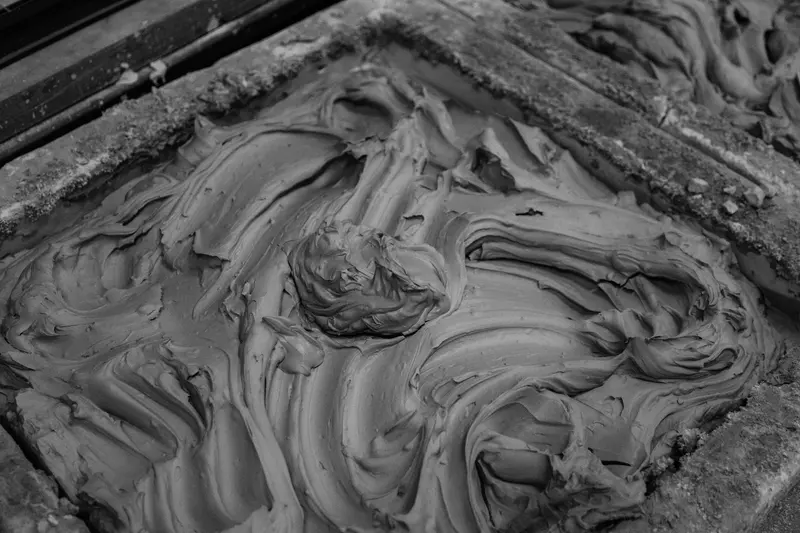
Decorating slips, dipping slips and terra sigillata are made at much lower specific gravities, because they’re meant to coat a surface rather than form a wall. The table above shows how much less dry material those thinner slips contain.
Measuring the specific gravity of your slip
The most accurate way to measure is to weigh a known volume. Put a measuring cylinder or jug on a scale, zero it, pour in slip to a known mark, and divide the grams by the millilitres. Digitalfire recommends a bigger cylinder for accuracy, because a small reading error matters less in 100 ml than in 10 ml.
A hydrometer is quicker but less reliable in thick, deflocculated slips, which can stop it floating freely. Whichever you use, stir the slip well first, because solids settle and the top of a bucket reads thinner than the bottom.
Check the specific gravity of every batch before casting, and record it. A slip that casts beautifully one week and badly the next has often just lost water to evaporation or gained it from a damp mould.
Thinning or thickening a slip
To thin a slip, the calculator keeps its dry material the same and works out how much bigger the volume must be at your target specific gravity. The extra volume is the water to add. To thicken a slip, it keeps the water the same and works out how much dry material that water can carry at the target. The extra is the dry material to add.
Add either in small amounts, mix thoroughly and measure again before adding more. Adding dry material can also upset the balance of deflocculant, so a thickened slip may need a little more to flow properly. Adding water usually does the opposite, and can leave a slip over-deflocculated, which casts poorly.
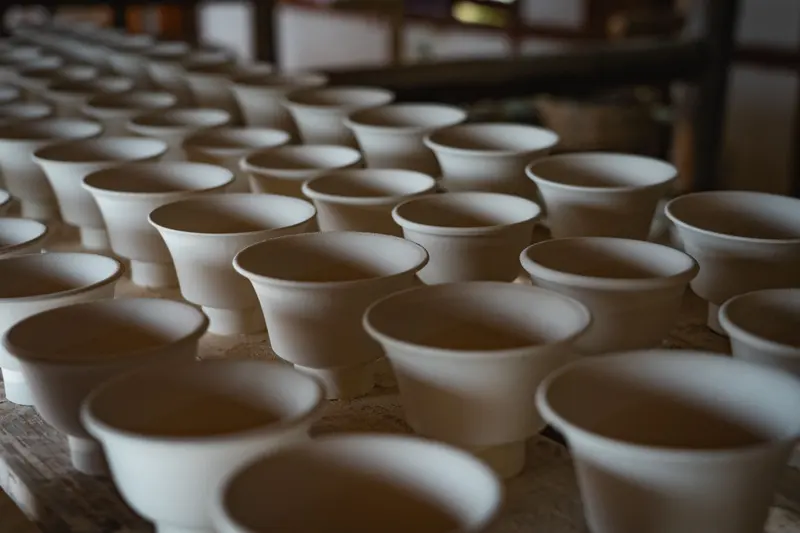
Reclaimed slip from trimmings and failed casts is worth measuring before you reuse it. It has usually dried out a little and may have picked up plaster from the moulds, which can cause casting problems. Sieve it, measure its specific gravity, bring it back to your target with the calculator, and mix it in with fresh slip rather than using it alone.
A worked example of a casting slip
Say you want 10 litres of slip at 1.78 to cast a set of cups, using a clay body with a specific gravity of 2.6. The calculator gives the dry material as 10 times 2.6 times 0.78, divided by 1.6, which is about 12.68 kg. The whole 10 litres weighs 17.8 kg, so the water is the rest, about 5.13 kg, which is 5.13 litres. That’s roughly 29% water by weight, a typical figure for a casting slip.
In practice, you’d start with a little less water than that, add the deflocculant, then add the dry material while mixing, because it’s easier to thin a slip than to thicken it. Measure the specific gravity once everything is mixed, then use the adjust mode to fine-tune it to exactly 1.78.
Choosing the specific gravity of your dry material
Most clays and clay bodies have a specific gravity close to 2.6, which is why it’s the default here and in most published versions of the formula. ClayCalc lists kaolin at about 2.63 and ball clay at about 2.58, and Glazy’s wiki uses about 2.6 for most glazes. Materials with heavy metals, such as tin or lead, run higher.
A small change in this figure makes only a small difference, so 2.6 is fine for most casting slips. If you’re making a slip from a single material with a known value, enter it for a more precise result.
Casting slip, shrinkage and absorption
Slip-cast pieces shrink as they dry and fire, just like thrown ones, and casting slips are often formulated to shrink less. Our clay shrinkage calculator works out how big to make a mould for a fired size. Once fired, a clay absorption test tells you whether the body has matured enough for functional ware.
When your casts are dry, they need firing at the cone the slip is made for. If you don’t have a kiln, a kiln firing service can fire them for you.
Frequently asked questions
What is the water to clay ratio for slip casting?
At a typical specific gravity of 1.75, a casting slip is roughly 30% water and 70% dry material by weight. In a litre, that’s about 1,220 g of dry material and 530 ml of water.
What is Brongniart’s formula?
It gives the dry weight in a slip from its weight per volume and the dry material’s specific gravity: dry weight equals the material’s specific gravity times (litre weight in grams minus 1,000), divided by (its specific gravity minus 1). It was published by Alexandre Brongniart in 1854 and is still the standard way to find solids in a slip or glaze.
Why is my casting slip too thick at the right specific gravity?
Because specific gravity measures water content, not flow. A casting slip needs the right amount of deflocculant to pour at 1.75. Add it carefully in small amounts, following your recipe or supplier.
Can I use this for glaze or decorating slip?
Yes, the same balance works for any mix of insoluble powder and water. Use the dry materials’ specific gravity, usually about 2.6, and the specific gravity you want for that use.
How do I measure specific gravity without a hydrometer?
Weigh a known volume. Zero a measuring cylinder on a scale, add 100 ml of well-stirred slip and divide the grams by 100. A 175 g reading means a specific gravity of 1.75.
Can Le Studio Art Space fire slip-cast work?
Yes. Le Studio Art Space’s firing service in Mordialloc fires bisque, earthenware and mid-fire cone 6 work. Tell the studio which slip you used so it’s fired to the right cone.
Sources and method
The formula follows Brongniart’s Traite des Arts Ceramiques (1854), as set out in “Brongniart’s formula made easy” from The Pottery at Old Toolijooa School and in the Glazy ceramics wiki, and it matches ClayCalc’s Brongniart calculator and Cardew’s version quoted on the Clayart list. Typical casting slip specific gravities and the measuring method are from Digitalfire’s specific gravity and casting slip glossary entries. Dry material specific gravities are from ClayCalc and Glazy.
The thinning and thickening method is the same mass and volume balance, worked out by us and checked in the unit tests on this tool. Deflocculant amounts are left to your recipe or supplier.
Figures last checked .
Use this tool on your site
You’re welcome to embed the slip casting water ratio calculator on your own site, studio page or class notes. Copy the code below. Please keep the credit link, it’s how other potters find the full version.
Cite this tool
Le Studio Art Space (2026). Slip Casting Water Ratio Calculator. The Potter’s Bench. https://lestudioartspace.com/potters-bench/slip-casting-water-ratio-calculator/ (accessed 28 October 2026).
This slip casting water ratio calculator from Le Studio Art Space is general educational content. Results are estimates: firing results vary from kiln to kiln and with your clay, glaze, cone placement and firing schedule. Always follow the clay and glaze manufacturer’s data, and for glaze and food safety decisions follow the manufacturer’s guidance and local regulations.