Good pottery ideas for beginners include pinched tealight holders, spiral coil coasters, stamped slab coasters and a first small bowl on the wheel, because each one teaches a core skill in a single session. Improvers can move on to mugs, lidded boxes and planters, and confident potters to teapots, lidded jars and large coiled forms. This generator picks a project from 64 original ideas to suit your technique, level, time and tools.
Pottery Ideas: Pottery Project Idea Generator
Looking for pottery ideas that actually suit you? Tell the generator which technique you want to use, how experienced you are, how much time you have and what tools are in the drawer, and it suggests a project with brief steps, the clay to weigh out and how it will be fired.
Every idea was written by our studio team for this tool. Press “Show another idea” to step through the other projects that fit, or browse the full library in the table.
Your project idea 1 of 17
Pinched tealight holder
Pinch · Beginner · One session
Steps in brief
- Pinch a ball into a cup a little wider than a tealight, keeping the walls about 6 mm thick.
- Tap the base flat on the bench so it sits level.
- Press a pattern of dots or lines around the outside with a pencil end or your fingernail.
- Clay
- About 250 gClay weight calculator
- Firing
- Bisque firing, then a glaze firing
Learn the hand-building skills for this project in our pottery workshops and classes at Le Studio Art Space in Mordialloc.
This tool at a glance
- What it does
- Suggests a pottery project that suits your technique, skill, time and tools, with steps, clay and firing.
- Inputs
- Technique (any, pinch, coil, slab or wheel), skill level, time available and the tools you have.
- Method
- Ideas are filtered so none is above your level, longer than your time or needs tools you don’t have. The closest fits come first: the same level as you, then the same time. If nothing fits, the tool relaxes the time, then the level, then the tools, and says so.
- Outputs
- A project with its steps in brief, wedged clay weight, firing stages and food-safe or outdoor notes, plus more ideas that fit and a link to classes.
All 64 pottery ideas in the generator
Every project in the generator, written by our studio team, with its technique, level, time, tools and the wedged clay it needs. Clay weights are a starting point for a typical size, so make it bigger or smaller to suit.
| Project | Technique | Level | Time | Tools | Clay | |
|---|---|---|---|---|---|---|
| Pinched tealight holder | Pinch | Beginner | One session | Hands only | 250 g | |
| Ring and trinket dish | Pinch | Beginner | One session | Hands only | 150 g | |
| Pinched espresso cup | Pinch | Beginner | One session | Basic tool kit | 200 g | |
| Mini succulent planter | Pinch | Beginner | One session | Basic tool kit | 350 g | |
| Spoon rest | Pinch | Beginner | One session | Hands only | 300 g | |
| Incense stick holder | Pinch | Beginner | One session | Hands only | 120 g | |
| Thumbprint textured cup | Pinch | Beginner | One session | Hands only | 300 g | |
| Shell soap dish | Pinch | Beginner | One session | Basic tool kit | 250 g | |
| Hollow pinched bird | Pinch | Improver | One session | Basic tool kit | 300 g | |
| Three nesting pinch bowls | Pinch | Improver | A weekend | Basic tool kit | 600 g | |
| Salt cellar with lid | Pinch | Improver | A weekend | Basic tool kit | 300 g | |
| Lidded creature pot | Pinch | Improver | A weekend | Basic tool kit | 450 g | |
| Pinched bud vase | Pinch | Improver | A weekend | Basic tool kit | 400 g | |
| Small pinched jug | Pinch | Improver | A weekend | Basic tool kit | 500 g | |
| Pinch-pot bird whistle | Pinch | Confident | A weekend | Basic tool kit | 200 g | |
| Mini moon jar | Pinch | Confident | Several sessions | Basic tool kit | 900 g | |
| Spiral coaster set | Coil | Beginner | One session | Hands only | 400 g | |
| Coil-and-pinch bowl | Coil | Beginner | One session | Hands only | 350 g | |
| Coiled pencil pot | Coil | Beginner | One session | Basic tool kit | 600 g | |
| Open-coil fruit bowl | Coil | Beginner | A weekend | Basic tool kit | 1.2 kg | |
| Coil-built mug | Coil | Improver | A weekend | Basic tool kit | 500 g | |
| Pierced tealight lantern | Coil | Improver | A weekend | Basic tool kit | 900 g | |
| Lattice coil basket | Coil | Improver | A weekend | Basic tool kit | 800 g | |
| Coiled trinket box | Coil | Improver | A weekend | Basic tool kit | 500 g | |
| Planter with saucer | Coil | Improver | A weekend | Basic tool kit | 1.5 kg | |
| Tall coiled vase | Coil | Improver | Several sessions | Basic tool kit | 2 kg | |
| Utensil crock | Coil | Improver | Several sessions | Basic tool kit | 2.2 kg | |
| Face jug | Coil | Improver | Several sessions | Basic tool kit | 1.5 kg | |
| Garden totem | Coil | Improver | Several sessions | Basic tool kit | 3 kg | |
| Large storage jar | Coil | Confident | Several sessions | Basic tool kit | 4 kg | |
| Shallow bird bath | Coil | Confident | Several sessions | Basic tool kit | 3 kg | |
| Asymmetric sculptural vessel | Coil | Confident | Several sessions | Basic tool kit | 2.5 kg | |
| Stamped tile coasters | Slab | Beginner | One session | Basic tool kit | 600 g | |
| Pressed leaf plate | Slab | Beginner | One session | Basic tool kit | 500 g | |
| Soft-slab trinket tray | Slab | Beginner | One session | Basic tool kit | 400 g | |
| Hanging ornaments | Slab | Beginner | One session | Basic tool kit | 300 g | |
| House number plaque | Slab | Beginner | One session | Basic tool kit | 800 g | |
| Textured slab pencil cup | Slab | Beginner | One session | Basic tool kit | 600 g | |
| Slab-built mug | Slab | Improver | A weekend | Basic tool kit | 500 g | |
| Wall pocket vase | Slab | Improver | A weekend | Basic tool kit | 700 g | |
| Lidded box | Slab | Improver | A weekend | Basic tool kit | 1.2 kg | |
| Rectangular vase | Slab | Improver | A weekend | Basic tool kit | 1.5 kg | |
| Cube planter | Slab | Improver | A weekend | Basic tool kit | 1.8 kg | |
| Hump-mould serving platter | Slab | Improver | A weekend | Basic tool kit | 1.5 kg | |
| Bird house | Slab | Improver | Several sessions | Basic tool kit | 1.5 kg | |
| Tile mural | Slab | Confident | Several sessions | Basic tool kit | 3 kg | |
| Butter dish | Slab | Confident | Several sessions | Basic tool kit | 1.3 kg | |
| Slab teapot | Slab | Confident | Several sessions | Basic tool kit | 2 kg | |
| Practice cylinders | Wheel | Beginner | One session | A wheel | 1 kg | |
| First small bowl | Wheel | Beginner | One session | A wheel | 500 g | |
| Handleless tumbler | Wheel | Beginner | One session | A wheel | 450 g | |
| Wheel-thrown planter | Wheel | Improver | A weekend | A wheel | 1.2 kg | |
| Mug with a pulled handle | Wheel | Improver | A weekend | A wheel | 550 g | |
| Cereal bowl | Wheel | Improver | A weekend | A wheel | 700 g | |
| Wide pasta bowl | Wheel | Improver | A weekend | A wheel | 900 g | |
| Dinner plate | Wheel | Improver | A weekend | A wheel | 1.2 kg | |
| Narrow-neck bud vase | Wheel | Improver | A weekend | A wheel | 600 g | |
| Pouring jug | Wheel | Improver | A weekend | A wheel | 1 kg | |
| Set of nesting bowls | Wheel | Improver | Several sessions | A wheel | 1.8 kg | |
| Small dishes off the hump | Wheel | Confident | A weekend | A wheel | 1.5 kg | |
| Lidded jar | Wheel | Confident | Several sessions | A wheel | 1 kg | |
| Closed bottle form | Wheel | Confident | Several sessions | A wheel | 1.2 kg | |
| Butter bell | Wheel | Confident | Several sessions | A wheel | 700 g | |
| Thrown teapot | Wheel | Confident | Several sessions | A wheel | 1.5 kg |
How the pottery idea generator works
Each of the 64 projects in the library is tagged with a technique, a skill level, the time it takes and the tools it needs. The generator first removes anything above your level, anything longer than the time you have, and anything that needs tools you don’t own. Hands-only projects suit everyone, basic-kit projects need a rolling pin, needle tool, rib and sponge, and wheel projects need a wheel.
The ideas that are left are ranked so the closest fits come first. A project at exactly your level scores highest, and one that matches your time exactly comes next, so a confident potter with a free weekend sees stretching projects before simple warm-ups. If nothing fits at all, the tool relaxes one rule at a time, starting with time, then level, then tools, and tells you what it changed.
The shareable link always opens on the best fit for your answers, so you can send a project to a friend or save it for your next studio session. The steps are a summary rather than a full lesson, written to remind you of the order of work and the step that matters most.
Beginner pottery projects to start with
The best first projects are small, quick and forgiving. A pinched tealight holder, a ring dish or a spiral coaster takes one session, uses a few hundred grams of clay and teaches you how clay responds to pressure, water and time. You’ll learn more from making five small things than from struggling with one big one.
Beginner projects also teach the habits that prevent failures later. Keeping walls even, scoring and slipping every join, and drying slowly under plastic matter just as much for a coaster as for a teapot. Each idea’s steps point out the step that most often goes wrong, such as leaving a vent hole in a hollow bird or turning tiles while they dry so they stay flat.

If you’re unsure where to start, our hand building vs wheel throwing chooser compares the two approaches on cost, learning curve and the kind of work each suits.
Pinch pot ideas
Pinching is the oldest way to shape clay and needs nothing but your hands. You press your thumb into a ball, then pinch and turn, thinning the wall a little at a time. It’s ideal for small, tactile pieces: espresso cups, salt cellars, incense holders and soap dishes.
Two pinch pots joined rim to rim make a hollow form, which opens up birds, creatures, bud vases and even a small moon jar. The key with any closed form is a vent hole, because air and moisture trapped inside expand in the kiln. Pinching also teaches you to feel wall thickness with your fingertips, a skill that carries over to every other technique.
Coil pot ideas
Coil building lets you go big without a wheel. You roll ropes of clay, stack them and blend them together, inside and out. Coils suit pencil pots, planters, vases, utensil crocks and large storage jars, and left visible they become decoration in their own right, as in an open-coil fruit bowl or a lattice basket.
The secret to tall coil pieces is patience. Build in stages and let the lower walls firm up before adding more height, keeping the top edge damp under plastic between sessions. A wooden paddle compresses the walls and evens out the curve, and it helps prevent cracks in large forms as they dry.
Slab pottery ideas
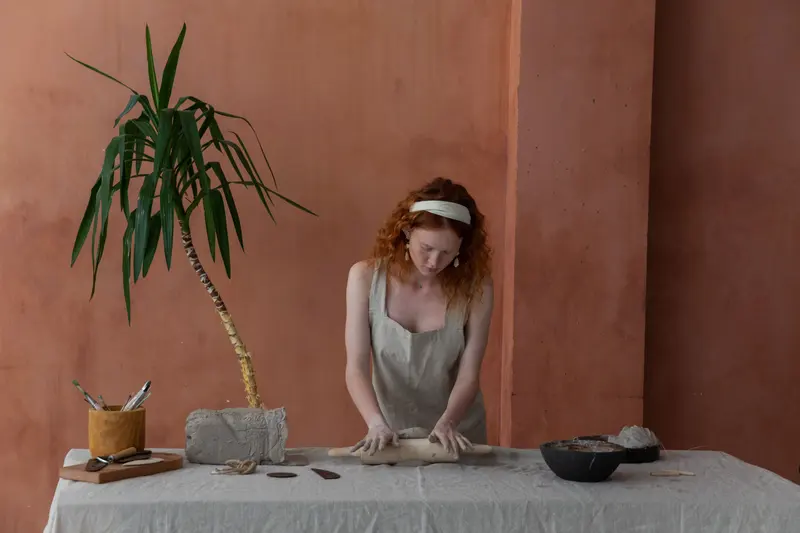
Slab building uses flat sheets of clay rolled to an even thickness. Soft slabs bend, so they suit trays, leaf plates and platters draped over a mould. Leather-hard slabs stand up on their own, so they suit boxes, rectangular vases, butter dishes and even a teapot.
Slabs take texture beautifully. Lace, leaves, stamps and carved rollers all print crisply into a fresh slab, which makes coasters, ornaments and house number plaques a lovely first project. The common mistakes are rolling slabs unevenly and drying them too fast, which both lead to warping, so roll between guide sticks and dry flat pieces between boards.
For boxes and other built forms, bevel the edges you join, score and slip both faces, and run a thin coil along every inside corner. Building a box closed and cutting the lid free afterwards is a neat trick that gives you a lid that fits exactly, because the two parts were made as one.
Wheel-thrown project ideas
On the wheel, the first project is practice, not a finished pot. Throwing a few cylinders, then cutting one in half to check the wall, teaches centring, opening and pulling faster than anything else. From there, a small bowl and a handleless tumbler are realistic first keepers.
Improvers can work towards mugs with pulled handles, cereal and pasta bowls, plates and jugs, each adding one new skill such as trimming a foot ring, pulling a spout or compressing a wide floor. Confident throwers can tackle lidded jars, closed bottle forms, throwing off the hump and the classic test of skill, a teapot that pours cleanly.
Whatever you throw, plan for trimming. Most wheel projects are trimmed at leather hard to refine the foot and remove excess weight, so leave a little extra clay at the base and wrap the piece in plastic if you can’t trim it the next day.
Plan the clay and the firing for your clay projects
Each idea lists a wedged clay weight for a typical size. Use it as a starting point, and our clay weight calculator will refine it for mugs, bowls, plates and vases of the size you want.
Every project is fired at least once, to bisque, and most go through a second glaze firing. Anything that holds food or drink needs a glaze its maker rates as food safe, and anything that lives outdoors should be made from a clay fired to its full rated cone so it survives frost. If you don’t have a kiln, a kiln firing service can fire your finished pieces for you.
Frequently asked questions
What is the easiest pottery project for a complete beginner?
A pinched tealight holder or a ring dish is the easiest place to start. Both need only your hands and a couple of hundred grams of clay, take one session and teach you how clay behaves as you shape it.
Can I make pottery at home without a kiln?
You can shape and dry pottery at home, but it needs firing to become ceramic. Many potters make work at home and take it to a studio or firing service for bisque and glaze firings.
Are these pottery ideas safe for food?
The ideas that hold food or drink are flagged in the tool. To be food safe, they need a glaze its maker rates for food contact, applied to every surface that touches food, and fired to the correct temperature.
How much clay do I need for a beginner project?
Most beginner projects use between 150 g and 600 g of wedged clay. A 10 kg bag is enough for a whole term of small projects, practice and a few mistakes.
Can I use air-dry clay for these projects?
Air-dry clay suits decorative pinch and slab pieces, but it isn’t waterproof or food safe and can’t go in a kiln. For mugs, bowls, planters and anything outdoors, use a kiln-fired clay.
Can I make these projects in a class at Le Studio Art Space?
Yes. Le Studio Art Space in Mordialloc runs hand-building and wheel-throwing workshops and classes where you can make projects like these with a teacher. Check the workshops page for the current program.
Sources and method
All 64 project ideas, steps and clay weights were written by the Le Studio Art Space studio team for this tool, and the weights are for a typical size of each piece. Technique advice on vent holes, drying, scoring and slipping, and compressing walls follows standard studio practice and the guidance in our pottery fault finder, which cites Digitalfire and the Ceramic Arts Network.
Food-safe and outdoor notes are general guidance. Always follow your clay and glaze makers’ data sheets for firing temperatures and food-contact ratings.
Figures last checked .
Use this tool on your site
You’re welcome to embed the pottery project idea generator on your own site, studio page or class notes. Copy the code below. Please keep the credit link, it’s how other potters find the full version.
Cite this tool
Le Studio Art Space (2026). Pottery Project Idea Generator. The Potter’s Bench. https://lestudioartspace.com/potters-bench/pottery-project-idea-generator/ (accessed 28 October 2026).
This pottery project idea generator from Le Studio Art Space is general educational content. Results are estimates: firing results vary from kiln to kiln and with your clay, glaze, cone placement and firing schedule. Always follow the clay and glaze manufacturer’s data, and for glaze and food safety decisions follow the manufacturer’s guidance and local regulations.