A mug that finishes about 8 cm wide and 9.5 cm tall needs roughly 450 to 500 g of wedged clay, a 15 cm cereal bowl about 700 to 800 g, and a 26 cm dinner plate about 1.8 to 1.9 kg. Lakeside Pottery’s throwing chart puts an 8 oz mug at 14 oz of clay, about 400 g. Beginners usually need around 25% more while they learn.
Clay Weight Calculator: How Much Clay for a Mug, Bowl or Plate
This clay weight calculator answers the question every new thrower asks at the wedging table: how much clay should I cut? Give it the finished size of your mug, bowl, plate or vase, and it works backwards through shrinkage and trimming to a starting weight, the size to throw to, and how many pieces you’ll get from a bag.
Wedged clay for your mug, cup or cylinder
460 g
420 g ends up in the thrown piece, plus 40 g for trimming.
- Throw it to
- 10.8 cm tall9.1 cm wide
- Ball of clay
- about 7.8 cmacross, once wedged
- From a 10 kg bag
- 21 piecesbefore reclaiming
- Finished weight
- about 330 gonce dry and fired, roughly
An estimate from a simple model of the shape, so treat it as a starting weight and adjust after your first few pieces.
This tool at a glance
- What it does
- Estimates how much wedged clay you need for a thrown mug, bowl, plate or vase, and the wet size to throw it to.
- Inputs
- Shape, finished width and height (and opening width for a vase), thrown wall and base thickness, shrinkage, trimming allowance, clay density and an optional 25% learner allowance.
- Method
- Finished sizes are scaled up by 1 / (1 – shrinkage). The clay volume is the base plus the wall: a cylinder for mugs, a tapered shell for bowls and plates (base half or three quarters of the rim width) and two tapered sections for vases. Weight = volume x density, plus the trimming and learner allowances.
- Outputs
- Wedged clay weight, clay left in the thrown piece, the trimming allowance, the size to throw to, the ball size, pieces per 10 kg bag and a rough fired weight.
How much clay for a mug, bowl or plate: a clay weight chart
Clay weights from Lakeside Pottery’s throwing chart, with our metric conversions. Sizes are the wet, freshly thrown height and width, so the fired piece will be about 10 to 14% smaller. Lakeside suggests adding about 25% while you are learning.
| Piece | Thrown height | Thrown width | Clay (imperial) | Clay (metric) |
|---|---|---|---|---|
| Small mug (6 oz) | 3 in (7.6 cm) | 3 in (7.6 cm) | 10 oz | 283 g |
| Mug (8 oz) | 5 in (12.7 cm) | 3 in (7.6 cm) | 14 oz | 397 g |
| Beer mug (14 oz) | 7 in (17.8 cm) | 3.5 in (8.9 cm) | 1 lb 5 oz | 595 g |
| Small bowl | 3 in (7.6 cm) | 6 in (15.2 cm) | 1 lb 6 oz | 624 g |
| Medium bowl | 4.5 in (11.4 cm) | 10 in (25.4 cm) | 4 lb | 1814 g |
| Large bowl | 6 in (15.2 cm) | 12 in (30.5 cm) | 5 lb 12 oz | 2608 g |
| Side plate | 1 in (2.5 cm) | 8 in (20.3 cm) | 2 lb 3 oz | 992 g |
| Medium dinner plate | 1 in (2.5 cm) | 10 in (25.4 cm) | 3 lb | 1361 g |
| Large dinner plate | 1.25 in (3.2 cm) | 11.5 in (29.2 cm) | 4 lb | 1814 g |
| Cylinder | 7 in (17.8 cm) | 5 in (12.7 cm) | 3 lb 4 oz | 1474 g |
How the clay weight calculator works
The clay weight calculator models your piece as a simple shape, works out how much clay is in its walls and base, and turns that volume into a weight. It starts from the finished size you want and scales it up for shrinkage, because you throw the wet piece bigger than the fired one. With the default 12% shrinkage, every measurement is divided by 0.88.
A mug is treated as a cylinder: a disc for the base plus a tube for the wall. A bowl is a tapered shell whose base is half the rim width, a plate is a shallow tapered shell with a base three quarters of the rim width, and a vase is two tapered sections that meet at the widest point, with a base 60% of that width. The volume of clay is the area of the wall times its thickness, plus the base disc.
Weight is volume times density. Plastic throwing clay holds about 21% water, according to Digitalfire, which puts wet clay at around 1.9 grams per cubic centimetre, so that’s the default. On top of the clay that stays in the piece, the tool adds an allowance for what you trim off and lose to slurry, 10% for mugs and 25% for bowls and plates, which leave a thick base to carve a foot from. Tick the learner box and it adds 25% more, the margin Lakeside Pottery suggests for beginners.
How much clay do you need for a mug, bowl or plate?
For a standard mug you’ll usually want 400 to 500 g of clay, for a cereal bowl 650 to 800 g, and for a dinner plate 1.4 to 1.9 kg, depending on size and how thick you throw. Lakeside Pottery’s widely used chart lists 14 oz (about 400 g) for an 8 oz mug, 1 lb 6 oz (about 620 g) for a small bowl and 3 lb (about 1.36 kg) for a 10 inch dinner plate.
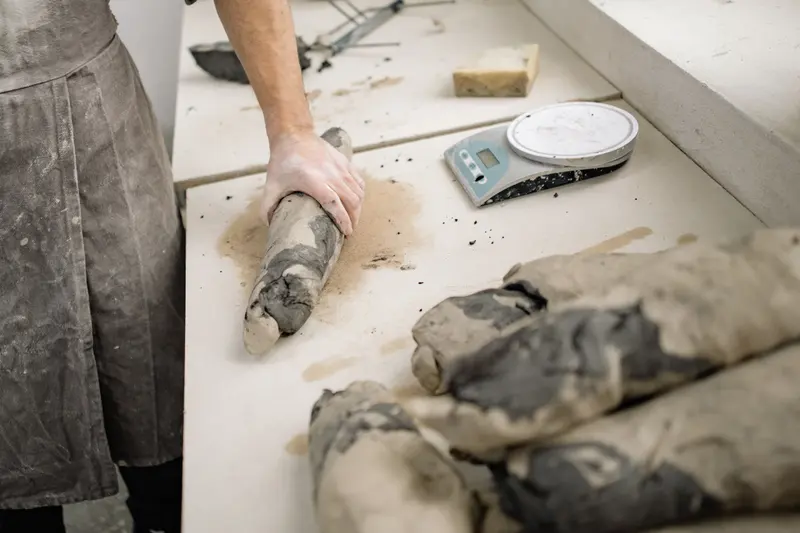
Those figures are for the freshly thrown size, not the fired one, which is the most common source of confusion. A mug thrown 12.7 cm tall comes out of the glaze firing nearer 11 cm in a typical stoneware. If you’re matching a mug you already own, measure it, enter those fired sizes here, and the calculator works out the wet size for you.
Weights also shift a lot with style. A chunky, rustic mug with 8 mm walls can take half as much clay again as a fine one with 5 mm walls, so the wall thickness box makes a bigger difference than most people expect. If you’re not sure what you throw, cut one of your pots in half with a wire when it’s leather hard and measure the wall with a ruler. It’s a sacrifice that teaches you a lot.
Why weigh your clay before throwing?
Weighing clay is the simplest way to make pieces that match. If you want a set of four mugs or six bowls, starting each from the same weight of wedged clay gets you most of the way, and the rest is practice. Production potters weigh every ball for exactly this reason.
It also makes learning faster. When a bowl comes out heavy, you can compare the weight you started with to the fired weight and see how much clay you left in the base. Over a term you’ll find your own numbers creeping down as your walls get thinner and more even, which is a satisfying thing to track. Our wheel throwing tips for beginners cover the habits that get you there.
Finally, weighing helps you plan. If you know a mug takes about 460 g wedged, a 10 kg bag gives you around 21 of them before reclaim, and you can work out how much clay to buy for a market stall or a class project instead of guessing.
How accurate is a clay weight estimate?
A clay weight estimate is a good starting point but rarely exact, usually within 10 to 15% of what an experienced thrower would cut. Real pots have thicker bases near the foot, flared rims and handles the simple model ignores, and every potter throws a little differently.
We checked the model against Lakeside Pottery’s chart using its wet thrown sizes. With 6 mm walls and a 10 mm base, the 8 oz mug came out at 417 g against Lakeside’s 397 g, and the small mug within a couple of percent. With the bowl and plate settings, all three of Lakeside’s bowls and all three of its plates landed within 9%, with the small side plate running the lightest. Wider cylinders ran light too, because they’re usually thrown with thicker walls than 6 mm, so increase the wall thickness for big forms.
Density is the other variable. Softer clay holds more water and weighs a touch less per cubic centimetre, while heavily grogged bodies can weigh more. You can measure your own: cut a 5 cm cube of fresh clay, weigh it and divide by 125. If you get 240 g, your density is about 1.92, and you can enter that instead.
Worked examples from the wheel
Take the default mug: 8 cm wide and 9.5 cm tall when fired, with 6 mm walls, a 10 mm base and 12% shrinkage. The tool scales that to a thrown size of about 9.1 cm wide and 10.8 cm tall, finds about 421 g of clay in the thrown mug, adds 10% for trimming and suggests wedging about 460 g. That’s a ball of clay roughly 7.8 cm across.
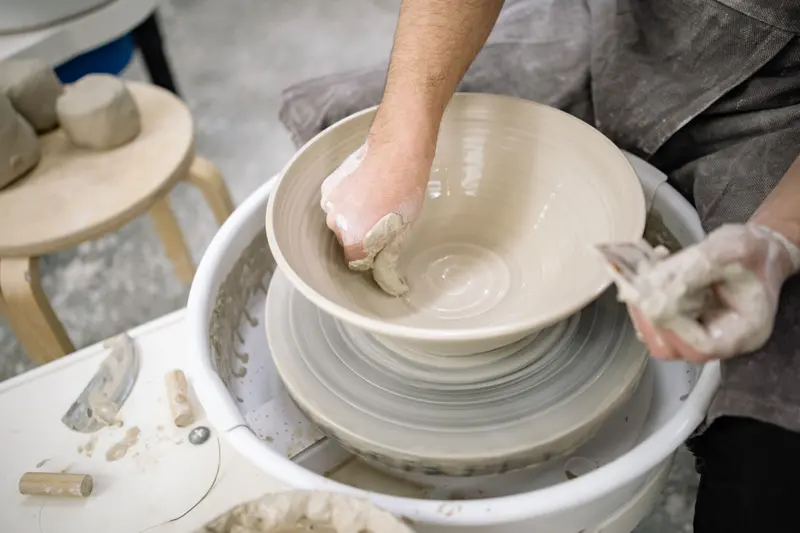
A 15 cm cereal bowl with 7 mm walls and a 12 mm base comes out at about 770 g of wedged clay, because bowls leave more clay in the base to trim a foot from. A 26 cm dinner plate with 8 mm walls needs about 1.87 kg, and a 22 cm vase with a 12 cm belly and a 6 cm opening about 1.45 kg.
If you’re in your first term, tick the learner box. The default mug then becomes about 580 g, which gives you room to collapse a rim, re-centre and still finish the piece. Once your mugs consistently come out heavy, drop back to the plain figure.
For handles, pull them from a separate lump of 50 to 80 g so they don’t eat into the body weight. For lids, weigh them separately as a shallow bowl or plate.
Common mistakes when weighing out clay
The biggest mistake is working from fired sizes without allowing for shrinkage, which leaves every piece smaller than planned. The second is weighing before wedging when the clay is fresh from a wet bag, then losing a surprising amount to the wedging board and slurry. Weigh after wedging if you can, or allow a little extra.
Another trap is using the same weight for every shape. A plate and a bowl of the same width take very different amounts of clay, and a vase with a narrow neck needs more than its width suggests because of the extra height. Choose the matching shape in the tool rather than stretching the mug setting.
Lastly, don’t chase the number too hard. If a 460 g mug feels heavy in the hand when it’s finished, use a little less clay next time. The calculator gets you close, and your own scale and notebook do the rest. If you’d like to check your sizes against shrinkage first, try the clay shrinkage calculator.
Frequently asked questions
Is 450 g of clay really enough for a mug?
For a standard mug of about 8 cm by 9.5 cm with 6 mm walls, yes, and Lakeside Pottery’s chart lists only about 400 g for an 8 oz mug. If you’re still learning to pull thin walls, start with 550 to 600 g and work down as your throwing improves.
Why does the calculator ask for the finished size instead of the thrown size?
Because the finished size is usually what you know, from a mug you like or a set you’re matching. The tool scales it up for shrinkage and shows the thrown size, so you can measure against it at the wheel.
Can I trust the density figure?
It’s an estimate. 1.9 grams per cubic centimetre follows from Digitalfire’s figure of about 21% water in plastic clay, but no maker publishes a wet density for their bodies. Weigh a 5 cm cube of your own clay and divide by 125 for a figure you can rely on.
How many mugs will I get from a 10 kg bag?
At about 460 g each, around 21 mugs before reclaiming your trimmings. Learners using 580 g get about 17. Reclaimed clay stretches that further, but expect to lose some along the way.
Can I use this for hand-built pieces?
Roughly. Pinch pots and coil pots follow the same shapes, so the clay volume is similar, but set the trimming allowance to zero or 5% since you won’t trim much. Slab pieces are easier to work out from the slab area times thickness.
Where can I practise throwing in Mordialloc?
The ceramic studio at Le Studio Art Space in Mordialloc has nine wheels and three kilns, and the workshops and classes page lists what’s currently running with our resident teachers. If you’re buying clay for home, the guide to where to buy pottery clay covers the options.
Sources and method
Clay weights for thrown pieces and the 25% beginner allowance are from Lakeside Pottery’s throwing chart (weights for wet thrown height and width). We compared the model with every item on that chart to set the bowl and plate assumptions. The water content of plastic throwing clay, about 21% within a range of 19.5 to 22.5%, is from Digitalfire’s reference library. The 1.9 g/cm³ density is our working figure derived from it, not a published value, so we flag it in the tool. Shrinkage defaults follow the clay data on our clay shrinkage calculator page.
The shape model and allowances are our own simplifications. The bowl and plate bases, trimming allowances and the 21% water figure used for the rough fired weight are assumptions. The tool rounds weights to the nearest 10 g or nearest ounce.
Figures last checked .
Use this tool on your site
You’re welcome to embed the clay weight calculator on your own site, studio page or class notes. Copy the code below. Please keep the credit link, it’s how other potters find the full version.
Cite this tool
Le Studio Art Space (2026). Clay Weight Calculator. The Potter’s Bench. https://lestudioartspace.com/potters-bench/clay-weight-calculator/ (accessed 27 October 2026).
This clay weight calculator from Le Studio Art Space is general educational content. Results are estimates: firing results vary from kiln to kiln and with your clay, glaze, cone placement and firing schedule. Always follow the clay and glaze manufacturer’s data, and for glaze and food safety decisions follow the manufacturer’s guidance and local regulations.