A clay absorption test measures how much water a fired clay soaks up, as a percentage of its dry weight: absorption = (soaked weight minus dry weight) divided by dry weight, times 100. Earthenware usually absorbs about 10 to 15%, stoneware about 0.5 to 3% at its rated cone, and porcelain close to zero. Lower absorption means a denser, stronger, more watertight piece.
Clay Absorption Test Calculator: Porosity Percentage
A clay absorption test is the simplest way to find out whether your clay has fired to maturity. You weigh a fired tile, soak it, weigh it again, and the difference tells you how porous the body is. This calculator does the arithmetic, classes the result and compares it with what’s typical for your type of clay.
It also explains what the number means for the piece you’re making, whether that’s a mug, a vase or something that will sit outside through winter. All you need is a fired tile, a pot of water and an accurate kitchen or jeweller’s scale.
Water absorption
1.8%
Vitreous: over 0.5% to 3%.
- Water taken up
- 0.9 g
- Dry weight
- 50 g
- Soaked weight
- 50.9 g
Typical for stoneware: about 0.5 to 3% (at its rated cone; Walker No 10 measures under 2% at cone 6). Yours is within that range.
Typical of studio stoneware. Glaze every surface that touches food or drink, keep the glaze free of crazing and seal the foot if it seeps. Firing a little hotter, within the clay’s range, can bring absorption down.
This tool at a glance
- What it does
- Works out the water absorption (porosity) of a fired clay from a simple soak test, and explains what the number means.
- Inputs
- The dry and soaked weights of a fired test tile, the type of clay and what the piece is for.
- Method
- Absorption % = (soaked weight minus dry weight) divided by dry weight, times 100. The result is classed with the tile industry’s ASTM C373 bands and compared with typical ranges from Digitalfire and Walker’s published data.
- Outputs
- Absorption percentage, water taken up, absorption class, comparison with the typical range for your clay, and advice for functional, decorative or outdoor use.
Clay absorption test: typical ranges and classes
Typical water absorption for each kind of fired clay, from Digitalfire and Walker’s published stoneware data, followed by the absorption classes the tile industry uses under ASTM C373. Every clay body differs, so your supplier’s data sheet is the best guide for yours.
| Clay or class | Absorption | Notes | |
|---|---|---|---|
| Earthenware or terracotta | 10 to 15% | fired around cone 06 to 04 | |
| Stoneware | 0.5 to 3% | at its rated cone; Walker No 10 measures under 2% at cone 6 | |
| Porcelain | 0 to 0.5% | at its rated cone, often close to zero | |
| Bisqueware (any clay) | 10 to 16% | bisque fired around cone 06 to 04; Walker No 10 measures 14.8% | |
| Impervious | 0.5% or less | ||
| Vitreous | over 0.5% to 3% | ||
| Semi-vitreous | over 3% to 7% | ||
| Non-vitreous | over 7% |
How the clay absorption calculator works
The formula is simple. The water a tile takes up is its soaked weight minus its dry weight. Divide that by the dry weight and multiply by 100 to get the absorption as a percentage. A 50 g tile that weighs 50.9 g after soaking has taken up 0.9 g of water, which is 1.8%.
The calculator then places your result in the absorption classes the tile industry uses under the ASTM C373 test: impervious at 0.5% or less, vitreous up to 3%, semi-vitreous up to 7% and non-vitreous above that. It compares the result with the typical range for the clay you choose, and explains what it means for functional, decorative or outdoor work.
Digitalfire uses the terms absorption and porosity almost interchangeably in studio testing, because the weight gain on soaking is how porosity is measured. Strictly, apparent porosity is a volume measure, but for comparing firings and clays, absorption by weight is what potters use.
How to do a clay absorption test
Make a few test tiles or bars from your clay, roughly the thickness of your work, and mark each with the cone it will be fired to. After firing, make sure they’re completely dry: leave them somewhere warm for a day or dry them in a low oven, then weigh each one on a scale that reads to at least 0.1 g, ideally 0.01 g.
Digitalfire’s method is to boil the tiles in water, which drives water into the pores faster and more completely than soaking. Boil them for several hours, let them cool in the water, then lift each one out, blot the surface with a damp cloth so there are no drips, and weigh it straight away. Laboratory standards such as ASTM C373 set exact boiling and soaking times, so if you need to compare with published figures, follow that standard.
Test several tiles and average them, because one tile can mislead. And test across a few cones if you can: Digitalfire recommends firing a body below and above your usual temperature to see how its absorption changes, which shows its maturing range.
Use unglazed tiles, because glaze seals the surface and hides the body’s real absorption. If you want to know how a finished glazed piece behaves, test a glazed tile separately, but treat that as a test of the glaze fit rather than the clay.
Typical absorption by clay type
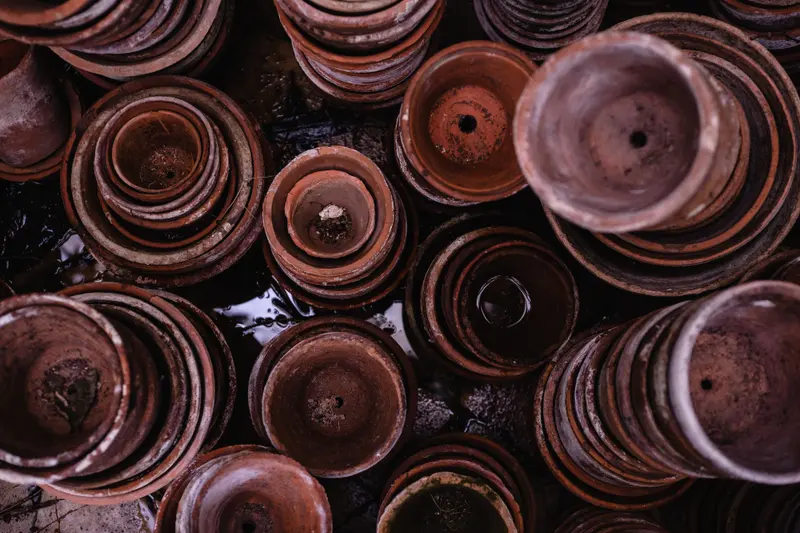
Earthenware and terracotta, fired around cone 06 to 04, typically absorb about 10 to 15%. They stay porous by design, which is why they rely on glaze to hold water. Bisqueware of any clay, fired around the same cones, is similar: Walker’s published data for its No 10 stoneware shows 14.8% absorption at a cone 06 bisque.
Stoneware becomes much denser at its rated cone. Walker’s No 10 measures under 2% at cone 6 and 0% at cone 8. Digitalfire notes that stonewares and earthenwares with coarser particles usually reach a minimum porosity well above zero, as much as 3%, and that firing beyond it bloats or melts the body. Porcelain can usually be fired to a point where no porosity can be measured.
Every clay body differs, so treat these as guides. Your supplier’s data sheet is the best reference for the body you use, and our clay body selector compares the main clay types.
What absorption means for food-safe pottery
For mugs, bowls and plates, lower absorption is better. Digitalfire treats about 1% as the industrial safety margin for ware that goes in the microwave, and notes that studio stoneware is often 2 to 3%. Water soaked up through an unglazed foot or a crazed glaze can turn to steam in a microwave and crack the piece, and it makes surfaces harder to keep clean.
Absorption isn’t the same as leaking. A well-fitted, uncrazed glaze can make a porous body hold liquid, which is how earthenware tableware works. But Digitalfire’s guidance on leaking ware is that a body needs to be close to vitrified, typically under 1% porosity, to be reliably watertight on its own. High absorption in stoneware usually means it was underfired, so check that your firing reaches the clay’s rated cone.

Our article on food-safe glaze explains how glaze and body work together, and our pottery fault finder covers leaking, crazing and microwave cracks.
Absorption, frost and outdoor pottery
For planters, garden pieces and tiles that stay outside, absorption decides whether they survive winter. Water in the pores expands as it freezes and can crack or flake a porous piece. Tile industry guidance treats impervious and vitreous ceramics, up to 3% absorption, as generally frost resistant, and semi-vitreous and non-vitreous ones as not.
Terracotta pots are porous by nature, which plants like, so they’re often brought in or kept dry in hard frost. For pieces that must stay out, choose a stoneware and fire it to maturity, then check it with an absorption test.
Using absorption to check your firing
An absorption test is also a firing check. If a stoneware that should measure 2% comes out at 6%, the kiln probably isn’t reaching the cone you think, or the clay was fired on a bisque schedule by mistake. Compare with a witness cone and our pyrometric cone chart. If you use a kiln firing service, tell them which clay you’re using so it’s fired to the right cone.
It works the other way too. A stoneware that measures almost zero but has started to bloat, blister or slump has probably been fired too hot, beyond its maturing range. The sweet spot for most functional stoneware is a firing that brings absorption close to its minimum without distorting the ware.
Keep a record of every test: the clay, the cone, the kiln, the schedule and the result. Over time, those numbers show you how consistent your firings are and warn you early when a kiln starts to underfire, often long before the glazes show it. A thermocouple drifting by just a few degrees can lift absorption by a percent or more.
Frequently asked questions
How do you calculate clay absorption?
Subtract the dry weight of a fired tile from its soaked weight, divide by the dry weight and multiply by 100. A 50 g tile that weighs 50.9 g soaked has an absorption of 1.8%.
What is a good absorption for stoneware?
Fired to its rated cone, stoneware typically absorbs about 0.5 to 3%. For functional ware, the lower the better, and around 1% or less gives a good margin for microwave use.
Is absorption the same as porosity?
In studio testing, they’re used almost interchangeably, because porosity is measured by the weight a tile gains in water. Strictly, apparent porosity is measured by volume, but absorption by weight is the usual studio figure.
Can pottery with high absorption be food safe?
It can, if every surface touching food is covered by a sound, uncrazed glaze rated for food use. Porous ware is more vulnerable to crazing, seepage and microwave cracks, so many potters choose a denser clay for tableware.
Why is my stoneware absorbing too much water?
Usually because it was underfired. Check that the kiln reaches the clay’s rated cone with witness cones, and that the piece wasn’t fired on a bisque schedule.
Which clays does Le Studio Art Space fire?
Le Studio Art Space’s firing service in Mordialloc fires bisque at cone 06, earthenware at cone 03, mid-fire work at cone 6 and high-fire work at cone 10. Choose a clay rated for the firing you book.
Sources and method
The absorption method, typical porosities and the maturing range advice are from Digitalfire’s clay body porosity, leaking and microwave entries. Stoneware absorption at bisque, cone 6 and cone 8 is Walker No 10 data published by Pottery Supplies Online. The impervious, vitreous, semi-vitreous and non-vitreous classes are as stated in TCNA test reports to ASTM C373, and the frost guidance is the tile industry’s rule of thumb from published tile specification sheets.
The earthenware and bisque ranges combine Digitalfire’s figures with Walker’s data and ThePotteryWheel’s guide. Clay bodies vary, so your supplier’s data sheet takes priority.
Figures last checked .
Use this tool on your site
You’re welcome to embed the clay absorption calculator on your own site, studio page or class notes. Copy the code below. Please keep the credit link, it’s how other potters find the full version.
Cite this tool
Le Studio Art Space (2026). Clay Absorption Calculator. The Potter’s Bench. https://lestudioartspace.com/potters-bench/clay-absorption-calculator/ (accessed 28 October 2026).
This clay absorption calculator from Le Studio Art Space is general educational content. Results are estimates: firing results vary from kiln to kiln and with your clay, glaze, cone placement and firing schedule. Always follow the clay and glaze manufacturer’s data, and for glaze and food safety decisions follow the manufacturer’s guidance and local regulations.