To reclaim clay, dry your scraps completely, soak them in water until they break down, then dry the slop on plaster or canvas until it no longer sticks to your hands, and wedge it. Throwing clay is usually about 21 to 22% water, so 10 kg of bone-dry scraps needs about 2.7 litres of water to get back there. This calculator works out the water for your own scraps.
How to Reclaim Clay: Reclaim Clay Calculator
Learning how to reclaim clay saves money and waste: trimmings, failed pots and slop from the wheel can all go back into the bag. The tricky part is knowing how much water to add, or how much to dry out. This calculator works it out from the weight of your scraps and how wet they are now.
It also lists the steps, so you can follow the whole reclaim process from bucket to wedging table.
Water to add
2.66 litres
to bring 10 kg of scraps from 0% to 21% water.
- Reclaimed clay
- 12.66 kgweight once mixed
- Dry clay in it
- 10 kg
The starting water content is our estimate for that state, so treat the amount as a guide: add a little less, then adjust by feel. For a precise figure, measure a sample and choose “I measured it”.
Steps
- Let the scraps dry out completely and break them into small pieces. Bone dry clay slakes (breaks down in water) much faster and more evenly than damp clay.
- Put them in a bucket and add the water. Leave them to slake for a day or two, without stirring, until there are no hard lumps.
- Mix to an even slop, then spread it on a plaster bat or canvas to firm up if it is softer than you want.
- When it no longer sticks to your hands, wedge it thoroughly to even out the moisture and remove air.
Keep dry scraps damp or bagged so they don’t make dust, and clean up wet. Dry clay dust contains crystalline silica.
This tool at a glance
- What it does
- Works out how much water to add to clay scraps, or dry out of slop, to bring them back to a workable consistency, and lists the steps.
- Inputs
- The weight of the scraps, how wet they are (a state with an estimated water content, or a measured figure) and the water content you want.
- Method
- Water content is a percentage of the damp weight. The dry clay stays the same, so the weight at the target is dry clay divided by (1 minus the target). The difference from the current weight is water to add or remove.
- Outputs
- Water to add or dry out, the reclaimed clay’s weight, the dry clay in it, a note when the starting figure is an estimate, and the reclaim steps.
How to reclaim clay: water per 10 kg of scraps
Water to add or dry out to bring 10 kg of scraps to 21% water, about right for throwing. The water contents for each state are approximate (our estimates, apart from the throwing figure from Digitalfire), so finish by feel.
| Scraps | Water now | To reach 21% | Reclaimed clay | |
|---|---|---|---|---|
| Bone dry scraps | About 0% | Add 2.66 litres | 12.66 kg | |
| Leather-hard trimmings | About 15% | Add 0.76 litres | 10.76 kg | |
| Soft, sticky clay | About 25% | Dry out 0.51 litres | 9.49 kg | |
| Slurry or slop from the wheel | About 35% | Dry out 1.77 litres | 8.23 kg |
How the reclaim clay calculator works
Water content in clay is usually given as a percentage of the damp weight. Digitalfire defines it that way: weigh a wet sample, dry it completely, weigh it again and work out the percentage lost. So 10 kg of clay at 21% water is 2.1 kg of water and 7.9 kg of dry clay.
When you reclaim, the dry clay stays the same and only the water changes. The calculator works out the dry clay in your scraps, then the weight that dry clay would be at your target water content: dry clay divided by (1 minus the target). The difference between that and the weight of your scraps is the water to add, or to dry out.
For 10 kg of bone-dry scraps, the dry clay is 10 kg, so at 21% the reclaimed clay weighs 10 divided by 0.79, about 12.66 kg. That means adding about 2.66 litres of water, since a litre of water weighs a kilogram.
How wet are your clay scraps?
The calculator needs to know how wet your scraps are now. Bone-dry scraps are close to 0% water. The states in the menu give rough figures for trimmings, soft clay and slurry, but only the throwing figure is published, so the others are our estimates and the result is marked as approximate.
For an exact figure, measure it. Weigh a lump of the scraps, dry it completely in a warm place or a low oven, and weigh it again. The weight lost, divided by the first weight, times 100, is the water content. Enter it and choose “I measured it”.
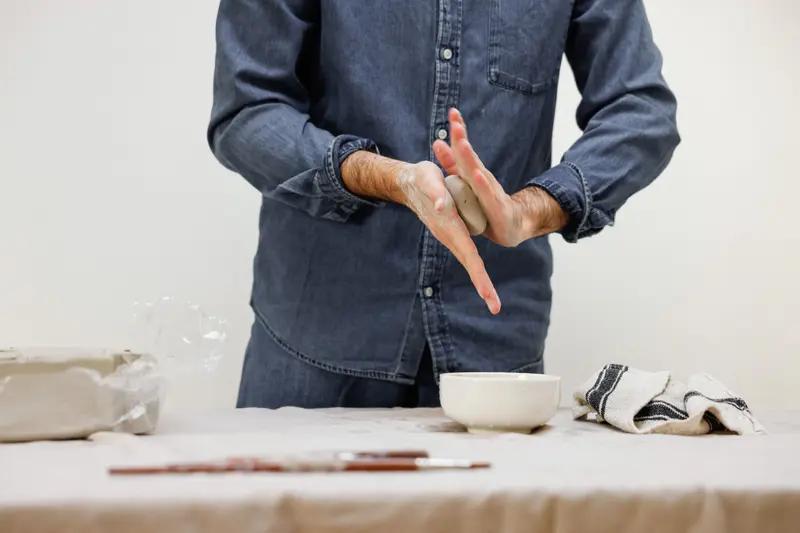
Many potters skip the measuring and reclaim by feel, which works well once you know your clay. The calculator is most useful when you’re reclaiming a lot at once, or want consistent clay every time.
Choosing the target water content
Digitalfire gives typical throwing clays at about 21% water, and notes that a porcelain that throws well at 21 to 22% can become short and difficult at 19%. Bodies for modelling and hand building typically sit between about 19.5 and 22.5%. The default target here is 21%, a good starting point for the wheel.
Go a little stiffer for hand building and large pieces, which need clay that holds its shape, and a little softer for soft slabs and pinching. Digitalfire also points out that water content isn’t a perfect measure of stiffness, because two clays at the same percentage can feel quite different, so let your hands make the final call.
Softer clay also shrinks more as it dries, because there’s more water to lose. If you’re making pieces that need to match, keep your reclaimed clay at the same consistency as fresh clay from the bag.
How to reclaim clay, step by step
Start by letting your scraps dry out completely. It sounds backwards, but bone-dry clay slakes, or breaks down in water, much faster and more evenly than damp clay, which stays in rubbery lumps. Break larger pieces up so they dry through.
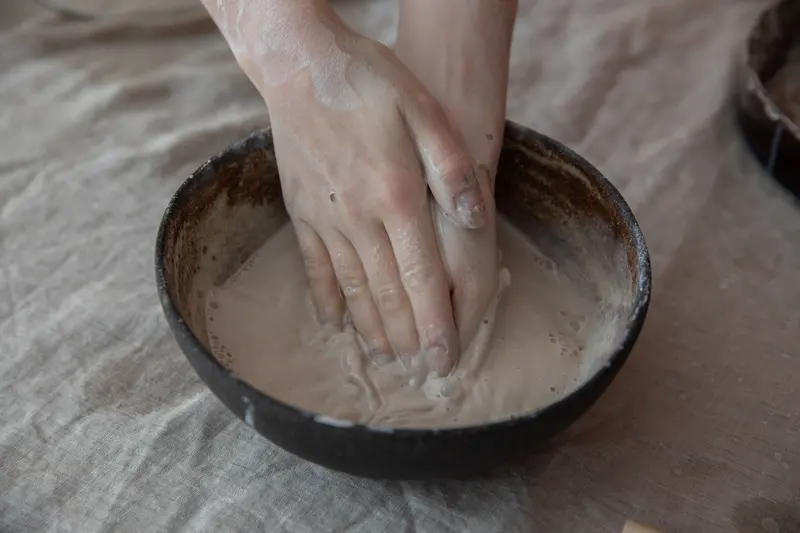
Put the dry scraps in a bucket and add the water the calculator gives you, or simply cover them with water and pour off the excess later. Leave them for a day or two without stirring until there are no hard lumps. Then mix to an even slop.
Spread the slop on a plaster bat or a canvas-covered board, about 3 to 5 cm thick, or hang it in a canvas bag to drip. Plaster draws water out fastest. Turn it every few hours and check by feel. When it no longer sticks to your hands, wedge it thoroughly to even out the moisture and remove air, then bag it.
Reclaiming slop and slurry
Slop from the wheel and slurry from the splash pan are already wet, so the calculator tells you how much water to dry out rather than add. Pour off any clear water on top first, because that’s the easiest water to remove.
Slop dries much faster on plaster than in the open air, and drying times vary with the weather, the thickness of the layer and how much plaster you have, so there’s no reliable rule for how long it takes. Weigh it as it dries if you want to hit the target exactly: when the scale shows the reclaimed clay weight from the calculator, it’s ready.
Reclaim clay at home or in a small studio
You don’t need special equipment to reclaim at home. Two lidded buckets work well: one for dry scraps waiting to slake, and one for slop. A plaster bat is the most useful extra, and you can cast your own by pouring pottery plaster into a shallow tray. Old pillowcases or canvas bags hung over a bucket also work, just more slowly.
Reclaim in batches rather than a little at a time. A full bucket of scraps slakes just as quickly as a handful, and the drying and wedging take about the same effort however much you do. Many potters reclaim once a month, or whenever the scrap bucket is full.
Weigh the clay as you bag it and write the weight and date on the bag. When you come to use it, our clay weight calculator and the weights on the bag tell you exactly how many pieces it will make. If a batch feels slightly too soft or stiff, mix it with fresh clay from the bag while wedging, which evens out the consistency quickly.
Keep reclaim clean and safe
Keep each clay body separate. Mixing a stoneware with an earthenware gives a clay that doesn’t fire properly at either temperature. Keep plaster crumbs and other debris out too, because a fleck of plaster in fired clay can pop out later.
Dry clay scraps and dried slop make dust, and clay dust contains crystalline silica. Keep scraps in a lidded bucket, avoid crushing dry clay where dust can spread, and clean up wet rather than sweeping. Our clay weight calculator helps you weigh out reclaimed clay for each project, and a kiln firing service can fire your finished work.
Frequently asked questions
How much water do I add to dry clay to reclaim it?
For throwing consistency at about 21% water, add about 0.27 litres for every kilogram of bone-dry scraps. That’s about 2.7 litres for 10 kg. Add a little less to start, then adjust by feel.
Why should clay scraps dry out before reclaiming?
Bone-dry clay slakes much faster and more evenly. Damp scraps absorb water slowly from the outside in, leaving hard or rubbery lumps that take much longer to break down.
How long does it take to reclaim clay?
Slaking usually takes a day or two. Drying slop to a workable consistency can take from a few hours on a big plaster bat to several days in the open, depending on the weather and thickness.
Is reclaimed clay as good as new clay?
Yes, if it’s kept clean and wedged well. Many potters find reclaimed clay throws even better, because it’s been thoroughly wetted. Just keep different clay bodies separate.
What is the right water content for throwing clay?
Typically about 21 to 22% of the damp weight, according to Digitalfire. Hand-building clay is often a little stiffer, and the right figure varies between clay bodies.
Does Le Studio Art Space sell fresh clay?
Yes. Le Studio Art Space’s ceramic studio in Mordialloc sells clay, glazes and raw materials on site, so you can top up reclaimed clay with fresh clay of the same body.
Sources and method
The definition of water content as a percentage of damp weight, the measuring method and the throwing and modelling ranges (about 21 to 22%, and 19.5 to 22.5%) are from Digitalfire’s water content glossary entry and its clay water content test. The link between water content and drying shrinkage is from the same source.
The water contents for bone-dry, leather-hard, soft and slurry scraps are our own approximate studio estimates and are marked as such in the tool. The reclaim steps are standard studio practice.
Figures last checked .
Use this tool on your site
You’re welcome to embed the reclaim clay calculator on your own site, studio page or class notes. Copy the code below. Please keep the credit link, it’s how other potters find the full version.
Cite this tool
Le Studio Art Space (2026). Reclaim Clay Calculator. The Potter’s Bench. https://lestudioartspace.com/potters-bench/reclaim-clay-calculator/ (accessed 28 October 2026).
This reclaim clay calculator from Le Studio Art Space is general educational content. Results are estimates: firing results vary from kiln to kiln and with your clay, glaze, cone placement and firing schedule. Always follow the clay and glaze manufacturer’s data, and for glaze and food safety decisions follow the manufacturer’s guidance and local regulations.