Acrylic paint on ceramic genuinely does work for decorative purposes, giving good colour and coverage without a kiln, but it never bonds into the clay the way a fired glaze does, so it’s a different kind of finish with different limits.
When you’re weighing up quick craft paint against booking a proper glazing session, it helps to get a genuinely honest performance verdict rather than a vague “it depends” answer.
At Le Studio Art Space, this comes up in decorating discussions all the time, usually from someone who already owns acrylics and wants to know if that’s genuinely good enough for their project.
Here’s a straight comparison of how acrylic actually performs on ceramic, why it behaves so differently from a fired finish, and what that means for your specific piece.
We’ll cover the honest tradeoffs rather than just the highlights, so you can make a genuinely informed choice before you pick up a brush or book a firing slot.
The Short Answer On Acrylic And Ceramic
Acrylic paint works well for decorative purposes on ceramic, with clear limits around durability, food safety, and long term handling that are worth understanding before you start.
It applies easily, dries quickly, and comes in an enormous range of colours, which is exactly why it’s such a popular choice for a first attempt at decorating a piece.
The tradeoff is that it never becomes a permanent part of the ceramic surface the way a properly fired glaze does, so its performance ceiling is genuinely lower for anything demanding.
For gift pieces, display work, and casual decorating, most studios report acrylic gives a perfectly satisfying result without needing any specialist equipment at all.
For anything functional that will be washed, handled, or used daily, the honest verdict shifts firmly in favour of a real glaze instead.
Knowing which category your project falls into before you start is genuinely the most useful first step, since it shapes every other decision that follows.
Why It Works Differently To A Fired Glaze
A fired glaze undergoes an actual chemical transformation in the kiln, melting into a glassy layer that fuses permanently with the clay body beneath it.
Acrylic paint, by contrast, simply dries through evaporation, forming a flexible plastic film that sits on the surface rather than becoming part of it.
There’s no kiln bonding involved at any stage, which is exactly why acrylic can eventually be scratched, peeled, or chipped away in a way a fired glaze genuinely resists.
This difference also explains why acrylic paint feels slightly different to the touch than a glazed surface, since one is a coating and the other is essentially melted glass.
Understanding this distinction upfront helps set realistic expectations before you commit hours of decorating time to a piece.
It also explains why a fired glaze can safely go through a dishwasher cycle after cycle while an acrylic finish genuinely can’t, since only one of them is chemically bonded to the clay.
What Kind Of Results To Expect
Colour vibrancy with acrylic is genuinely strong straight out of the bottle, often more immediately saturated than an unfired glaze looks before its own transformation in the kiln.
Coverage is also reliable and even, especially over a couple of thin coats, giving a clean, consistent finish without needing to master glaze application techniques.
Where acrylic falls short compared to glaze is depth and shine. A fired glaze often produces a glossy, almost three-dimensional quality that a flat painted surface can’t fully replicate.
Texture is another difference. Acrylic sits as a thin, uniform film, while certain glazes can pool, crackle, or vary in thickness for a genuinely more textured, organic result.
For flat, graphic designs and bold colour blocking, acrylic often looks just as sharp as glaze. For subtle, dimensional effects, glaze usually has the edge.
Many potters find that photographing a piece under good light straight after painting helps capture the acrylic finish at its brightest, since some fading is genuinely normal over time.
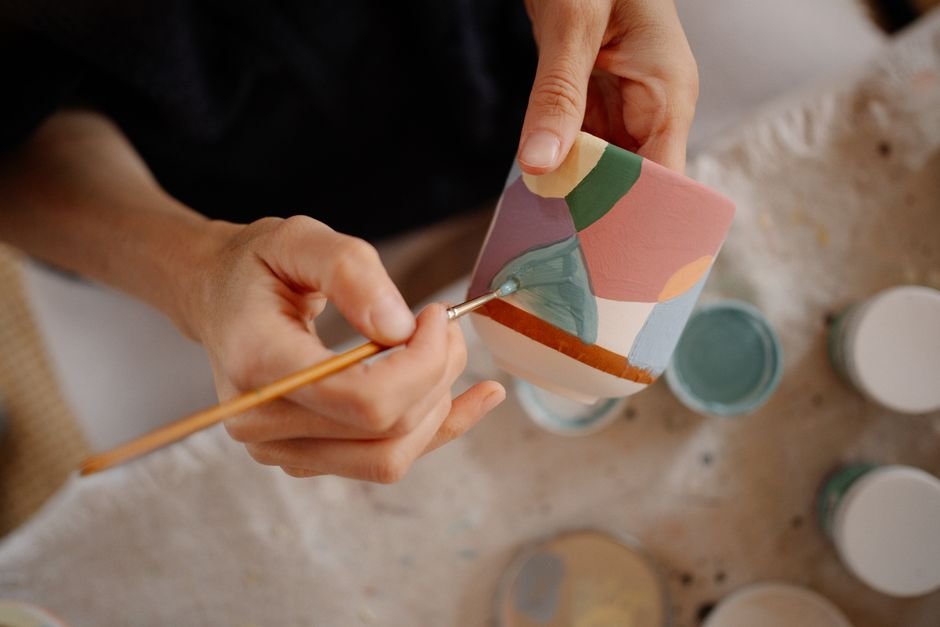
Best Practices If You Do Use Acrylic On Ceramic
Starting with a clean, dust-free bisque surface genuinely improves how well acrylic adheres from the very first coat.
Applying thin, even layers and letting each one dry fully before adding the next gives a noticeably more durable, professional looking finish than one thick, rushed coat.
A light sanding between coats, using a fine grit, can help smooth out any texture and improve how the next layer sits on top.
Sealing the finished piece with a clear acrylic varnish afterward adds a genuine layer of protection against light handling and dust, extending how long the colour stays crisp.
Keeping brushes clean and working in a well lit space also makes a noticeable difference to how neat and even the final result looks.
Taping off clean straight edges before painting geometric patterns is another genuinely simple trick that helps a hand-painted design look considerably more polished once it’s finished.
What Competing Guides Leave Out
Most articles compare acrylic and glaze purely on first appearance and skip how humidity and regular handling actually affect acrylic’s durability over the following months, which matters enormously for anyone gifting a piece.
A humid bathroom shelf or a piece that gets picked up daily will show wear on an acrylic finish far sooner than the same piece kept dry and mostly on display.
Realistic expectations for gift pieces rarely get addressed either. An acrylic painted mug given as a present will likely need to be treated as decorative rather than daily-use, and saying so upfront avoids disappointment later.
Cost and turnaround time are also usually left out. Acrylic gives an instant result you can take home the same day, while a glaze firing involves a kiln schedule and a longer wait.
Few guides mention that testing a small design in acrylic first, before committing to a full glaze piece, is a genuinely practical way to try out a pattern cheaply before investing more time.
Storage conditions matter too, and a piece kept in a steamy bathroom or a sunny windowsill will genuinely show acrylic wear sooner than one kept in a stable, dry spot on a shelf.
Acrylic Paint Versus Ceramic Glaze For Your Project
If your piece is purely decorative and won’t be washed or handled often, acrylic is a genuinely practical, low cost choice that most hobbyists find perfectly satisfying.
If it needs to hold food, survive a dishwasher, or realistically handle years of daily use, a proper fired glaze is genuinely the only option that will hold up over time.
Somewhere in between, for a display gift that might occasionally be handled, sealed acrylic can be a genuinely reasonable middle ground, as long as expectations are set honestly and clearly from the very start.
Talking through your specific project with the team at Le Studio Art Space’s ceramic studio is a genuinely useful way to land on the right approach before you begin.
Bringing a reference photo or a rough sketch of what you’re picturing can also help the conversation move faster, whichever technique you end up choosing for the piece.
Whichever you choose, matching the technique to how the piece will actually be used is the single biggest factor in how happy you’ll be with the result.
There’s genuinely no wrong choice here, just a mismatch to avoid between how a piece is finished and what it’s actually going to be asked to do once it’s home.

Want to see the difference for yourself? Compare acrylic paint results with a real glaze firing at Le Studio Art Space’s ceramic studio in Mordialloc.
Frequently Asked Questions
Does acrylic paint actually stick to ceramic long term?
It sticks well initially and can last a long time on display pieces, but it isn’t as permanent as a fired glaze and can chip or wear with regular handling.
Is acrylic paint on ceramic waterproof?
Not reliably. Light moisture is usually fine once dry, but acrylic isn’t dishwasher safe and shouldn’t be relied on for anything that gets washed often.
Why does my glazed pottery look so much shinier than acrylic paint?
A fired glaze melts into an actual glass surface during firing, which naturally reflects more light than a painted acrylic coating ever will.
Can I mix acrylic paint colours to match a specific shade?
Yes, acrylics blend easily, which is one of its genuine advantages over glaze, where colour results can shift more during firing.
Should I just glaze my piece instead of using acrylic paint?
If the piece will be used daily or hold food, yes. For purely decorative work, many potters find acrylic gives a genuinely good result, and the team at Le Studio Art Space can help you decide either way.
This article is provided for general educational purposes by Le Studio Art Space and reflects common studio practice and material knowledge.