Good clay art ideas to try in the studio include organic forms inspired by leaves, shells, and seed pods, textured wall tiles, small abstract sculptures, expressive faces or creatures, and sculptural vessels that don’t need to be functional. Working in a series, setting simple constraints, and making small experimental pieces are reliable ways to spark new ideas when you feel stuck.
Every potter hits a point where the wheel feels like a loop of bowls and mugs, and fresh clay art ideas seem hard to find. You sit down with a fresh bag of clay and nothing new comes to mind. It’s a completely normal stage, and it often means you’re ready to stretch into something more expressive, even if you’re not sure what yet.
At Le Studio Art Space in Mordialloc, some of the most exciting work on our shelves comes from members who pushed past that feeling. This list of clay art ideas is designed to spark your imagination, with directions for nature-inspired pieces, abstract work, quick experiments, and practical ways to turn an idea into something real.
Moving Beyond Functional Pieces
Functional pottery is wonderful, but it comes with rules. A mug needs a handle that fits a hand, a bowl needs a stable base, and a plate needs to stack. When you step away from function, those rules loosen, and clay becomes a far more open creative material.
A gentle way to start is by making a vessel that isn’t meant to be used. Try a vase with an exaggerated, twisting neck, a bowl with walls that fold and ripple, or a closed form with a tiny opening. These pieces still feel familiar but invite you to focus on shape, surface, and mood instead of practicality.
Wall pieces are another great shift. Tiles, plaques, and relief panels let you work almost like a painter or printmaker, building texture, pattern, and imagery in a flat format. Groups of small tiles hung together can make a striking installation for a wall at home.
You might also try making objects that tell a story. Miniature scenes, symbolic objects, or pieces that respond to a memory or a place can carry real personal meaning, even at a small scale.
The aim isn’t to abandon functional work, but to give yourself permission to make things simply because they’re interesting. Many potters find that this freedom feeds back into their functional pieces too, adding more character and confidence.
Clay Art Ideas Inspired By Nature And Organic Form
Nature is one of the richest sources of clay art ideas. Leaves, seed pods, shells, coral, bark, and stones all offer shapes and textures that translate beautifully into clay. A walk along the beach at Mordialloc or through a local park can supply enough ideas for months.
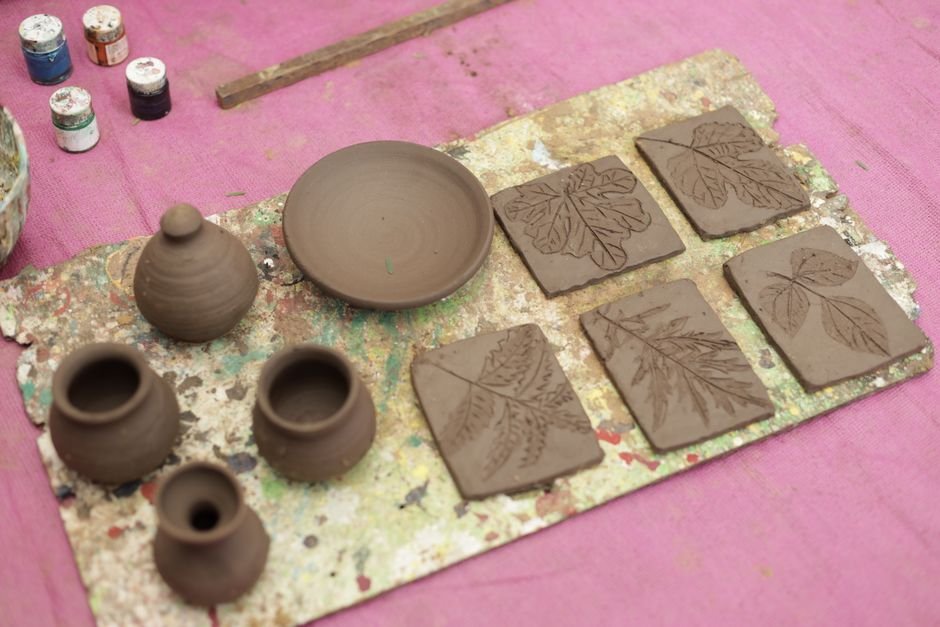
Pressing real leaves or flowers into soft clay is a simple way to begin. The fine veins and edges leave delicate impressions that look lovely under a glaze that pools in the recesses. You can make tiles, small dishes, or even wrap a textured slab around a cylinder.
For more sculptural work, try building forms inspired by seed pods, cactus, or sea creatures. Coil building works well for these, since it allows gradual, organic growth. Surfaces can be pinched, carved, or dotted to suggest spines, ridges, and pores.
Studying natural patterns closely also helps. Spirals in shells, branching in trees, and repetition in pinecones all suggest structures you can borrow. Sketching them first, even roughly, can help you understand the forms before building.
Earthy surface treatments complement these forms well. Oxides rubbed into textures, matte glazes, or terra sigillata can give pieces a natural, weathered quality that suits organic subjects.
Abstract And Expressive Directions
Abstract clay work can feel intimidating, but it simply means focusing on form, texture, and feeling rather than representing something recognisable. Start by choosing a single quality you want to explore, such as balance, tension, softness, or movement, and build a small piece around it.
Stacking and assembling is a good entry point. Make several simple shapes, such as spheres, cylinders, and slabs, then stack and join them in different arrangements. Playing with how shapes sit together often leads to surprising results.
Gestural work embraces the marks of making. Try throwing a piece, then pushing, cutting, or altering it while it’s still soft. Slabs can be torn rather than cut, or folded like fabric. These pieces often have energy that more controlled work lacks.
Faces and creatures are another expressive direction that sits between realism and abstraction. Exaggerated features, odd proportions, and playful characters can be a joy to make, and they often become favourite pieces for people who see them.
If you’d like to understand how established makers develop this kind of voice, our articles on ceramic sculpture and how clay artists develop their style offer useful context.
Small Scale Clay Art Ideas For Limited Studio Time
Not every idea needs a big time commitment. Small-scale projects are perfect for single sessions and make great experiments. Try a series of tiny sculptures, each no bigger than your palm, exploring one idea from several angles.
Test tiles are underrated creative tools. Make a batch of small tiles and use them to explore textures, carving, slip decoration, or glaze combinations. They take little time and clay, and the results guide bigger pieces later.
Small ornaments, beads, and pendants are also quick and satisfying. They let you practise surface detail and glazing without risking a large piece, and they make lovely gifts.
Pinch pot creatures are another quick idea. Two pinch pots joined together create a hollow body that can become a bird, fish, or imaginary animal with a few added details. They’re fun, forgiving, and great practice for joins.
For more quick options sized to one visit, see our list of clay projects perfect for a studio session.
What Competing Guides Leave Out
Most lists of clay art ideas give you things to make, but they don’t help much when every idea feels like it’s been done before. That feeling is common, and it usually comes from comparing your work to the huge volume of finished pieces online rather than to your own starting point.
One of the most effective ways past creative block is to set constraints. Limit yourself to one technique, one colour, or one simple shape, and make ten variations. Constraints force you to explore more deeply, and many potters find their most original ideas emerge around the sixth or seventh attempt.
Working in a series helps for the same reason. Instead of chasing a single perfect idea, make several pieces that develop a theme. Each one teaches you something that shapes the next, and the series as a whole becomes more personal than any one piece.
It also helps to borrow from outside ceramics. Architecture, textiles, music, and even food can suggest forms and patterns that feel fresh in clay. Keeping a small sketchbook or photo folder of things that catch your eye builds a personal library of ideas.
Finally, remember that done before doesn’t mean done by you. Your hands, choices, and experiences will make even a familiar idea distinct.
Turning An Idea Into An Actual Piece
Once you have an idea, start with quick sketches or a small maquette, a rough model in clay. This helps you test proportions and structure before committing to a larger piece, and it’s much less stressful if something doesn’t work.
Next, think through the practical steps. Which technique suits the form best, and does it need to be hollow? Where might it crack as it dries? How will it sit in the kiln? Planning these details early saves disappointment later.
Build steadily, letting sections firm up where needed, and keep your piece covered between sessions. Don’t be afraid to change direction if the clay suggests something better. Some of the best pieces emerge from happy accidents.
When the piece is finished, take a moment to reflect before moving on. Note what worked, what surprised you, and what you’d change next time. That short habit turns every experiment, successful or not, into a stepping stone toward your next idea, and over months it quietly builds the personal style so many potters are searching for.
Finally, plan your surface and firing. Our firing service can advise on suitable temperatures for sculptural work, and time in our ceramic studio or a workshop or class gives you space and support to experiment.
Got a spark of an idea? Bring it to life during a session at Le Studio Art Space in Mordialloc, where you’ll find space, tools, kilns, and a creative community happy to help you experiment.
Frequently Asked Questions
What can I make with clay besides bowls and mugs?
Plenty, including wall tiles, sculptures, ornaments, planters, faces, creatures, and abstract forms. Sculptural vessels that don’t need to be functional are a great bridge.
How do I get unstuck when I have no ideas?
Try setting a simple constraint, like one technique or shape, and making several variations. Working in a series often unlocks ideas faster than waiting for inspiration.
Are abstract clay pieces harder for beginners?
Not necessarily, since abstract work is often more forgiving than realistic sculpture. The main technical challenges are still even walls and careful drying.
Can I use real leaves to add texture to clay?
Yes, pressing leaves into soft clay leaves lovely impressions. The leaf burns away in the kiln, but it’s best to peel it off first so it doesn’t leave ash.
Can I get feedback on my ideas at the studio?
Absolutely. At Le Studio Art Space, members often share ideas and ask for technical advice, and our team is always happy to help plan a piece.
This article is provided for general educational purposes by Le Studio Art Space. Results vary with materials, construction, and firing, so test new ideas at a small scale first.