A pottery wheel in Australia costs about $120 to $500 for a hobby tabletop wheel, about $1,900 to $2,100 for an entry studio wheel, and about $2,200 to $3,100 for a quiet direct-drive studio wheel, including GST. Heavy-duty wheels for big work cost more. The right one depends mostly on the heaviest piece of clay you want to centre, so size the wheel to your work rather than to the price tag.
How Much Is a Pottery Wheel? Wheel Buying Guide Calculator
How much is a pottery wheel worth paying for? It depends far more on what you plan to throw than on the badge on the splash pan. This buying guide asks how heavy your biggest pieces will be, how often you’ll throw, where the wheel will live and what you can spend, then tells you which tier of wheel suits you and the specs to check on any listing.
It doesn’t rank brands. Named wheels appear only as examples with their published specs and current Australian prices, so you can compare like with like.
Wheel to look for
Entry studio wheel
$1,900 to $2,060. Examples, not a ranking: Shimpo RK55 VL Lite $1,899.95 (11 kg centring, 30 cm head); Venco No 3 $2,020 to $2,060 (33 cm head).
- Centring capacity
- 6 kg+four times your 1.5 kg piece
- Motor
- About 100 to 550 W
- Wheel head
- 30 to 33 cm
- Drive
- Belt or direct drive, foot pedal
- Size and weight
- About 23 to 30 kg, needs its own spot
Your budget of $2,500 covers this tier, and reaches the studio direct-drive wheel if you want room to grow.
Hiring a wheel at $60 to $65 a week costs as much as the cheapest wheel in this tier after about 30 weeks.
Every tier
| Tier | Price | Heaviest piece |
|---|---|---|
| Hobby tabletop wheel | $120 to $500 | Up to 1 kg |
| Professional tabletop wheel | $1,260 to $1,420 | Up to 2 kg |
| Entry studio wheel | $1,900 to $2,060 | Up to 3 kg |
| Studio direct-drive wheel | $2,220 to $3,110 | Up to 11 kg |
| Heavy-duty wheel | from about $3,500 (estimate) | Over 11 kg |
Indicative Australian prices including GST, checked 28 October 2026. Prices change, and estimates are converted from overseas listings.
This tool at a glance
- What it does
- Answers how much a pottery wheel costs for the way you’ll throw, and which specs to look for, without ranking brands.
- Inputs
- The heaviest piece you want to throw, how often you throw, the space you have, whether it must be carried or quiet, and your budget.
- Method
- Your heaviest piece times four gives the centring capacity to look for, which picks the lowest tier that can handle it. Throwing most days lifts a hobby wheel to a studio wheel, and a professional tabletop is only suggested when the wheel has to pack away or travel.
- Outputs
- The wheel tier and its Australian price range, a spec profile (centring capacity, motor, wheel head, drive, size), a budget check, notes on noise and space, and how many weeks of hire equal the price.
How much is a pottery wheel in Australia?
Five tiers of pottery wheel with Australian prices including GST, checked in October 2026. The heaviest piece each tier suits is a quarter of its centring capacity. Named wheels are examples with published specs, not a ranking, and the estimates are converted from overseas prices because we found no Australian listing.
| Tier | Price (AUD) | Heaviest piece | Centring capacity | Motor | Wheel head | Examples |
|---|---|---|---|---|---|---|
| Hobby tabletop wheel | $120 to $500 | Up to 1 kg | Rarely published | 60 to 350 W, often quoted as input power | 15 to 28 cm | Mains-powered tabletop wheels sold online in Australia, from about $120 to $500 |
| Professional tabletop wheel | $1,260 to $1,420 | Up to 2 kg | About 9 kg | About 100 W DC | 18 cm, with bat pins for larger bats | Shimpo Aspire RK-5T with a speed lever $1,259.95, or RK-5TF with a foot pedal $1,417.45 (9 kg centring, 18 cm head) |
| Entry studio wheel | $1,900 to $2,060 | Up to 3 kg | About 11 kg and up | About 100 to 550 W | 30 to 33 cm | Shimpo RK55 VL Lite $1,899.95 (11 kg centring, 30 cm head); Venco No 3 $2,020 to $2,060 (33 cm head) |
| Studio direct-drive wheel | $2,220 to $3,110 | Up to 11 kg | Up to about 45 kg | Half a horsepower (about 370 W) to 600 W, brushless | 33 to 36 cm | Venco Direct Drive Flow $2,220 to $2,535 (600 W, 33 cm, 0 to 300 rpm); Shimpo VL-Whisper $2,999.95 to $3,109.95 (half a horsepower, 36 cm, 45 kg centring) |
| Heavy-duty wheel | from about $3,500 (estimate) | Over 11 kg | Over 45 kg | Three quarters to 1 horsepower or more | 36 cm | Brent C and CXC (three quarters and 1 horsepower; Brent rates them for 225 and 300 lb of clay); no Australian listing found |
How the pottery wheel buying guide works
The guide starts with the heaviest piece you want to throw and multiplies it by four. That figure is the centring capacity to look for on a spec sheet. A manufacturer’s rating is the most clay an experienced potter can centre on that wheel at full effort, so a wheel worked near its limit slows, bogs down and runs hot. Leaving plenty of headroom keeps it turning steadily while you learn.
The centring figure picks the lowest of five tiers that can cope: a hobby tabletop wheel for pieces up to about 1 kg, a professional tabletop up to about 2 kg, an entry studio wheel up to about 3 kg, a direct-drive studio wheel up to about 11 kg, and a heavy-duty wheel beyond that. Three rules then adjust the answer. If you’ll throw most days, a hobby wheel is lifted to an entry studio wheel. If the wheel has to pack away or travel, the guide keeps to tabletop wheels and tells you when your pieces are too big for one. If you need it quiet, it points you to brushless direct drive.
The multiplier of four is our studio judgement, not an industry standard. It is deliberately cautious, because a wheel that struggles is the most common regret we hear from people who bought their first one online.
How much is a pottery wheel in Australia?
Prices fall into clear bands. Mains-powered tabletop wheels sold online in Australia run from about $120 to $500. They have small motors, wheel heads of 15 to 28 cm and rarely publish a centring capacity, so they suit mugs, cups and small bowls. A 2026 Australian buyer’s guide found that the smallest of them, at 60 W, will bog down if you lean hard into a big lump of stoneware.
Studio wheels start a big step up. The Shimpo RK55 VL Lite lists at $1,899.95 and the Western Australian made Venco No 3 at $2,020 to $2,060. Quiet brushless direct-drive wheels cost more again: the Venco Direct Drive Flow sells for $2,220 to $2,535 and the Shimpo VL-Whisper for $2,999.95 to $3,109.95 at Australian suppliers.

Between the two sit professional tabletop wheels such as the Shimpo Aspire, which Keane Ceramics lists at $1,259.95 with a speed lever and $1,417.45 with a foot pedal. One tier in the table is an estimate because we couldn’t find an Australian listing: heavy-duty Brent wheels are rarely stocked locally, so allow from about $3,500 and ask a supplier to quote. Our pottery equipment cost calculator spreads any of these prices over the years you’ll use the wheel and compares it with a studio membership.
What centring capacity really means
Centring capacity is the single most useful number on a wheel’s spec sheet, and the one most cheap listings leave out. It tells you how much clay the wheel can keep turning against while you push it into centre, which is the hardest work the motor ever does.
Published ratings vary a lot. Shimpo rates the VL Lite at about 11 kg and the VL-Whisper at about 45 kg, and the Aspire tabletop at about 9 kg. Brent quotes its B, C and CXC wheels at 150, 225 and 300 pounds of clay, but potters on the Ceramic Arts Daily forum point out that those are continuous load figures, not centring figures, so they aren’t directly comparable. Treat any rating as a ceiling rather than a comfortable working weight.
To find your own number, weigh the clay for the largest piece you want to make. Our clay weight calculator gives a starting weight for mugs, bowls, plates and vases. A mug usually starts around 400 g, a large serving bowl 1.5 to 2.5 kg and a tall vase 3 kg or more.
Motor power, torque and the wheel head
Motor power matters, but horsepower alone doesn’t settle it. Two wheels with the same half horsepower motor can feel very different, because the gearing, the drive and the controller decide how much of that power reaches the wheel head at low speed, where centring happens. That low-speed pushing force is the torque, and it’s what stops the wheel slowing when you lean in.
Be wary of comparing watts across categories. Cheap tabletop wheels often quote the power the motor draws from the wall, while studio makers quote the power it delivers, so a 350 W hobby wheel is not a match for a 600 W studio wheel. Look instead for a published centring capacity and a speed range that reaches about 250 to 300 rpm.
The wheel head sets the widest piece you can throw directly. Heads of 15 to 20 cm suit cups and mugs, 25 to 28 cm handles plates and larger bowls, and studio wheels have 30 to 36 cm heads. Bat pins let you throw on removable bats wider than the head, which is why a small professional head can still make a plate.
The best pottery wheel for beginners
For most beginners, the best pottery wheel is one with more capacity than you think you need, a smooth foot pedal and a splash pan that comes off easily. Centring is the first skill you learn and the one that strains a wheel most, because beginners push hard and use more clay than they need.
If you’ll throw weekly and have a corner it can stay in, an entry studio wheel is usually the sweet spot. It costs about four times a good hobby wheel, but it will centre a large bowl without stalling, it holds its value second hand and it won’t be the thing you outgrow in six months. A hobby tabletop is fine for small work, children and trying the wheel at home, as long as you keep to modest balls of clay.
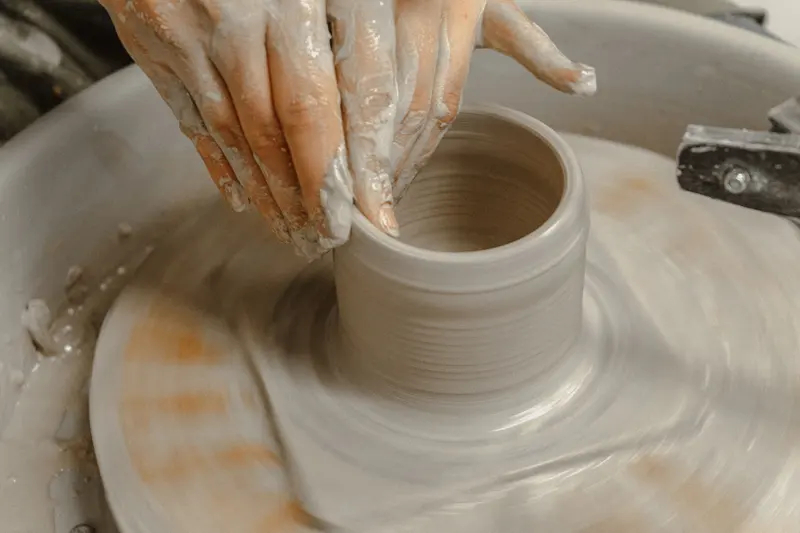
Learning on a good wheel first also helps you buy well. Our article on the Brent and Shimpo pottery wheels compared covers two of the brands you’ll meet most often in studios.
Noise, space and portability
A studio wheel needs a permanent spot. Plan on roughly a metre square for the wheel, the stool and room to move your elbows, near water and on a floor you can mop, because clay slurry gets everywhere. Most floor wheels weigh 23 to 30 kg, so they move, but not every week.
If your wheel has to pack away after each session or travel to classes, stay with a tabletop wheel, and keep your pieces within its limits. For noise, brushless direct-drive wheels are the quietest, which matters in a flat or a shared house. Belt-drive wheels hum and the belt adds its own sound, and cheap tabletop wheels vary widely and seldom publish a noise figure.
Buy, hire or join a studio?
If you’ll throw now and then, buying may not be the cheapest start. Australian Pottery Supplies hires wheels at $60 to $65 a week, so an entry studio wheel costs the same as about 30 weeks of hire. A studio membership costs more each month but adds kilns, glazes, space and teachers, and our studio hire cost planner compares the options over a year.
Whatever you choose, remember the wheel is only half the process. Your pots still need firing, and a kiln firing service lets you fire work thrown at home without owning a kiln.
Frequently asked questions
How much is a pottery wheel for a beginner?
A hobby tabletop wheel costs about $120 to $500 in Australia, and an entry studio wheel about $1,900 to $2,100 including GST. If you’ll throw weekly and want to make bowls of more than a kilogram, the studio wheel is usually the better buy.
Is a cheap pottery wheel worth it?
For small pieces, children and trying the wheel at home, yes. Cheap wheels rarely publish a centring capacity and small motors bog down under a big lump of stoneware, so keep your clay balls modest and expect to upgrade if you get hooked.
How much clay can a pottery wheel centre?
It depends on the wheel. Published ratings run from about 9 kg for a professional tabletop to about 45 kg for a half horsepower direct-drive studio wheel. We suggest buying a wheel rated for about four times your heaviest piece.
Should I buy a second-hand pottery wheel?
A good second-hand studio wheel can be a smart buy. Ask to see it run under load, listen for grinding or belt slip, check the pedal is smooth from slow to fast, and confirm parts are still available before you pay.
Why won’t the guide recommend a specific wheel?
Because the right wheel depends on your work, and stock and prices change. The named wheels are examples with published specs and Australian prices, not a ranking, so use the spec profile to compare any listing.
Can I try a pottery wheel at Le Studio Art Space?
Yes. Le Studio Art Space in Mordialloc runs pottery workshops and classes on the wheel, and the ceramic studio has wheels for students and members. Throwing on a studio wheel first is the best way to learn what to look for.
Sources and method
Australian prices including GST were checked on 28 October 2026: the Shimpo VL-Whisper and RK55 VL Lite at Walker Ceramics, Ceramix, Keane Ceramics and The Potter’s Market; the Venco Direct Drive Flow at The Potter’s Market and Keane Ceramics; the Venco No 3 at Pottery Supplies Online; the Shimpo Aspire RK-5T and RK-5TF at Keane Ceramics; wheel hire from Australian Pottery Supplies. Hobby tabletop prices and wattages are from Amazon Australia listings summarised by NestPath’s 2026 Australian buyer’s guide. Wheel specifications are from the makers’ published data as listed by Dick Blick, Seattle Pottery Supply, Utrecht, Krueger Pottery and The Ceramic Shop, and Venco data from Pottery Supplies Online.
The heavy-duty tier price is our estimate from United States and United Kingdom listings, because we found no Australian listing. The four times headroom rule, the tier limits and the beginner advice are our own studio judgement, informed by the Ceramic Arts Daily community forum. They are not a standard, and you should confirm specs with the seller.
Figures last checked .
Use this tool on your site
You’re welcome to embed the pottery wheel buying guide on your own site, studio page or class notes. Copy the code below. Please keep the credit link, it’s how other potters find the full version.
Cite this tool
Le Studio Art Space (2026). Pottery Wheel Buying Guide. The Potter’s Bench. https://lestudioartspace.com/potters-bench/pottery-wheel-buying-guide-calculator/ (accessed 28 October 2026).
This pottery wheel buying guide from Le Studio Art Space is general educational content. Results are estimates: firing results vary from kiln to kiln and with your clay, glaze, cone placement and firing schedule. Always follow the clay and glaze manufacturer’s data, and for glaze and food safety decisions follow the manufacturer’s guidance and local regulations.