Pottery clay generally falls into three main types, earthenware, stoneware, and porcelain, each firing to a different temperature and offering a different balance of durability, workability, and finished appearance.
Clay terminology can feel genuinely overwhelming when you’re just starting out, with terms like earthenware, stoneware, and porcelain thrown around as though everyone already knows the difference.
At Le Studio Art Space, we walk new members through exactly this in our introductory classes, and it usually clicks quickly once broken down simply.
This guide gives a genuinely clear overview of the three main pottery clay types, how they compare, and which one might suit your first project.
None of this requires memorising chemistry. A few practical distinctions are really all you need to make a confident, informed choice.
By the time you finish reading, you should genuinely feel comfortable picking a clay type rather than guessing based on whichever bag looks familiar.
Earthenware Explained Simply
Earthenware fires at the lowest temperature of the three main clay types, typically somewhere around cone 06 to 04, making it genuinely accessible for basic studio setups.
Because of its lower firing temperature, earthenware remains slightly porous even after firing, meaning it generally needs a glaze to become properly watertight.
It’s genuinely one of the most common beginner clays, prized for being soft, plastic, and forgiving to work with on the wheel or by hand.
Earthenware typically fires to a warm orange, red, or terracotta colour, depending on the specific clay body and the iron content within it.
Its lower firing temperature also makes it genuinely more energy efficient to fire, which is part of why it’s remained popular across pottery history.
The tradeoff is durability. Earthenware is generally more prone to chipping and cracking than a higher-fired clay body, especially under repeated daily use.
It remains a genuinely popular choice for decorative work and paint-your-own pottery pieces, where its lower cost and easy workability outweigh the reduced durability.
Stoneware Explained Simply
Stoneware fires at a mid to high temperature, typically cone 5 to 10, resulting in a genuinely dense, durable, and largely non-porous finished piece even without glaze.
This durability is exactly why stoneware is such a popular choice for functional ware, like everyday mugs, bowls, and plates meant for daily use.
Stoneware clay bodies range from smooth to lightly grogged, offering genuinely good versatility across both wheel throwing and hand building techniques.
Fired colour generally ranges from grey to warm brown, though this varies meaningfully depending on the specific clay body and its mineral content.
Stoneware strikes a genuinely useful middle ground for a beginner, being tougher than earthenware while still remaining reasonably forgiving to work with.
It’s the clay body most commonly stocked in shared studios precisely because it performs reliably across such a wide range of projects.
Stoneware also takes glaze genuinely well, giving consistent, predictable results that make it a dependable choice while you’re still learning glazing techniques too.
Porcelain Explained Simply
Porcelain fires at the highest temperature of the three, typically cone 6 to 10, and matures into a genuinely dense, often translucent, refined finished material.
Its smooth, fine particle structure gives porcelain a distinctively elegant look and feel, prized for delicate, refined forms and detailed surface work.
That same smoothness, though, makes porcelain genuinely more challenging to work with, since it has less structural strength while wet and can slump or crack more readily.
Porcelain also shrinks more than earthenware or stoneware during drying and firing, which demands more careful handling at every stage of the process.
Fired porcelain is typically bright white, which makes it a genuinely popular choice when a clean, pale surface is important to the finished piece.
Many potters work toward porcelain gradually, building confidence with more forgiving clay bodies first before tackling its added technical demands.
Some studios offer a porcelain blend that includes a small amount of stoneware, giving some of porcelain’s refined look with a little more forgiving workability.
Because it’s less forgiving overall, porcelain also rewards slower, more deliberate handling, so rushing a piece tends to punish you more than it would with a sturdier clay body.
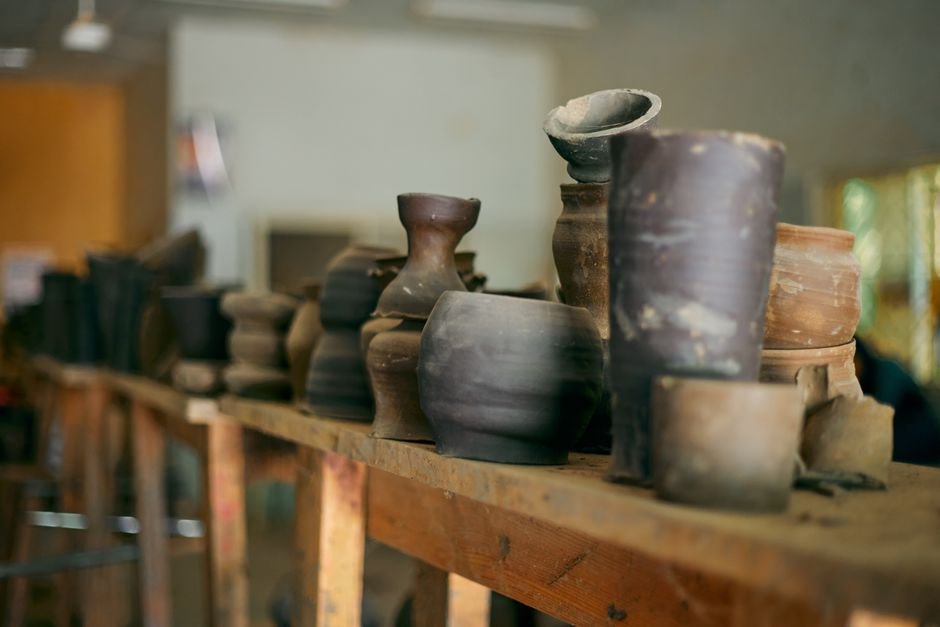
How These Types Compare For A Beginner
Earthenware is generally the most forgiving on the wheel, thanks to its softness and plasticity, though it demands more care once fired due to its fragility.
Stoneware offers a genuinely balanced middle ground, reasonably forgiving to work with while producing a durable, everyday-use finished piece.
Porcelain is typically the most technically demanding of the three, better suited to a beginner who’s already built some confidence with a more forgiving clay body first.
Most studios, including ours, recommend starting with stoneware precisely because it balances workability and durability so well for someone still developing their skills.
That said, the right starting clay also depends a little on what you actually want to make, so it’s worth thinking ahead to your goal, not just picking whatever’s easiest.
It’s also genuinely the most versatile choice if you’re not yet sure whether you’ll gravitate toward functional ware, sculptural work, or something in between.
There’s genuinely no wrong starting point though, and plenty of beginners have happily learned on earthenware or even ambitiously jumped straight into porcelain.
What matters more than the specific clay type is simply getting comfortable handling clay at all, since that basic familiarity transfers across every type you’ll eventually try.
What Competing Guides Leave Out
Many overviews explain firing temperature and appearance without mentioning how clay type genuinely affects glaze choice, and not every glaze is formulated to work across every clay body’s cone range.
Firing schedule compatibility rarely gets proper attention either, and a studio’s kiln typically fires to one consistent cone, which genuinely limits which clay types can actually be used there.
What a shared studio actually stocks is another gap most guides skip, and it’s genuinely more useful to know your specific studio’s options than to read about clay types you can’t access anyway.
Few guides mention that clay bodies within each category still vary meaningfully by brand and specific formulation, so two different stoneware clays can behave quite differently from each other.
Regional availability matters too, and what’s easy to source in one country or studio may be genuinely harder to find elsewhere, shaping which clay types feel like the default locally.
Cost differences also rarely get a mention, with porcelain typically priced higher than stoneware or earthenware due to its more refined, carefully controlled composition.
How each clay type responds to trimming and handling at the leather-hard stage is another practical detail many overviews skip entirely, despite it genuinely shaping the whole process.
Choosing Your First Clay Type To Try
If you’re brand new to pottery, a mid-range stoneware clay is a genuinely sensible, low-pressure starting point that balances workability and durability well.
If you’re specifically drawn to a soft, forgiving feel while learning basic wheel throwing, earthenware is also a genuinely reasonable place to begin.
If refined, delicate forms are your goal from the outset, porcelain is achievable, though expect a steeper learning curve than the other two options.
Whichever you choose, ask studio staff what’s actually available and compatible with the kiln schedule before committing to a larger project.
At Le Studio Art Space, we’re always happy to help you choose a first clay type suited to what you’re hoping to make.
There’s also nothing stopping you from trying a small piece in each of the three types over a few sessions, simply to feel the genuine difference for yourself firsthand.

Want to try different pottery clay types hands-on? Join an introductory class at Le Studio Art Space in Mordialloc.
Frequently Asked Questions
What’s the actual difference between stoneware and earthenware?
Stoneware fires hotter and becomes far less porous and more durable, while earthenware fires at a lower temperature and generally needs a glaze to be watertight.
Is porcelain really that much harder to work with?
Yes, its smooth, fine structure gives it less strength while wet, so it’s genuinely more prone to slumping or cracking than stoneware or earthenware for a beginner.
Can I mix different pottery clay types together?
Generally no, since different clay types shrink and mature at different rates, which can cause cracking or separation if combined in a single piece.
Which clay type should I ask for as a beginner?
A mid-range stoneware is usually recommended, and the team at Le Studio Art Space can point you toward what’s stocked and compatible with our kiln.
Does the clay type actually affect how a glaze looks once fired?
Yes, a clay body’s fired colour and porosity both genuinely influence how a glaze develops, so testing your specific clay and glaze combination together matters.
This article is provided for general educational purposes by Le Studio Art Space and reflects common studio practice.