Skutt and L&L kilns are both long established, reliable American brands, with Skutt generally known for its intuitive control panel design and L&L known for its distinctive hard ceramic element holders that simplify maintenance. Neither is objectively better, the right choice depends on a studio’s specific priorities.
Choosing a kiln is one of the biggest equipment decisions a studio ever makes, and it’s genuinely common to end up comparing Skutt and L&L, two of the most recommended American kiln brands in ceramics. At Le Studio Art Space, this exact comparison came up during our own equipment decisions, and the honest answer is that both brands are excellent, they simply prioritise slightly different things depending on how a studio actually plans to use its kiln day to day.
This comparison aims to give clear, practical criteria for when each brand suits a different studio, rather than declaring one an overall winner over the other.
Both brands have supplied schools, universities, and working studios for decades, and both show up constantly in kiln recommendations across ceramics communities, which is exactly why this comparison comes up so often for anyone furnishing a new or growing studio space.
What Skutt Kilns Are Known For
Skutt has been manufacturing kilns since 1953, when father and son team Ralph and Neil Skutt built the industry’s first multi-sided hobby kiln, a lightweight design that genuinely helped bring ceramics into home and small studio use for the first time in a way heavier, more industrial kilns never had.
The brand, now based in Portland, Oregon and still family owned into its third generation, has built a strong reputation specifically around intuitive control panel design, with many potters finding Skutt’s interface genuinely easy to program and monitor even without extensive technical kiln experience going in.
Skutt kilns and wheels are made in America and sold worldwide to artists, schools, and institutions, giving the brand a genuinely broad presence across both hobbyist and more serious professional ceramic settings.
Skutt also manufactures pottery wheels alongside its kiln range, giving studios the option of sourcing both major pieces of equipment from a single, well established brand if that kind of consistency matters to their purchasing decisions and long term equipment planning.
What L&L Kilns Are Known For
L&L Kiln Mfg has been manufacturing kilns since 1947, making it the oldest continuous American manufacturer of pottery and school kilns, now in its third generation of family ownership as well, a similarly long, stable history to Skutt’s own family run business.
The brand’s defining feature is its hard ceramic element holder, an innovation developed in the 1950s that protects the softer surrounding brick from the wear and bumping that happens naturally during loading and unloading a kiln over years of regular use.
This design genuinely simplifies element replacement and reduces the kind of soft brick damage that can shorten a kiln’s working life, which is part of why L&L has built such a loyal following among studios that prioritise long term durability.
L&L’s product range spans from small one cubic foot test kilns through to enormous hundred cubic foot production kilns, giving the brand genuine reach across everything from a home hobbyist setup to a large scale institutional or production pottery operation of considerable size.
Comparing Day To Day Use And Controls
Skutt’s control panel is often described by potters as particularly approachable, with straightforward programming that suits a studio where multiple people, including newer members, might need to operate the kiln with minimal training.
L&L’s kilns are equally programmable and reliable, though some potters find the hard element holder design changes the physical experience of maintenance slightly, generally for the better, since swapping elements is more straightforward than in a kiln without this feature.
Neither brand requires a specialist electrician for routine day to day operation once a kiln is properly installed and wired, though initial installation for either brand does typically need a qualified electrician familiar with the specific voltage and amperage requirements involved.
Both brands offer genuinely dependable electronic controllers at this point, so day to day programming ease has narrowed between them considerably compared to older kiln generations from either brand.

Loading and unloading physically feels slightly different between the two brands too, since L&L’s element holder design changes how the interior brick surface looks and feels compared to a standard element groove, though both remain straightforward once a potter gets used to their specific kiln.
Comparing Cost And Long Term Ownership
Purchase price between comparable Skutt and L&L models tends to be broadly similar, with actual cost depending more on kiln size, voltage requirements, and specific features than on brand alone.
Element replacement costs and frequency are where L&L’s hard element holder design can offer a genuine long term advantage, since reduced brick wear and simpler element swaps can lower both the cost and hassle of routine maintenance over a kiln’s working life.
Servicing and replacement parts are widely available for both brands through established ceramic supply networks, so neither brand leaves a studio stranded if a part needs replacing down the line.
Resale value for both brands also tends to hold up reasonably well, since both are recognised, trusted names that a secondhand buyer is likely to recognise and trust, unlike a lesser known or unbranded kiln that might be harder to sell on later.
What Competing Guides Leave Out
How each brand performs in a shared studio with frequent firings rarely gets honest, practical treatment. A community studio like Le Studio Art Space fires far more often than a typical home studio, and that heavier use makes long term durability features, like L&L’s element holders, genuinely more valuable in that specific context.
Parts availability for Australian owners is another gap worth naming directly. Both brands are established enough to have reasonable support through specialty ceramic suppliers here, though shipping times for a specific replacement part can vary and are worth checking before a purchase decision, not after something breaks unexpectedly mid-firing-season.
Noise and heat output during firing are rarely compared directly either, though both brands perform comparably in this respect, and any meaningful difference potters notice usually comes down to kiln size and studio ventilation rather than brand-specific engineering.
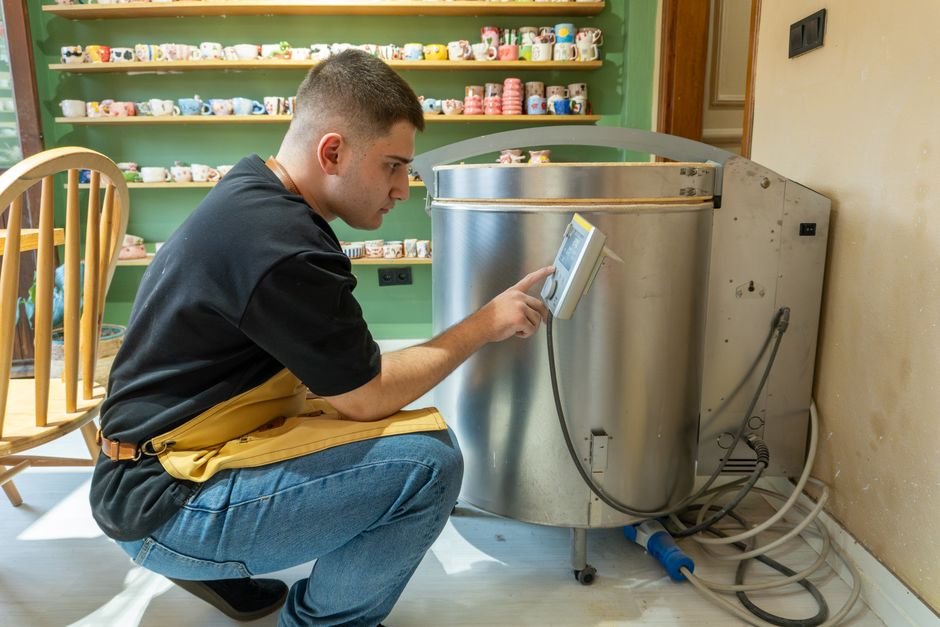
Warranty coverage and manufacturer support are also worth comparing directly at the time of purchase, since both companies stand behind their kilns with genuine manufacturer support, though specific terms can vary by model and are worth reading carefully before buying rather than assuming they’re identical.
Which Kiln Suits Which Kind Of Studio
A studio prioritising the most intuitive, approachable control panel for a team of members with varying technical experience may lean toward Skutt, given its long reputation for user-friendly programming that welcomes newer members without a steep learning curve.
A studio expecting particularly heavy, frequent firing cycles, where long term durability and simplified element maintenance matter most, may find L&L’s hard element holder design a genuinely compelling long term advantage worth the specific research into that feature.
Most studios report that either brand serves a working ceramic space extremely well, and the deciding factor often comes down to specific model availability, sizing needs, and budget at the time of purchase rather than a fundamental quality gap between them.
Talking to other studios or potters who already own a specific model, and asking honestly about their maintenance experience over several years of use, genuinely rounds out the general research covered here with real world, lived-in detail.
Curious which kilns Le Studio Art Space actually uses in Mordialloc? Come see them in person and ask about our firing service.
Frequently Asked Questions
Is one of these kiln brands genuinely more reliable than the other?
Both are well established, reliable brands with decades of manufacturing history. Neither is objectively more reliable, though each brand’s specific design strengths may matter more depending on how heavily a kiln gets used.
Which kiln is easier for a beginner to actually operate?
Many potters find Skutt’s control panel particularly approachable for someone newer to programming a kiln, though L&L’s electronic controllers are also genuinely user friendly once you’re familiar with the interface.
Does L&L’s element holder design really make a practical difference?
Yes, genuinely. It reduces soft brick wear and simplifies element replacement, which can lower long term maintenance hassle, particularly in a kiln firing frequently in a busy shared studio setting.
Can I get parts for either brand easily in Australia?
Both brands have reasonable support through specialty ceramic suppliers here, though it’s worth checking specific part availability and shipping times before purchasing, rather than assuming instant local stock for every model.
Which kiln does Le Studio Art Space actually use?
In our experience, both brands have genuine merits, and the specific kilns in our own ceramic studio reflect our particular firing volume and needs. Come visit and ask us directly during a class or firing service enquiry.
This article is provided for general educational purposes by Le Studio Art Space and reflects publicly available product information and common studio practice.