Skutt kilns are American-made electric kilns and pottery wheels manufactured by a family-owned company that has built ceramic equipment since 1953, and they have become a genuine studio standard because of their reliability, straightforward digital controls, and widely available replacement parts. Working studios lean on Skutt because a kiln that breaks down mid-firing costs real time and material, and Skutt’s reputation for dependable, easily serviced equipment directly addresses that risk. They are not the only well-regarded kiln brand, but they are one of the most consistently trusted across teaching and professional studios alike.
Anyone shopping for a kiln, or just curious why their studio uses the equipment it does, runs into the name Skutt fairly quickly. Here at Le Studio Art Space in Mordialloc, our own equipment choices come up in conversation with members often, so here is an honest rundown of what makes Skutt kilns so widely trusted.
What Skutt Kilns Are
Skutt Ceramic Products was founded in 1953 by Ralph and Neil Skutt, who built the industry’s first multi-sided hobby kiln, a lightweight design that helped bring ceramics into home and small studio use rather than keeping it confined to large industrial setups. That original innovation still shapes the brand’s reputation today.
The company is now based in Portland, Oregon, and remains family owned and operated, currently led by a third generation of the Skutt family. Their product range covers electric kilns across a wide span of sizes, along with Brent pottery wheels, all manufactured in the United States and sold to artists, schools, and institutions around the world.
That original multi-sided design is worth appreciating for what it actually solved. Before it existed, kilns capable of firing ceramics were largely industrial equipment out of reach for an individual artist or a small classroom, so a genuinely affordable, manageable kiln built specifically for smaller-scale use was a real turning point for who could practically access ceramics in the first place.
That legacy still shows up in how the company approaches product development today, generally favouring incremental, well-tested improvements over flashy redesigns, which is exactly the kind of steady, conservative engineering philosophy that busy working studios genuinely value in equipment they’re relying on daily.
Why Skutt Is So Common In Working Studios
Reliability is the reason that comes up first in almost every conversation about Skutt kilns. A kiln failure mid-firing can mean lost work, wasted materials, and a disrupted studio schedule, so studios gravitate toward equipment with a strong track record for finishing firings without drama.
Control panel simplicity matters just as much day to day. Skutt’s digital controllers are widely regarded as intuitive, even for staff or members who aren’t kiln specialists, which reduces the risk of a programming mistake ruining a firing. Parts availability rounds out the picture, since Skutt’s popularity means replacement parts and knowledgeable technicians are relatively easy to find compared to less common kiln brands, keeping repairs faster and cheaper when something does eventually need attention.
Warranty support adds another layer of confidence for studios making a genuinely significant equipment purchase. A kiln backed by a manufacturer with a strong reputation for standing behind its products reduces the financial risk of a major breakdown, which matters a great deal when a single kiln might be firing work for dozens of different studio members regularly.
It’s worth asking directly about warranty terms and what they actually cover, since the details can vary meaningfully between models and over time. A clear understanding of what’s included upfront avoids unpleasant surprises if something does eventually need attention down the line.
Skutt Kiln Sizes And Studio Fit
Skutt makes kilns across a genuinely wide size range, from compact models suited to a home hobbyist working solo, up to large capacity kilns built for commercial studios firing high volumes of work regularly. That range is part of why the brand shows up in such different settings, a single potter’s garage studio and a busy teaching studio can both be running Skutt equipment scaled appropriately to their needs.
Choosing the right size comes down to realistic firing volume and available space rather than simply buying the biggest option available. A shared studio like ours needs enough capacity to keep multiple members’ work moving through regular firing cycles, which is a genuinely different calculation than an individual potter firing occasional small batches at home.
Electrical requirements are worth factoring into that sizing decision too, since larger kilns typically need dedicated wiring and higher voltage service that a standard home power supply may not provide. This is one of the more practical reasons many hobbyist potters choose to fire through a shared studio rather than installing a large kiln of their own at home.
What It Is Like Using A Skutt Kiln Day To Day
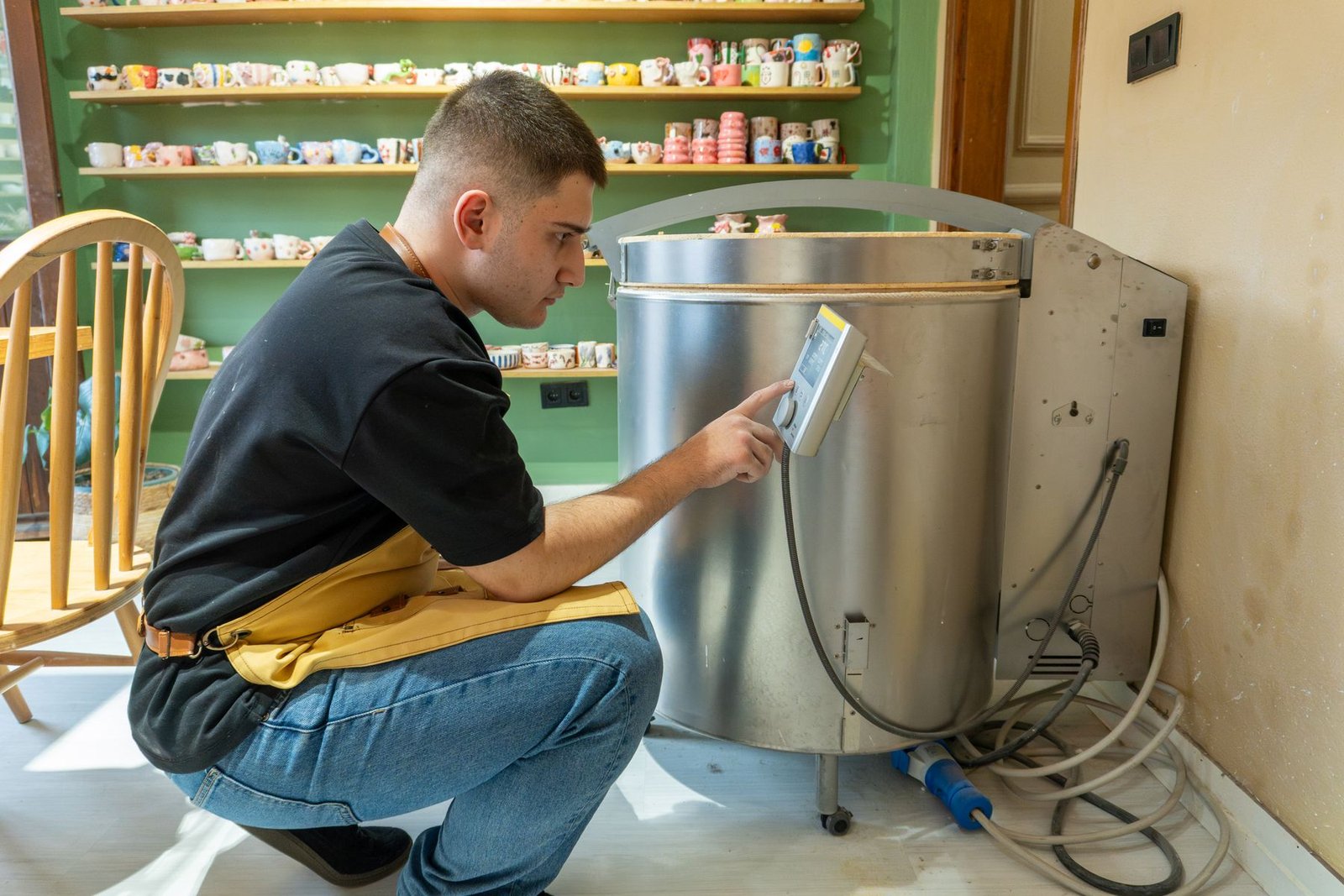
Day to day, a Skutt kiln’s digital controller lets you select or program a firing schedule and largely trust it to run correctly, checking in periodically rather than babysitting the entire firing. Built-in safety features, things like lid switches that stop elements from firing if the lid is opened, are standard on modern models and add a real layer of everyday reassurance in a shared studio setting.
In a busy studio workflow, that dependability compounds. Staff and members can load, program, and start a firing with confidence it will run correctly overnight or over a weekend, which matters enormously when a kiln is running almost constantly to keep pace with a full class and open studio schedule.
Monitoring a firing remotely, a feature available on some Skutt controller models, adds a further layer of convenience for a busy studio, letting staff check progress without needing to be physically present the entire time. It’s a genuinely practical feature once a kiln is running near-daily rather than occasionally.
What Competing Guides Leave Out
Most kiln buying guides focus heavily on upfront price and capacity, while glossing over running costs and realistic maintenance expectations. Electricity use, element replacement over time, and periodic servicing all add up, and being upfront about that ongoing cost gives a much more honest picture than sticker price alone.
Shared studio scheduling is another gap worth naming plainly. In a studio like Le Studio Art Space’s Ceramic Studio, a kiln doesn’t just need to work reliably, it needs to fit into a shared firing schedule that multiple members are relying on, which is part of why our Firing Service plans firings around realistic turnaround times rather than promising instant results.
Element wear is a third gap worth naming honestly. Kiln elements gradually degrade with repeated firing regardless of brand, and replacing them is a routine part of kiln ownership rather than a sign something has gone wrong. Studios that fire constantly, like ours, factor element replacement into regular maintenance rather than treating it as an unexpected failure.
Skutt Versus Other Kiln Brands
Skutt is far from the only respected kiln manufacturer, and it’s worth being fair about that. Other brands offer their own strengths, sometimes a different price point, sometimes features suited to a specific niche like glass work or large-scale production that a Skutt model might not be optimized for.
Where Skutt tends to stand out is the specific combination of reliability, simple controls, and easy parts access that matters most in a busy teaching or shared studio environment. If your setup has more specialized needs, a different budget, or a particular firing style, it’s genuinely worth comparing a few brands rather than assuming Skutt is automatically the right fit.
Talking to a technician or supplier familiar with the specific brands available in your region is genuinely worth doing before a major kiln purchase, since local parts availability and servicing support can vary meaningfully by country and region in ways a brand’s general global reputation doesn’t fully capture.

Seeing a Skutt kiln running in a real working studio tells you more than any spec sheet. Come see a Skutt kiln in action and ask about the firing service at Le Studio Art Space in Mordialloc.
Frequently Asked Questions
Are Skutt kilns actually worth the reputation, or is it just brand hype?
In our experience the reputation holds up, mostly because of genuine reliability, straightforward controls, and how easy it is to find parts and service when something does need attention. That said, other kiln brands are also well regarded, so it’s worth comparing options against your specific needs.
Is a Skutt kiln too complicated for someone who isn’t a kiln expert?
Not really, the digital controllers are widely regarded as intuitive even for staff or students without technical kiln experience. Most studios, including ours, train members on the specific controls rather than expecting anyone to figure it out alone.
How much does it actually cost to run a Skutt kiln regularly?
This depends on kiln size, firing frequency, and local electricity costs, so there’s no single universal number, but running costs and periodic element replacement are genuine ongoing expenses worth planning for beyond the kiln’s upfront price. Many studios factor this into firing service pricing rather than passing it along unpredictably.
What size Skutt kiln does a shared studio actually need?
This depends on realistic firing volume and available space rather than simply choosing the largest option. A busy shared studio typically needs enough capacity to keep multiple members’ work moving through regular firing cycles without long delays.
Should I just assume Skutt is the best choice for my own kiln purchase?
Not automatically. Skutt has earned a strong reputation, but other kiln brands genuinely suit certain budgets, specialized needs, or firing styles better, so it’s worth comparing a few options against your specific situation rather than assuming one brand fits every case.
This article is provided for general educational purposes by Le Studio Art Space and reflects publicly available company information and common studio practice. Always consult a qualified kiln technician for equipment purchasing or servicing decisions.