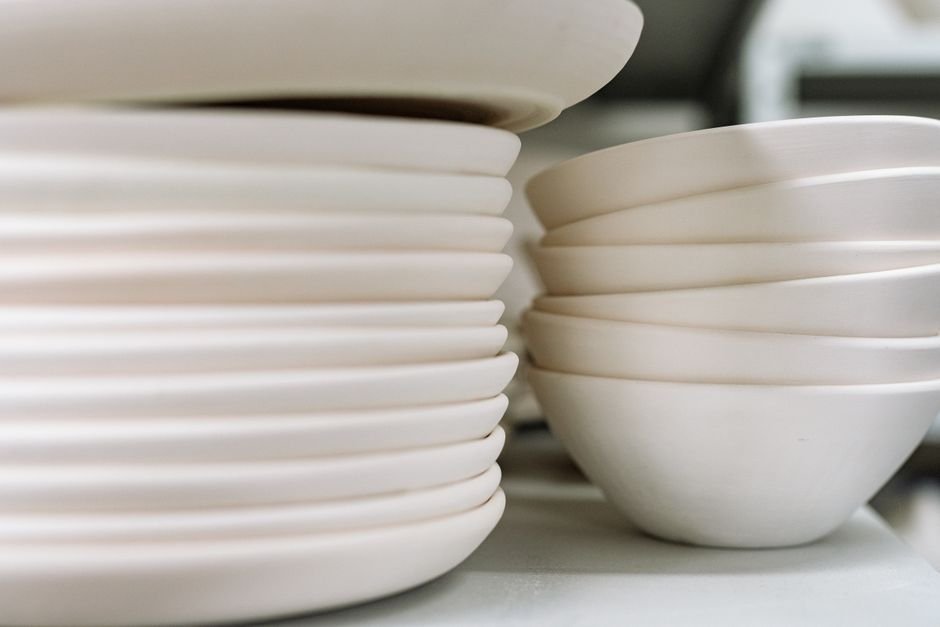
Bisqueware is pottery that has been fired once in a kiln but not yet glazed. The first firing turns fragile dried clay into a hard, permanent ceramic that is still porous, so it soaks up glaze, underglaze and paint easily. It is the blank, chalky white or pale piece you choose at a paint your own studio before decorating it.
If you’ve ever visited a paint your own pottery studio, you’ve already met bisqueware. It’s the shelves of plain white mugs, plates and figurines waiting to be decorated. Yet the word itself rarely gets explained, and plenty of people walk away thinking it’s a type of clay or a brand.
At Le Studio Art Space in Mordialloc, bisqueware moves through our ceramic studio every week, from student pieces to work booked in through our firing service. This guide explains what bisqueware means, how it’s made, why it behaves the way it does, what you can do with it, and how to handle it without heartbreak.
What Bisqueware Means
Bisqueware simply means clay ware that has been through its first firing, called the bisque firing. You’ll also hear it called bisque or biscuit ware, which is where the name comes from. It isn’t a clay type. Earthenware, stoneware and porcelain can all become bisqueware.
After this firing, the piece is hard and permanent. You can’t add water and turn it back into soft clay, which is the big difference from unfired work. Chemically, the clay has changed for good.
At the same time, bisqueware is unglazed and still porous. Tiny pores run through the body, so it feels dry and slightly rough, and it drinks up water if you touch it with a wet sponge.
Most bisqueware is a pale white, cream or buff colour, though red earthenware bisque has a warm terracotta tone. That plain surface is exactly what makes it such a good canvas.
In everyday studio talk, people often shorten bisqueware to just bisque, as in a bisque mug or a bisque load. They all mean the same once fired, unglazed stage.
How Bisqueware Is Made
Every piece starts as soft, workable clay shaped on a wheel, by hand or in a mould. Once formed, it’s left to dry slowly until it reaches the bone dry stage, when almost all the loose water has evaporated and it feels room temperature rather than cool.
Dry, unfired clay is called greenware, and it’s incredibly fragile. A firm squeeze can snap a handle, and a drop of water can soften it. Our guide to greenware in ceramics explains this stage in more detail.
The greenware is then stacked in a kiln and fired slowly. Bisque firings usually reach a relatively low temperature compared with later glaze firings. At Le Studio, our firing service bisque fires at around cone 06, roughly 960 to 1000 degrees Celsius.
During the firing, remaining water and organic matter burn away, and the clay particles begin to fuse at their edges. The kiln then cools slowly, and what comes out is bisqueware.
Because nothing is glazed yet, pieces can touch and even nest inside each other in a bisque load. That’s one reason studios bisque fire everything first, since it packs the kiln efficiently. Our piece on the stages of clay from wet to fired shows where bisque fits in the full journey.

Why Bisqueware Is Porous
The bisque firing is deliberately kept cool enough that the clay doesn’t fully mature or vitrify. Its particles stick together, but there are still countless microscopic gaps between them, and those gaps are the pores.
That porosity is the whole point. When you dip bisqueware in glaze, the water in the glaze is drawn into the pores, leaving an even layer of powdery glaze stuck to the surface. Without that suction, glaze would simply slide off.
The same thing happens with underglaze and paint. The surface grips colour well, which is why paint your own studios use bisque rather than glazed blanks.
Porosity also explains a few quirks. Bisqueware can feel slightly cool and dusty, it marks easily if you touch it with greasy hands, and it can soak up spills or stains that are hard to remove.
The exact porosity varies with the clay and the bisque temperature. A slightly hotter bisque produces a slightly denser, less absorbent surface, which affects how thickly glaze goes on.
What You Can Do With Bisqueware
The most common next step is glazing. Bisqueware is dipped, poured, brushed or sprayed with glaze, then fired again at a higher temperature so the glaze melts into a glassy coat. Our guide to how ceramic glaze works covers that process.
Painting is the other big option. Underglaze colours brushed onto bisque, then sealed with clear glaze and fired, give bright, detailed designs. Our recent beginner’s guide to ceramic paint explains which products need firing and which don’t.
You can also leave bisqueware as it is. Some makers like the soft, matte look for decorative pieces, sculptures or wall art. Just remember it stays porous, so it isn’t watertight.
Unfired decoration is possible too. Acrylics or other cold finishes can be used on bisqueware for display pieces, although they sit on the surface rather than fusing with it.
Finally, some potters keep a few bisque test tiles handy. They’re perfect for trying glaze combinations before committing a finished pot, which saves a lot of guessing.
Bisqueware also makes a forgiving surface for techniques like wax resist, sponging and stencilling. Because the piece is already hard, you can handle it, turn it and rework a design without worrying about denting soft clay. Many beginners find that this stage, rather than throwing or hand building, is where they first feel genuinely creative with ceramics, since the shape is done and the surface is all theirs.
Handling Bisqueware Safely
Bisqueware is much tougher than greenware, but it isn’t indestructible. Thin rims, handles and delicate details can still chip or crack if they’re knocked, dropped or stacked carelessly.
Carry pieces by their body, not their handles or rims, and use both hands for anything larger than a cup. On shelves, give each piece a little space so they don’t rub together.
Keep bisque clean. Wash your hands before handling it, because oils and lotions can repel glaze and leave bare patches after the glaze firing. A quick wipe with a damp sponge before glazing removes dust.
If you sand a bisque piece to smooth rough spots, do it lightly, wear a suitable dust mask, and wipe the dust away with a damp sponge rather than blowing it. Fine ceramic dust isn’t something you want to breathe in.
Finally, store bisque somewhere dry. Because it absorbs moisture, pieces left in a damp spot need extra time to dry out before glazing.
If a bisque piece does crack, it usually can’t be repaired in a way that survives another firing. Hairline cracks tend to open up in the glaze kiln, so many potters simply retire a cracked piece to the test shelf or use it for practising brushwork. It’s a small loss compared with discovering the crack after you’ve spent an afternoon decorating it, so check each piece carefully under good light before you start.
What Competing Bisqueware Guides Leave Out
Many guides blur bisqueware and greenware together. The difference matters. Greenware is dried but unfired, so it’s fragile and can still be reclaimed with water. Bisqueware has been fired, so it’s hard, permanent and ready for glaze.
They also rarely explain how bisqueware differs from finished glazed pottery. A glazed piece has a glassy coating and, depending on the clay and firing, may be much less absorbent. Bisqueware has no protective coat, so it isn’t suitable for holding food or liquids.
Another gap is that bisque isn’t always the same. A commercial bisque blank from a supplier and a student’s bisqued bowl may be fired at different temperatures and absorb glaze differently. If glaze goes on too thin or too thick, that difference is often why.
It’s also worth knowing that some potters skip bisque firing entirely and glaze greenware in a single firing. It saves time and energy, but it’s trickier and less common for beginners.
If you’d like to see bisqueware in action, our ceramic studio and workshops and classes are the best places to start.
Want to decorate a piece of bisqueware yourself? Visit Le Studio Art Space in Mordialloc to ask about current painting sessions and classes, and let our firing service take your design through the final glaze firing.
Frequently Asked Questions
Is bisqueware the same as unglazed pottery?
Mostly, yes. Bisqueware is fired but unglazed. Some finished pottery is also left unglazed on purpose, but the term bisqueware usually means a piece waiting for glaze or paint.
Can you drink from bisqueware?
It isn’t a good idea. Bisqueware is porous, so it absorbs liquid, can harbour residue, and isn’t sealed. Glaze it properly first.
Why does my bisqueware feel dusty?
The surface is matte and slightly powdery, and kiln dust settles on it. A quick wipe with a damp sponge before glazing removes most of it.
Can bisqueware go back into the kiln?
Yes. In fact it usually does, for the glaze firing. Some potters even re-bisque a piece if it gets wet or contaminated before glazing.
Does Le Studio Art Space bisque fire work for other potters?
Yes, Le Studio Art Space offers bisque firing through its firing service. Pieces need to be completely dry, clearly named and placed on the right shelf before firing.
This article is provided for general educational purposes by Le Studio Art Space. Firing results vary with clay, kiln and schedule, so always follow your studio’s guidance and product instructions.