Bisque fired pottery is clay that has been through its first, lower temperature kiln firing. The heat drives out water, burns away organic matter and permanently fuses the clay particles, turning fragile greenware into a hard but porous ceramic. Potters then glaze or decorate it and fire it a second time to finish it.
Most handmade pottery goes into the kiln twice, and the first trip is the bisque firing, which produces bisque fired pottery. It’s a step that’s easy to overlook because the results look so plain: a matte, pale pot that seems unfinished. But that plain stage is doing a lot of quiet work, and understanding it helps everything that comes after make more sense.
At Le Studio Art Space in Mordialloc, bisque firing is one of the most common jobs our kilns handle, both for studio members and for potters who use our firing service. This guide explains what bisque firing does, why potters fire twice, what happens inside the clay, what bisque fired pottery looks and feels like, and what comes next.
What Bisque Firing Does To Pottery
Before firing, dried clay is called greenware. It looks solid but it’s fragile, and if you added water it would slowly turn back into soft clay. Bisque firing changes that permanently.
During the firing, the kiln heats slowly to a moderate temperature. At Le Studio our bisque firings reach around cone 06, roughly 960 to 1000 degrees Celsius. That heat transforms the clay into a hard ceramic that can no longer be softened with water.
The result is strong enough to handle, dip and decorate without the risk of it collapsing or dissolving. That alone makes the rest of the process much safer for the pot and much less stressful for the potter.
Bisque firing also makes the surface ideal for glazing. Because the clay hasn’t fully matured, it stays porous and absorbs water from glaze, holding an even coat in place.
Finally, bisque firing burns out impurities that could cause trouble in a glaze firing. Organic material and some trapped gases escape at this stage, so they’re less likely to bubble through the glaze later. Our guide to kiln firing temperatures places bisque in context with other firings.
Why Potters Fire Pottery Twice
The two firing approach separates two very different jobs. The bisque firing makes the clay safe to handle, and the glaze firing melts glaze and matures the clay body.
Glazing raw greenware is possible, but it’s riskier. Wet glaze can soften unfired clay, causing cracks, warping or even collapse. Thin or delicate forms are especially vulnerable.
Bisque firing also lets potters load kilns more efficiently. Unglazed pieces can touch and even stack inside one another, so many more pots fit in a bisque load than in a glaze load, where pieces must be kept apart.
It reduces losses too. If a pot is going to crack from trapped moisture or uneven walls, it often does so in the bisque firing. Finding that out before you spend time glazing saves effort and materials. Our article on why pottery can explode in the kiln explains the most common cause.
Some potters do single fire, glazing greenware and firing once. It saves energy and time, but it needs careful technique and suitable glazes, so most studios and beginners stick with two firings.
What Happens Inside The Clay
Even bone dry clay still holds some water. Early in a bisque firing, that leftover physical water evaporates. If it escapes too quickly, steam pressure can crack or burst a pot, which is why the early part of a firing is kept slow.
As the temperature climbs, water that’s chemically bound within the clay minerals is driven off. Once this happens, the clay can never return to its plastic state. This is the moment it truly becomes ceramic.
Organic material in the clay, such as tiny bits of plant matter, burns away. Good airflow in the kiln helps this happen cleanly.
The clay also passes through changes in its silica content, which is part of why kilns heat and cool at controlled rates. Rushing these stages can stress the clay.
Toward the top of the bisque firing, particles begin to bond at their contact points, a process called sintering. The pot shrinks a little and becomes hard, but it doesn’t fully melt or seal, which is what leaves it porous. Our guide to the stages of clay from wet to fired shows the full sequence.
What Bisque Fired Pottery Looks And Feels Like
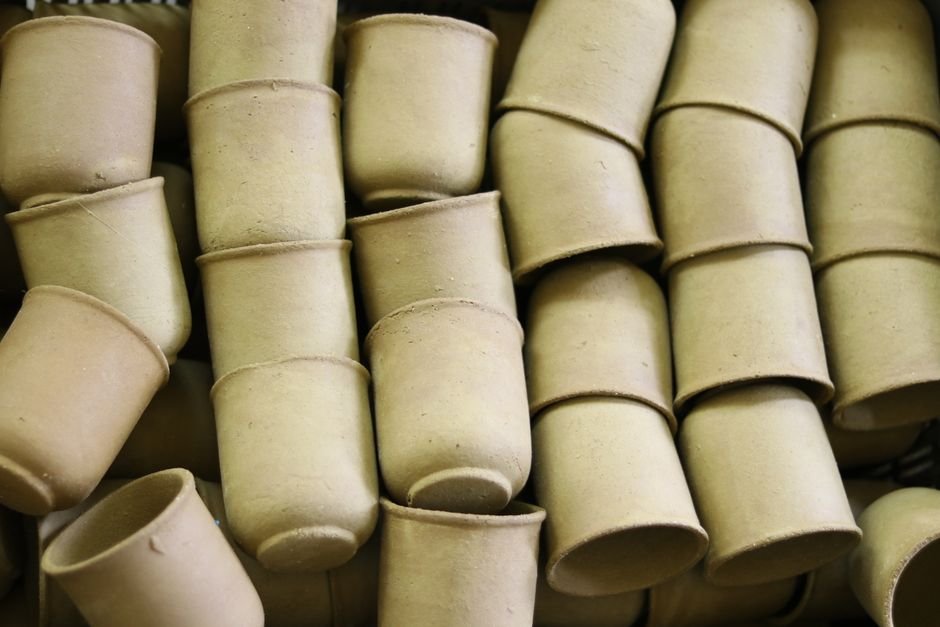
Bisque fired pottery usually has a matte, chalky surface. It feels dry and slightly rough, a little like an unglazed terracotta pot or a piece of chalk.
The colour depends on the clay. White stoneware and porcelain bisque turn white or pale cream, buff clays look warm beige, and red earthenware becomes a soft terracotta.
Tap a bisque piece lightly and it should sound fairly clear rather than dull. A dull thud can sometimes suggest a crack, although thickness and shape affect the sound too.
Touch it with a damp finger and you’ll feel the surface drink up the moisture. That absorbency is exactly what you want before glazing.
Bisque pieces can also look a little different from greenware in size. Most clays shrink slightly during bisque firing, with further shrinkage happening in the glaze firing. Our clay shrinkage calculator helps estimate the final size.
What Comes Next After Bisque Firing
The next step is usually glazing. Potters clean the bisque with a damp sponge, wax the foot so glaze won’t stick to the kiln shelf, then dip, pour, brush or spray glaze onto the surface.
Some potters decorate first with underglaze or slip. Underglazes are painted onto bisque, then covered with clear glaze so the colours are sealed. Our recent guide to ceramic paint for beginners explains how these products fit together.
Once glazed and dry, the piece goes back into the kiln for the glaze firing. This firing typically reaches higher temperatures, melting the glaze into a glassy coat and maturing the clay body.
For paint your own studios, bisque fired pottery is the starting point. You paint the bisque, and the studio handles the clear glaze and final firing. Our guide to what bisqueware is covers that side.
Some pieces stay at the bisque stage on purpose. Decorative sculptures or planters may be left unglazed for their natural matte look, though they’ll remain porous.

What Competing Bisque Fired Pottery Guides Leave Out
Many guides treat bisque temperature as a fixed number, but it isn’t. Bisque firing slightly hotter makes pottery less porous, so glaze goes on thinner. Bisque firing slightly cooler leaves it more absorbent, so glaze goes on thicker. Potters adjust dipping times to suit.
That’s why consistency matters. If a glaze behaves differently from one batch to the next, an unexpected change in bisque temperature can be a hidden cause. Our pyrometric cone chart and guide to what cone numbers mean explain how temperatures are measured.
Guides also rarely mention how bisque firing connects to a studio firing service. When you book a bisque firing, pieces must be completely dry, as hidden moisture is the leading cause of cracks. At Le Studio, our firing service asks for work to be fully dry, clearly named and placed on the correct shelf.
Shared kilns also mean your work is fired alongside others. That’s normal and efficient, but it’s why good labelling and realistic timing expectations matter.
Another point competing guides skip is that bisque firing is the best moment to catch problems. Before glazing, look over each bisqued piece in good light. Hairline cracks, thin spots and rough rims are far easier to spot on plain bisque than under glaze, and a quick check here can save a whole glaze firing from disappointment.
Finally, bisque temperature should suit your clay. Most bisque firings sit in a similar range whatever the final firing will be, but your clay supplier’s guidance is the best place to start, and a studio technician can tell you how their kilns are set up.
If you’d like to learn the whole process, our ceramic studio and workshops and classes walk you through every firing step.
Have greenware that’s ready for its first firing? Ask Le Studio Art Space in Mordialloc about bisque firing through our firing service, and we’ll explain how to prepare and drop off your work.
Frequently Asked Questions
Is bisque fired pottery waterproof?
No. Bisque fired pottery is still porous, so it absorbs water. Glazing and a second firing are usually needed to make a piece more water resistant.
Can I skip bisque firing?
Some potters single fire, glazing greenware and firing once. It’s possible but trickier, and most studios and beginners use two firings for better results.
Why did my pot crack in the bisque firing?
Hidden moisture is a common cause, along with uneven wall thickness and trapped air. Drying pieces fully and slowly helps reduce the risk.
How long does a bisque firing take?
The firing itself often takes many hours, followed by a long cooling period. Including kiln scheduling, most studios return work within days to a couple of weeks.
Does Le Studio Art Space bisque fire for outside potters?
Yes. Le Studio Art Space offers bisque firing through its firing service for potters at the studio and beyond. Work must be completely dry and clearly labelled.
This article is provided for general educational purposes by Le Studio Art Space. Firing results depend on clay, kiln and schedule, so follow your clay supplier’s and studio’s guidance.