Hand painted pottery is ceramic ware decorated by a person using a brush, slip or carving tool rather than a printed decal or machine transfer. People value it for the small variations every piece carries, from brush marks to slightly uneven lines, which show a maker’s hand and make each item genuinely one of a kind.
There’s something about hand painted pottery that draws people in. Maybe it’s the loose brushstroke on a breakfast bowl, a slightly wobbly border on a jug, or the way a pattern on one plate never quite matches the next. In a world of identical mass produced homewares, those differences feel personal.
At Le Studio Art Space in Mordialloc, we’re surrounded by makers who decorate their work by hand, and we never tire of seeing pieces come out of the kiln. This guide looks at what makes pottery hand painted, why imperfection is part of the appeal, the main techniques, how to live with hand painted pieces, and how to tell real handwork from printed decoration.
What Makes Pottery Hand Painted
At its simplest, hand painted pottery means a person applied the decoration by hand. That might be brushwork in underglaze or glaze, painted slip, carved lines, or a combination of all three. The key is that each mark was made individually rather than printed in one go.
Mass produced ceramics are often decorated with decals, which are printed images transferred onto the glaze and fired on, or with screen printing and pad printing machines. These methods are fast and consistent, which is exactly why they look so uniform.
Hand painted pieces sit at the other end of the spectrum. Even skilled decorators who repeat the same pattern hundreds of times leave subtle differences in line weight, spacing and colour density from one piece to the next.
Some pottery mixes both approaches. A factory might print an outline and have decorators fill it in by hand, or a studio potter might use a stamp alongside freehand brushwork. Calling something hand painted usually means the hand work is significant, not just a single dab of colour.
Traditions of hand painted ceramics run across the world, from Chinese blue and white porcelain to Spanish and Italian maiolica, Dutch Delftware and Japanese brushwork. Our article on why Japanese ceramics are so highly regarded touches on one of these traditions.
The Character In Imperfection
Slight variation is part of what people love about hand painted pottery. A brushstroke that thins at the end, a dot that’s a little larger than its neighbours, or a border that drifts slightly as it wraps around a bowl all carry evidence of a person at work.
These marks give each piece a rhythm. Many collectors talk about being able to see the speed and confidence of a decorator’s hand, especially in loose, fluid brushwork.
Imperfection also creates individuality. If you buy a set of hand painted mugs, each one will be a little different, which often makes them feel more like a collection than a matching set.
There’s a cultural side too. Ideas like the Japanese appreciation of wabi sabi, finding beauty in imperfection and impermanence, have influenced how many people see handmade ceramics today.
Of course, there’s a difference between charming variation and careless work. Good hand painting still has intention, balance and skill. The variation comes from the process, not from a lack of care.
Kiln firing adds its own layer of individuality. Glaze can pool slightly thicker in one place, a colour can break softly over an edge, or a brushstroke can blur a touch as the glaze melts. Even two pieces painted side by side by the same person rarely come out of the kiln looking identical, and that unpredictability is a big part of the charm.
Common Hand Painted Pottery Techniques
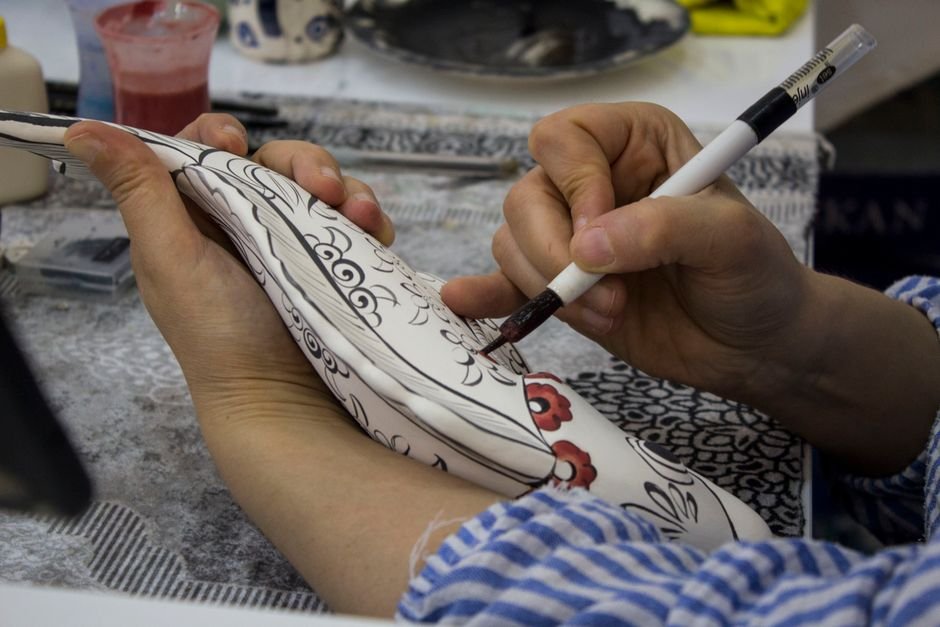
Brush painting is the most familiar technique. Decorators use underglaze, glaze or oxide washes and a range of brushes to paint patterns, figures or abstract marks. Underglaze is often painted onto bisque and covered with clear glaze, while some traditions paint colours directly onto an unfired white glaze. Our guide to underglaze and how to use it explains the basics.
Sgraffito takes a different approach. A layer of coloured slip or underglaze is applied to leather hard clay, then scratched away to reveal the clay beneath, creating crisp line drawings. Our article on the tools you need for sgraffito shows how it’s done.
Slip decoration uses liquid clay as paint. Potters can trail it from a bottle, brush it on, or marble it, building raised lines and soft blended areas. Slip trailing has a long history in English country pottery and many other traditions.
Wax resist and masking techniques help decorators create clean shapes. Painting wax onto parts of a pot stops glaze sticking there, leaving crisp patterns. Our guide to how wax resist works goes deeper.
Many makers combine techniques. A piece might have slip trailed lines, brushed colour and sgraffito details all working together, and that layering is often what gives hand painted pottery its depth.
Hand Painted Pottery In Everyday Life
Hand painted pottery isn’t only for display. Many people use hand painted mugs, bowls and plates every day, and part of the pleasure is noticing small details while you eat or drink.
Mixing hand painted pieces with plain ware is a simple way to bring character to a kitchen. A single decorated serving bowl or a handful of patterned side plates can lift an otherwise simple table setting.
Display pieces work well on open shelves, mantels or walls. Grouping pieces by colour or pattern creates a cohesive look, while a single statement platter can become a focal point.
Hand painted pottery also makes meaningful gifts, especially when it’s made locally or by someone you know. A piece with a story often gets used and treasured far longer than a mass produced alternative.
Whether a piece is suitable for food depends on the materials and firing, not on whether it’s hand painted. If you’re unsure, ask the maker or check any labelling before using it for food.
Caring For Hand Painted Pottery
Care depends on how the piece was made. Decoration sealed under or within a fired glaze is usually more durable than unfired paint on the surface, but every piece is different.
Gentle hand washing is a sensible default. Use warm water and a soft sponge rather than abrasive scrubbers, which can dull glaze surfaces and wear away delicate details over time.
Many makers suggest caution with dishwashers and microwaves. Harsh detergents and repeated hot cycles can gradually affect some glazes and overglaze decoration, and metallic lustres shouldn’t go in a microwave. Follow any advice from the maker.
Avoid sudden temperature changes. Moving a cold piece straight into a hot oven or pouring boiling water into a chilled mug can stress ceramics and cause cracks.
For display pieces, dusting with a soft cloth is usually enough. Keep pieces out of direct, harsh sunlight if they have unfired decoration, as some colours may fade over time.

What Competing Hand Painted Pottery Guides Leave Out
Few guides explain how to tell hand painted pottery from decal or printed pieces. Look closely at lines and edges. Brushwork varies in thickness and often shows tapered ends, while printed decoration has consistent lines and sometimes visible dots from the printing process.
Compare repeated motifs. On a hand painted piece, the same flower or leaf will differ slightly each time. On a printed one, every repeat is identical. Raised or textured lines can also hint at slip trailing, while a decal usually sits as a flat image. Our guide to how ceramic decals work shows what those look like.
Check edges where decoration meets the glaze. Decals can leave a faint outline or slight sheen difference around an image.
Another gap is how to try hand painting yourself. You don’t need to be an illustrator. Starting with simple patterns on bisqueware is an easy entry point, and our beginner’s guide to ceramic paint and guide to bisqueware explain the materials.
When you’re ready to go further, our ceramic studio, workshops and classes and firing service give you everything you need to make and decorate pieces from scratch.
Want to leave your own mark on clay? Try hand painting a piece at Le Studio Art Space in Mordialloc, where classes and our in-house firing service help you turn simple brushwork into finished pottery.
Frequently Asked Questions
How can I tell if pottery is really hand painted?
Look for variation in line thickness, tapered brush ends and small differences between repeated motifs. Printed decoration is usually perfectly uniform.
Is hand painted pottery worth the higher price?
Many people think so, because each piece takes individual time and skill. Value is personal, but you’re paying for craftsmanship rather than mass production.
Can hand painted pottery go in the dishwasher?
It depends on the materials and firing. Some pieces cope well, while others are best hand washed. Follow the maker’s care advice.
Do I need drawing skills to hand paint pottery?
No. Many beautiful designs use simple patterns like dots, stripes and repeated shapes. Skill builds quickly with practice.
Can I learn hand painting at Le Studio Art Space?
Le Studio Art Space runs a rotating program of classes and workshops, and our ceramic studio and firing service support makers who decorate their own work. Check our classes page for what’s on.
This article is provided for general educational purposes by Le Studio Art Space. Care and food use depend on the specific materials and firing, so follow the maker’s or manufacturer’s guidance.